Department of Physiology, Faculty of Biology and Medicine, University of Lausanne, 1005 Lausanne, Switzerland.
The Laboratory for Investigative Neurophysiology (The LINE), Departments of Radiology and Clinical Neurosciences, University of Lausanne and Lausanne University Hospital, 1011 Lausanne, Switzerland.
Nutrients. 2018 May 15;10(5):615. doi: 10.3390/nu10050615.
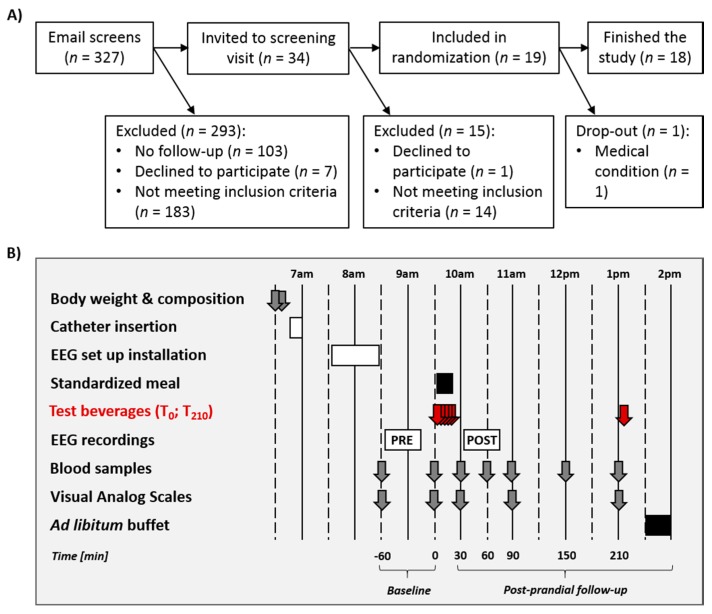
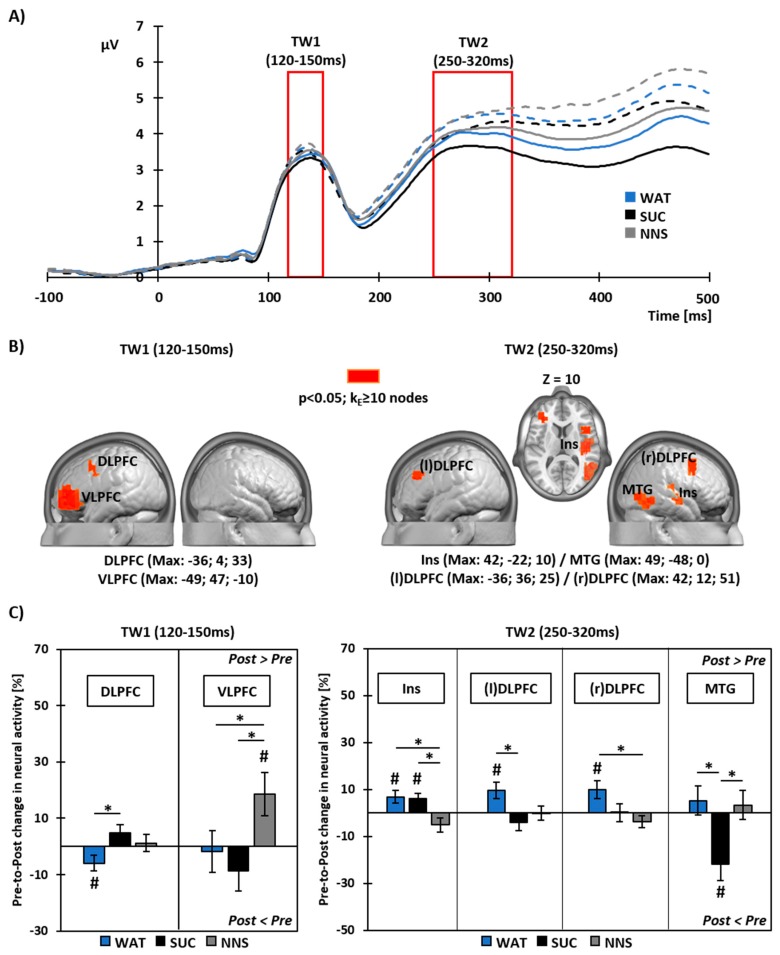
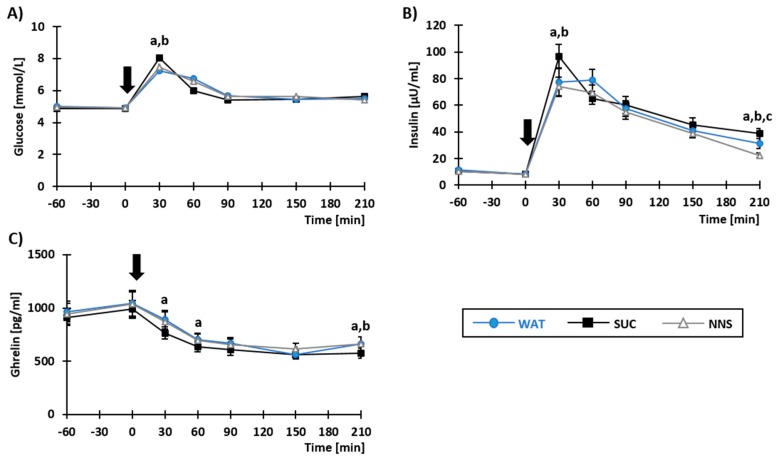
Whether non-nutritive sweetener (NNS) consumption impacts food intake behavior in humans is still unclear. Discrepant sensory and metabolic signals are proposed to mislead brain regulatory centers, in turn promoting maladaptive food choices favoring weight gain. We aimed to assess whether ingestion of sucrose- and NNS-sweetened drinks would differently alter brain responses to food viewing and food intake. Eighteen normal-weight men were studied in a fasted condition and after consumption of a standardized meal accompanied by either a NNS-sweetened (NNS), or a sucrose-sweetened (SUC) drink, or water (WAT). Their brain responses to visual food cues were assessed by means of electroencephalography (EEG) before and 45 min after meal ingestion. Four hours after meal ingestion, spontaneous food intake was monitored during an ad libitum buffet. With WAT, meal intake led to increased neural activity in the dorsal prefrontal cortex and the insula, areas linked to cognitive control and interoception. With SUC, neural activity in the insula increased as well, but decreased in temporal regions linked to food categorization, and remained unchanged in dorsal prefrontal areas. The latter modulations were associated with a significantly lower total energy intake at buffet (mean kcal ± SEM; 791 ± 62) as compared to WAT (942 ± 71) and NNS (917 ± 70). In contrast to WAT and SUC, NNS consumption did not impact activity in the insula, but led to increased neural activity in ventrolateral prefrontal regions linked to the inhibition of reward. Total energy intake at the buffet was not significantly different between WAT and NNS. Our findings highlight the differential impact of caloric and non-caloric sweeteners on subsequent brain responses to visual food cues and energy intake. These variations may reflect an initial stage of adaptation to taste-calorie uncoupling, and could be indicative of longer-term consequences of repeated NNS consumption on food intake behavior.
非营养性甜味剂(NNS)的摄入是否会影响人类的食物摄入行为尚不清楚。据推测,不一致的感觉和代谢信号会误导大脑调节中心,进而促使人们做出不利于体重增加的适应性食物选择。我们旨在评估摄入蔗糖和 NNS 甜味饮料是否会对食物视觉刺激和食物摄入产生不同的大脑反应。在禁食状态下和摄入标准餐后,18 名正常体重男性分别饮用 NNS 甜味(NNS)、蔗糖甜味(SUC)或水(WAT)饮料。在餐后 45 分钟,通过脑电图(EEG)评估他们对视觉食物线索的大脑反应。在餐后 4 小时,通过随意自助餐监测自发食物摄入。饮用 WAT 后,进食会导致背外侧前额叶皮层和岛叶的神经活动增加,这些区域与认知控制和内脏感觉有关。饮用 SUC 后,岛叶的神经活动也增加,但与食物分类相关的颞叶区域的神经活动减少,而背外侧前额叶区域的神经活动不变。这些调节与自助餐时的总能量摄入显著降低有关(平均值±SEM;791±62),与 WAT(942±71)和 NNS(917±70)相比。与 WAT 和 SUC 不同,NNS 消耗不会影响岛叶的活动,但会导致与抑制奖励相关的腹外侧前额叶区域的神经活动增加。自助餐时的总能量摄入在 WAT 和 NNS 之间没有显著差异。我们的研究结果强调了热量和非热量甜味剂对随后的视觉食物线索和能量摄入的大脑反应的不同影响。这些差异可能反映了味觉与热量脱耦的初始适应阶段,并且可能表明重复摄入 NNS 对食物摄入行为的长期影响。