Xie Yujie, Zhang Chi, Jiang Wei, Huang Juan, Xu Lili, Pang Guoyin, Tang Haiyan, Chen Ruyan, Yu Jihua, Guo Shengmin, Xu Fangyuan, Wang Jianxiong
Rehabilitation Medicine Department of the Affiliated Hospital of Southwest Medical University, Luzhou, Sichuan, People's Republic of China.
BMC Musculoskelet Disord. 2018 May 15;19(1):147. doi: 10.1186/s12891-018-2041-7.
Lower limb strengthening, especially the quadriceps training, is of much necessity for patients with knee osteoarthritis (KOA). Previous studies suggest that strengthening of the hip muscles, especially the hip abductor, can potentially relieve the KOA-associated symptoms. Nevertheless, the effects of quadriceps combined with hip abductor strengthening remain unclear. Therefore, the current randomized controlled trial is designed aiming to observe whether quadriceps in combination with hip abductor strengthening can better improve the function and reduce pain in KOA patients than quadriceps training alone.
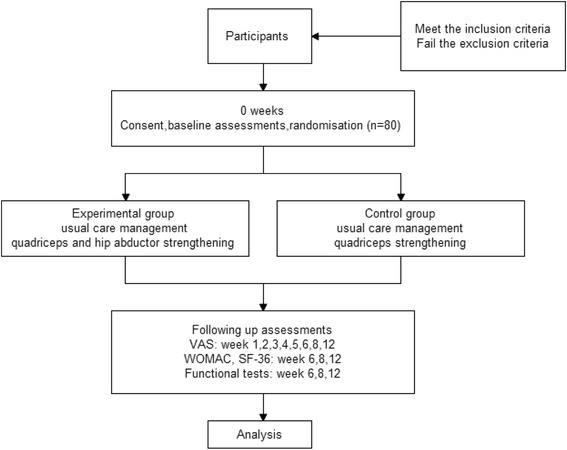
A total of 80 subjects with symptomatic KOA will be recruited from the communities and hospital outpatient, and will be randomly assigned to the experiment group (Quadriceps-plus-hip-abductor-strengthening) or the control group (Quadriceps-strengthening). Specifically, participants in the experiment group will complete 4 exercises to train the quadriceps and hip abductor twice a day for 6 weeks at home, while those in the control group will only perform 2 exercises to strengthen the quadriceps. Besides, all patients will also receive usual care management, including health education and physical agent therapy when necessary. Knee pain will be measured using the Visual Analogue Scale (VAS) at baseline, in every week during the course of treatment, as well as 8 and 12 weeks after randomization. Furthermore, knee function will be measured using the Western Ontario and McMaster Universities Osteoarthritis Index (WOMAC) scale, and the quality of life will be measured using the MOS Item Short-form Health Survey (SF-36). In this study, several simple tests will be applied to assess the objective function. All the assessments except for VAS will be carried out at baseline, and in the 6th, 8th and 12th weeks respectively.
Our findings will provide more evidence for the effects of hip abductor strengthening on relieving pain and improving function in KOA patients. Hip abductor strengthening can be added into the muscle training program for KOA patients as a supplementary content if it is proved to be effective.
The current study has been registered with the Chinese Clinical Trials Registry (the registration number is ChiCTR-IOC-15007590 , 3rd December, 2015).
下肢强化训练,尤其是股四头肌训练,对于膝关节骨关节炎(KOA)患者非常必要。先前的研究表明,强化髋部肌肉,尤其是髋外展肌,可能会缓解与KOA相关的症状。然而,股四头肌与髋外展肌联合强化训练的效果仍不明确。因此,本随机对照试验旨在观察股四头肌与髋外展肌联合强化训练是否比单纯股四头肌训练能更好地改善KOA患者的功能并减轻疼痛。
将从社区和医院门诊招募80名有症状的KOA患者,并随机分配到实验组(股四头肌加髋外展肌强化训练组)或对照组(股四头肌强化训练组)。具体而言,实验组的参与者将在家中每天完成4项训练股四头肌和髋外展肌的练习,持续6周,每天2次,而对照组的参与者仅进行2项强化股四头肌的练习。此外,所有患者还将接受常规护理管理,包括健康教育和必要时的物理因子治疗。在基线、治疗过程中的每周以及随机分组后的8周和12周,使用视觉模拟量表(VAS)测量膝关节疼痛。此外,使用西安大略和麦克马斯特大学骨关节炎指数(WOMAC)量表测量膝关节功能,使用MOS条目简明健康调查(SF-36)测量生活质量。在本研究中,将应用几种简单测试来评估客观功能。除VAS外,所有评估将分别在基线以及第6、8和12周进行。
我们的研究结果将为髋外展肌强化训练对缓解KOA患者疼痛和改善功能的效果提供更多证据。如果证明有效,髋外展肌强化训练可作为补充内容纳入KOA患者的肌肉训练计划。
本研究已在中国临床试验注册中心注册(注册号为ChiCTR-IOC-15007590,2015年12月3日)。