Department of Orthopedics, Faculty of Medicine, Prince of Songkla University, Hat Yai, Songkhla, 90110, Thailand.
BMC Musculoskelet Disord. 2020 May 7;21(1):284. doi: 10.1186/s12891-020-03316-z.
Osteoarthritis knee (OA) for patients whom had varus malalignment had higher peak adductor moment. Hip abductor strength played an important role in the decreasement of knee adduction moment. This study aimed to evaluate the effect of hip abductor exercises for patients who had medial compartment knees OA.
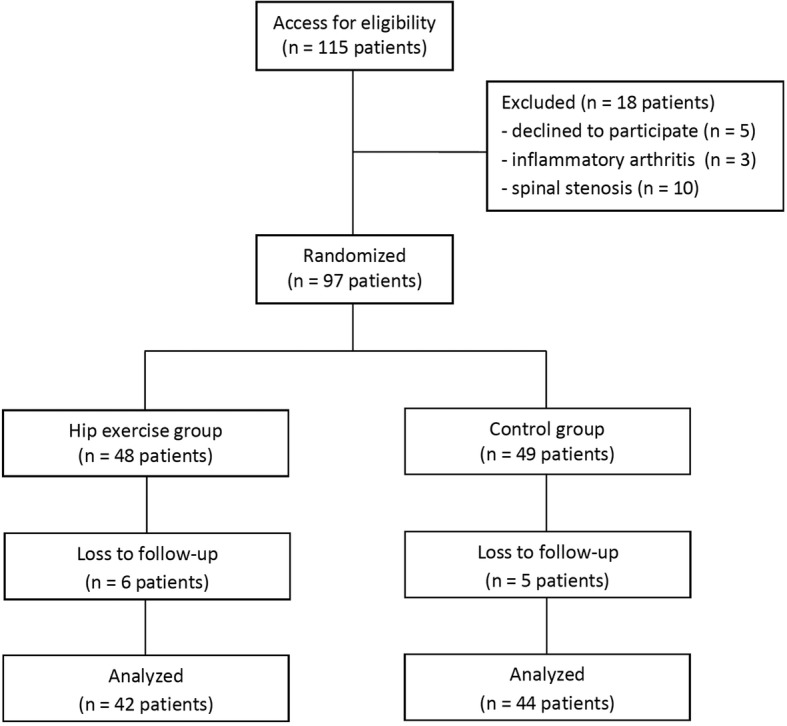
Patients who had medial compartmental OA knee were randomized into two groups. The first group performed hip abductor strengthening exercises, combined with quadriceps strengthening exercises; whereas, the second group performed standalone quadriceps strengthening exercises. Self-reported Knee Injury and Osteoarthritis Outcome Scores (KOOS) were collected by patients on follow-up visits.
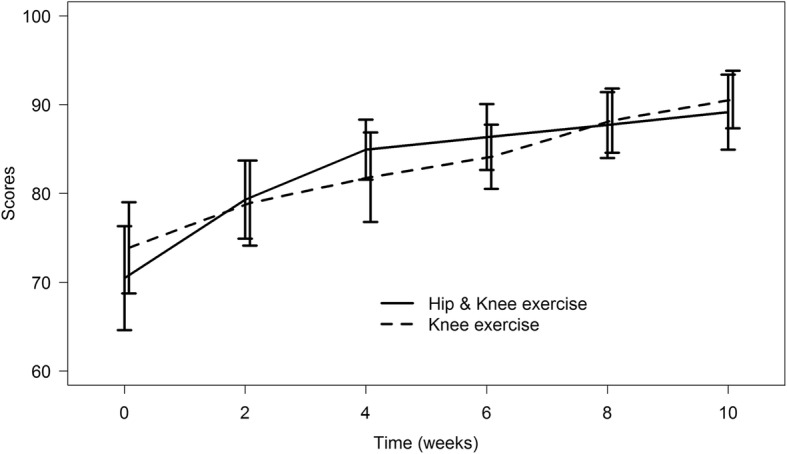
Eighty-six patients completed the trial. All KOOS subscales were significantly improved in both groups after 10 weeks of treatment. However, there was no significant difference in the scores between either group at 2-10 weeks after treatment. Nevertheless, the effects of exercise for pain, symptoms, function in daily living and knee-related quality of life were found to have faster improvement within the hip abduction exercise group compared to the control group (2 weeks faster; pain, function in daily living and knee-related quality of life, 4 weeks faster; symptoms.) CONCLUSION: Since, adding quadriceps exercises could expedite improvement of less pain, symptoms, activity in daily living and quality of life faster than quadriceps exercises solely for a 2-4 weeks period. However, the effect size was small and there were no differences after this; hence, consideration of adding hip abductor exercises in the treatment protocol should be based on the patients and doctors appraisal.
TCTR, TCTR20180517005. Registered 17 May 2018.
对于存在内翻畸形的膝骨关节炎(OA)患者,其内收肌峰值力矩更高。髋关节外展肌力在降低膝关节内收力矩方面起着重要作用。本研究旨在评估髋关节外展肌锻炼对内侧间室膝骨关节炎患者的影响。
将内侧间室 OA 膝关节患者随机分为两组。第一组进行髋关节外展肌力增强训练,结合股四头肌增强训练;第二组仅进行股四头肌增强训练。患者在随访时通过自我报告的膝关节损伤和骨关节炎结果评分(KOOS)进行评分。
86 例患者完成了试验。两组患者在治疗 10 周后,所有 KOOS 亚量表评分均显著改善。然而,治疗后 2-10 周,两组之间的评分无显著差异。尽管如此,在治疗的前 2-4 周内,与对照组相比,髋关节外展运动组的运动对疼痛、症状、日常生活功能和膝关节相关生活质量的影响更快(疼痛、日常生活功能和膝关节相关生活质量更快 2 周;症状更快 4 周)。
由于在 2-4 周内,添加股四头肌锻炼可以更快地减轻疼痛、症状、日常生活活动和生活质量,而单独进行股四头肌锻炼则更快。然而,效果大小较小,之后没有差异;因此,应根据患者和医生的评估,考虑在治疗方案中添加髋关节外展运动。
TCTR,TCTR20180517005。2018 年 5 月 17 日注册。