Department of Etiology and Carcinogenesis, National Cancer Center/Cancer Hospital, Chinese Academy of Medical Sciences and Peking Union Medical College, Beijing, 100021, P.R. China.
Sun Yat-sen University Cancer Center, State Key Laboratory of Oncology in South China, Collaborative Innovation Center for Cancer Medicine, Guangzhou, Guangdong, 510060, P.R. China.
Cancer Commun (Lond). 2018 Apr 27;38(1):13. doi: 10.1186/s40880-018-0289-9.
Pancreatic duct adenocarcinoma (PDAC) remains a major health problem because conventional cancer treatments are relatively ineffective against it. Microarray studies have linked many genes to pancreatic cancer, but the available data have not been extensively mined for potential insights into PDAC. This study attempted to identify PDAC-associated genes and signaling pathways based on six microarray-based profiles of gene expression in pancreatic cancer deposited in the gene expression omnibus database.
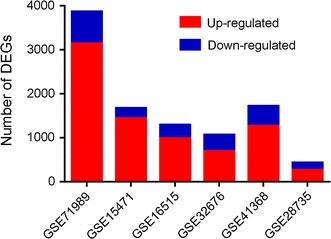
Pathway network methods were used to analyze core pathways in six publicly available pancreatic cancer gene (GSE71989, GSE15471, GSE16515, GSE32676, GSE41368 and GSE28735) expression profiles. Genes potentially linked to PDAC were assessed for potential impact on survival time based on data in The Cancer Genome Atlas and International Cancer Genome Consortium databases, and the expression of one candidate gene (CKS2) and its association with survival was examined in 102 patients with PDAC from our hospital. Effects of CKS2 knockdown were explored in the PDAC cell lines BxPC-3 and CFPAC-1.
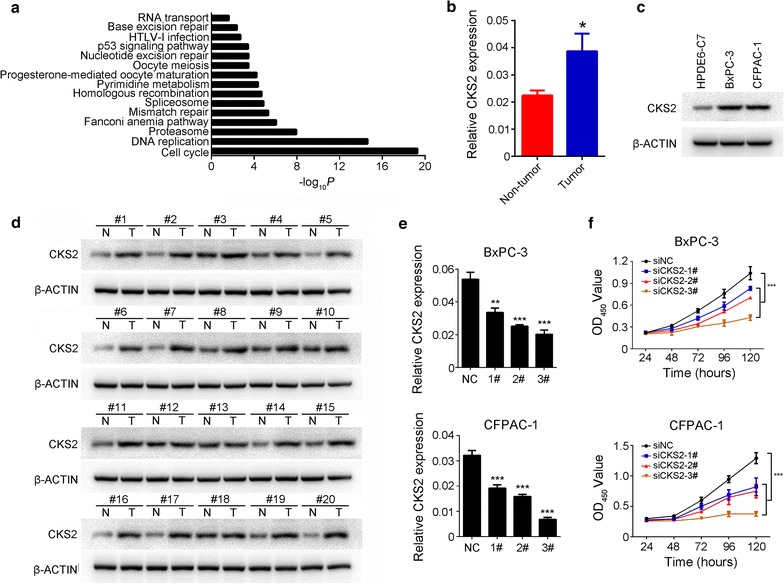
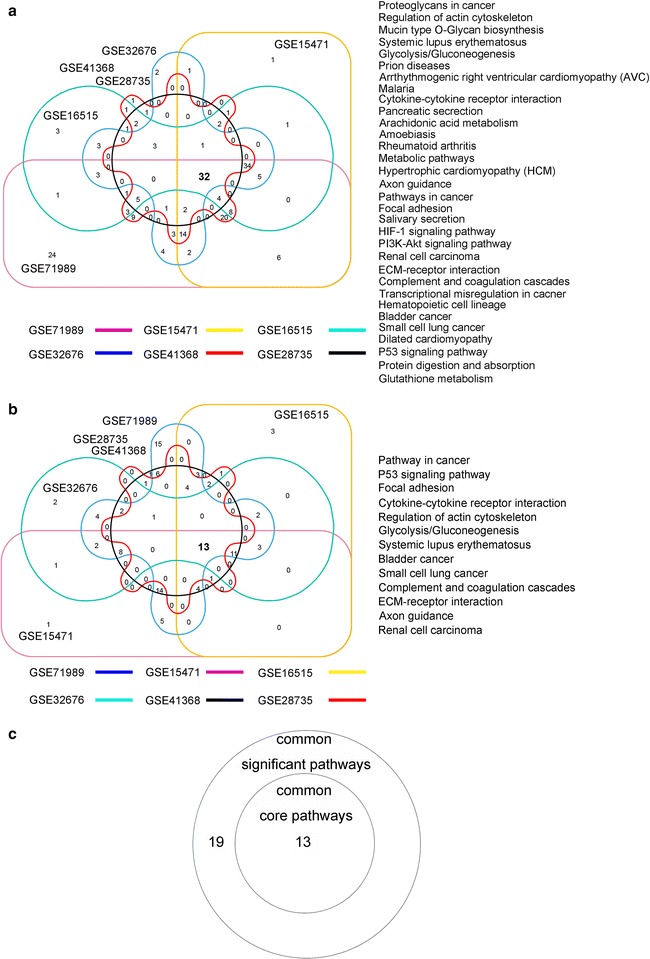
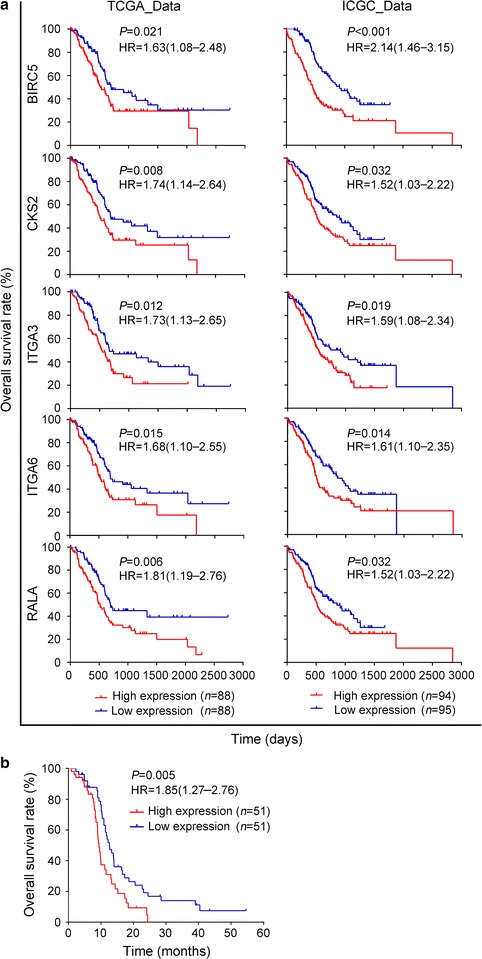
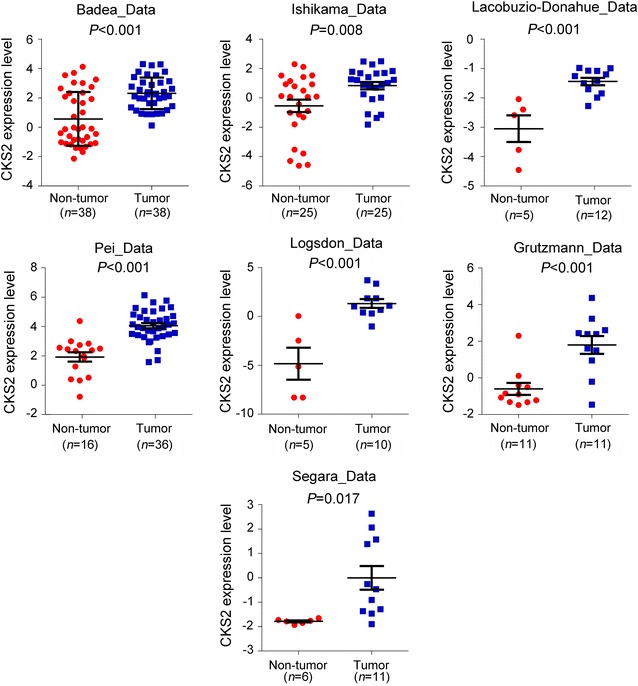
The KEGG signaling pathway called "pathway in cancer" may play an important role in pancreatic cancer development and progression. Five genes (BIRC5, CKS2, ITGA3, ITGA6 and RALA) in this pathway were significantly associated with survival time in patients with PDAC. CKS2 was overexpressed in PDAC samples from our hospital, and higher CKS2 expression in these patients was associated with shorter survival time. CKS2 knockdown substantially inhibited PDAC cell proliferation in vitro.
Analysis integrating existing microarray datasets allowed identification of the "pathway in cancer" as an important signaling pathway in PDAC. This integrative approach may be powerful for identifying genes and pathways involved in cancer.
胰腺导管腺癌(PDAC)仍然是一个主要的健康问题,因为传统的癌症治疗方法对其相对无效。微阵列研究将许多基因与胰腺癌联系起来,但现有数据尚未被广泛挖掘,以深入了解 PDAC。本研究试图根据基因表达综合数据库中六个基于微阵列的胰腺癌基因表达谱,确定与 PDAC 相关的基因和信号通路。
使用通路网络方法分析六个公开的胰腺癌基因(GSE71989、GSE15471、GSE16515、GSE32676、GSE41368 和 GSE28735)表达谱中的核心通路。根据癌症基因组图谱和国际癌症基因组联盟数据库中的数据,评估与 PDAC 潜在相关的基因对生存时间的潜在影响,并在我院 102 例 PDAC 患者中检查候选基因(CKS2)的表达及其与生存的关系。在 PDAC 细胞系 BxPC-3 和 CFPAC-1 中研究了 CKS2 敲低的效果。
KEGG 信号通路称为“癌症中的通路”,可能在胰腺癌的发展和进展中发挥重要作用。该通路中的五个基因(BIRC5、CKS2、ITGA3、ITGA6 和 RALA)与 PDAC 患者的生存时间显著相关。CKS2 在我院 PDAC 样本中过度表达,这些患者的 CKS2 表达水平较高与生存时间较短相关。CKS2 敲低可显著抑制 PDAC 细胞在体外的增殖。
整合现有微阵列数据集的分析确定“癌症中的通路”是 PDAC 中的一个重要信号通路。这种综合方法可能在识别癌症相关基因和通路方面具有强大作用。