Institute of Functional Nano and Soft Materials (FUNSOM) & Collaborative Innovation Center of Suzhou Nano Science and Technology, Soochow University, Suzhou, 215123, P. R. China.
Department of Neurosurgery, First Affiliated Hospital of Soochow University, Suzhou, 215006, P. R. China.
Cancer Commun (Lond). 2018 May 4;38(1):16. doi: 10.1186/s40880-018-0291-2.
Extracranial metastasis (ENM) of meningiomas is extremely rare, and typically occurs several years after a primary tumor is diagnosed. However, the genetic changes underlying ENM events have not yet been investigated.
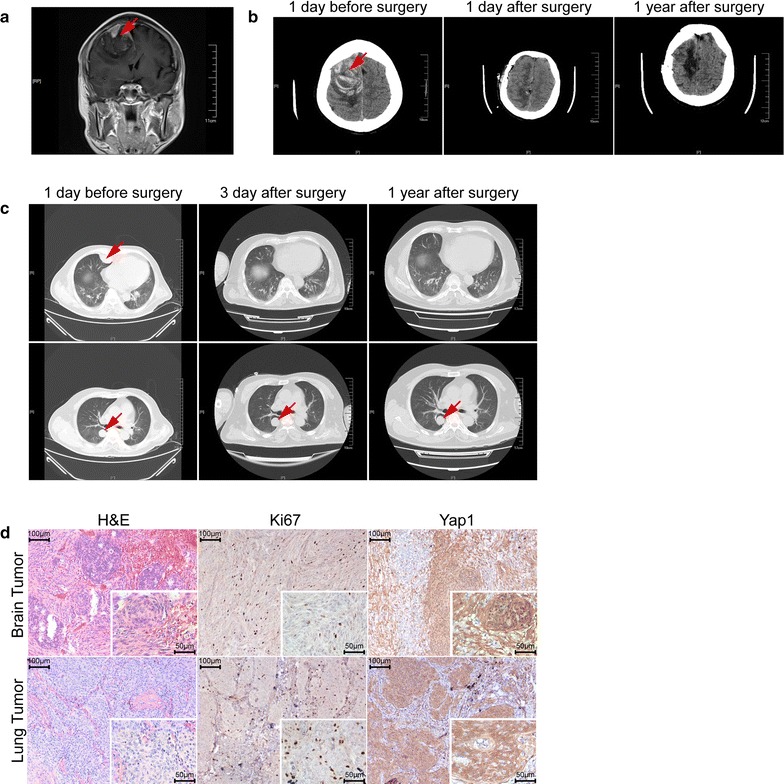
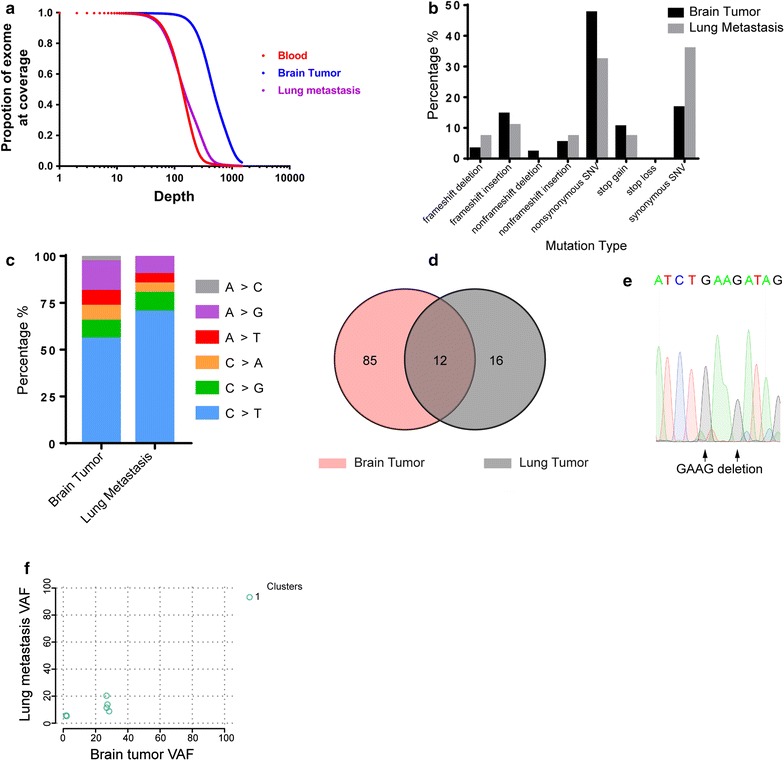
A 58-year-old male patient was sent to the emergency room of our hospital because of a sudden fall. Magnetic resonance imaging detected a mass at the right frontal sagittal sinus. He underwent tumor resection and recovered well, but post-operative computed tomography revealed three lumps on the right side of his chest. Thoracic surgery was performed to remove two of the lumps. Pathological findings revealed that the brain and lung tumors were grade I meningiomas. The patient received no additional radiation or chemotherapy post-surgery, and there was no sign of tumor recurrence in the brain or progression of the remaining lump in the chest 1 year after surgery. We performed whole exome sequencing of the patient's blood, primary brain tumor, and lung metastatic tumor tissues to identify somatic genetic alterations that had occurred during ENM. This revealed that a frameshift deletion of the neurofibromin 2 gene likely drove formation of the meningioma. Surprisingly, we found that the brain tumor was relatively homogeneous and contained only one dominant clone; both the pulmonary metastasis and the original brain tumor were derived from the same clone, and no obvious additional driver mutations were detected in the metastatic tumor.
Although ENM of meningiomas is very rare, brain tumor cells appear to be more adaptable to tissue microenvironments outside of the central nervous system than was commonly thought.
脑膜瘤颅外转移(ENM)极为罕见,通常在原发性肿瘤诊断后数年发生。然而,ENM 事件背后的遗传变化尚未得到研究。
一名 58 岁男性因突然摔倒被送往我院急诊室。磁共振成像检测到右额矢状窦有一个肿块。他接受了肿瘤切除术,恢复良好,但术后计算机断层扫描显示他的右侧胸部有三个肿块。进行了胸部手术以切除其中两个肿块。病理检查结果显示,脑部和肺部肿瘤均为 I 级脑膜瘤。患者术后未接受额外的放疗或化疗,术后 1 年脑部无肿瘤复发迹象,胸部剩余肿块也无进展。我们对患者的血液、原发性脑部肿瘤和肺部转移瘤组织进行了全外显子组测序,以鉴定 ENM 过程中发生的体细胞遗传改变。结果显示,神经纤维瘤 2 基因的框移缺失可能导致了脑膜瘤的形成。令人惊讶的是,我们发现脑部肿瘤相对同质,仅含有一个优势克隆;肺部转移瘤和原发性脑部肿瘤均来源于同一克隆,在转移瘤中未检测到明显的额外驱动突变。
尽管脑膜瘤的 ENM 非常罕见,但与人们普遍认为的情况相比,脑肿瘤细胞似乎更能适应中枢神经系统外的组织微环境。