Department of Social and Behavioral Sciences, Yale School of Public Health, 60 College St., Suite 316, New Haven, CT, 06520, USA.
Department of Clinical Neuroscience, Karolinska Institutet, Stockholm, Sweden.
Eur J Epidemiol. 2018 Jun;33(6):591-599. doi: 10.1007/s10654-018-0411-y. Epub 2018 May 15.
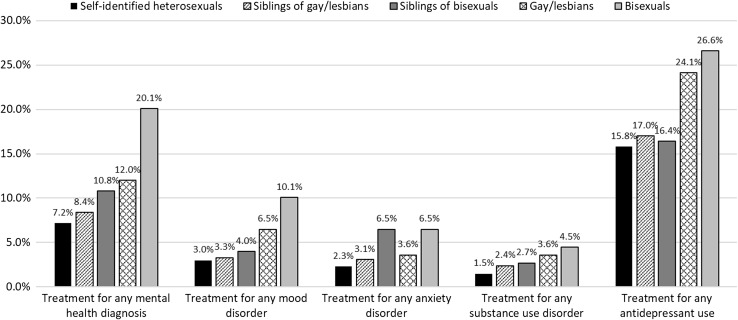
In the past two decades, population-based health surveys have begun including measures of sexual orientation, permitting estimates of sexual orientation disparities in psychiatric morbidity and differences in treatment utilization. The present study takes advantage of the high-quality, comprehensive nationwide health registry data available in Sweden to examine whether psychiatric outpatient treatment for various diagnoses and antidepressant medication usage are greater in sexual minority individuals compared to their siblings. A longitudinal cohort study design was used with a representative random population-based sample in Stockholm, Sweden. Registry-based health record data on all specialized outpatient health care visits and prescription drug use was linked to a sample of 1154 sexual minority individuals from the Stockholm Public Health Cohort and their siblings. The main outcomes were treatment due to psychiatric diagnoses retrieved from nationwide registry-based health records. In analyses accounting for dependency between siblings, gay men/lesbians had a greater likelihood of being treated for mood disorder [adjusted odds ratio (AOR) 1.77; 99% confidence intervals (CI) 1.00, 3.16] and being prescribed antidepressants (AOR 1.51; 99% CI 1.10, 2.07) compared to their siblings. Further, bisexual individuals had a greater likelihood of any outpatient psychiatric treatment (AOR 1.69; 99% CI 1.17, 2.45) and being prescribed antidepressants (AOR 1.48; 99% CI 1.07, 2.05) as well as a greater likelihood of being treated for a mood disorder (AOR 1.98; 99% CI 1.33, 2.95) compared to their siblings. No difference in anxiety or substance use disorder treatment was found between any sexual minority subgroup and their siblings. The potential role of familial confounding in psychiatric disorder treatment was not supported for more than half of the outcomes that were examined. Results suggest that sexual minority individuals are significantly more likely to be treated for certain psychiatric disorders compared to their siblings. Future research is needed to understand mechanisms other than familial factors that might cause the substantial treatment differences based on sexual orientation reported here.
在过去的二十年中,基于人群的健康调查开始包括性取向的衡量标准,从而可以估计精神疾病发病率和治疗利用方面的性取向差异。本研究利用瑞典高质量的全面国家健康登记数据,研究各种诊断的精神科门诊治疗和使用抗抑郁药物在性少数群体个体与他们的兄弟姐妹之间是否存在差异。本研究采用了具有代表性的随机人群的斯德哥尔摩纵向队列研究设计,在瑞典。从斯德哥尔摩公共卫生队列中选择了 1154 名性少数个体及其兄弟姐妹作为样本,基于登记的健康记录数据,获得了所有专业门诊医疗就诊和处方药物使用的信息。主要结局是通过全国登记的健康记录获得的精神科诊断的治疗。在考虑到兄弟姐妹之间依赖性的分析中,男同性恋/女同性恋者治疗情绪障碍的可能性更高(调整后的优势比(AOR)1.77;99%置信区间(CI)1.00,3.16),并且与他们的兄弟姐妹相比,服用抗抑郁药的可能性更高(AOR 1.51;99%CI 1.10,2.07)。此外,双性恋者更有可能接受任何精神科门诊治疗(AOR 1.69;99%CI 1.17,2.45)和开抗抑郁药(AOR 1.48;99%CI 1.07,2.05),并且与他们的兄弟姐妹相比,更有可能治疗情绪障碍(AOR 1.98;99%CI 1.33,2.95)。在焦虑或物质使用障碍治疗方面,没有发现任何性少数亚组与他们的兄弟姐妹之间存在差异。对于大多数被研究的结果,家族性混杂在精神疾病治疗中的潜在作用并没有得到支持。结果表明,与他们的兄弟姐妹相比,性少数群体个体更有可能因某些精神疾病而接受治疗。需要进一步研究以了解除家庭因素以外可能导致此处报告的性取向相关大量治疗差异的机制。