Chang Wenhuan, Xie Qing, Zheng Aijuan, Zhang Shu, Chen Zhimin, Wang Jinquan, Liu Guohuo, Cai Huiyi
The Key Laboratory of Feed Biotechnology of the Ministry of Agriculture, Feed Research Institute, Chinese Academy of Agricultural Sciences, Beijing 100081, China.
Anim Nutr. 2016 Sep;2(3):186-191. doi: 10.1016/j.aninu.2016.06.002. Epub 2016 Jun 23.
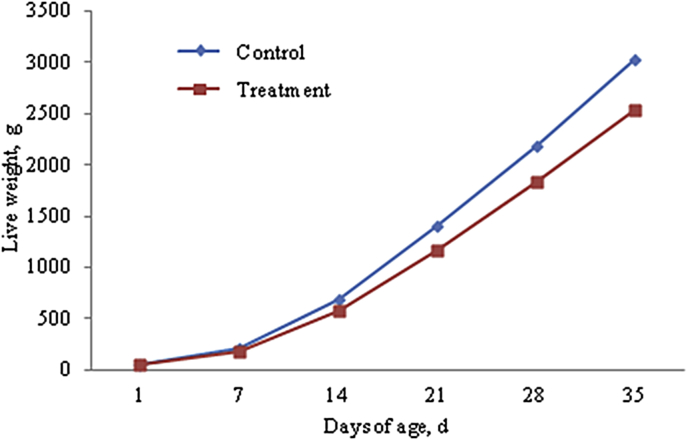
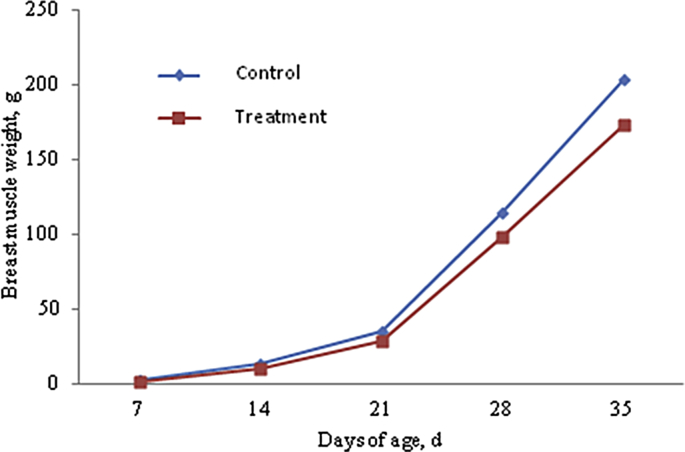
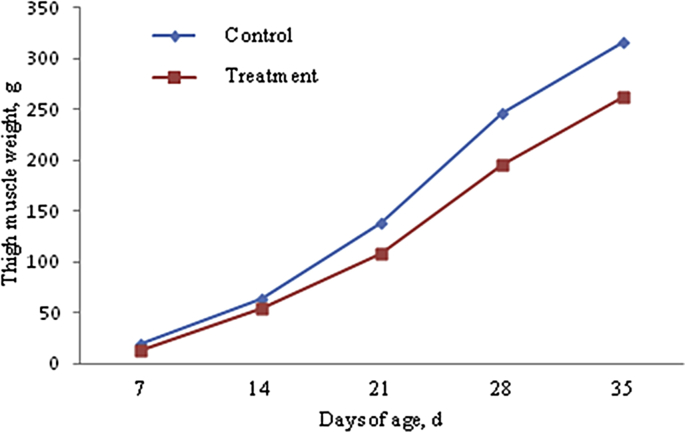
This study aims to evaluate the effects of aflatoxins on growth performance and skeletal muscle of Cherry Valley meat male ducks as they grow and develop. One-day-old healthy meat male ducks ( = 180) were randomly divided into 2 groups; there were 6 replicates in each group and 15 ducks in each replicate. The control group was fed a basic diet, and the experimental group was fed a mold-exposed cottonseed meal diet containing aflatoxins instead of normal cottonseed meal. The experimental period was 35 days, and divided into two stages of 1 to 14 days (early stage) and 15 to 35 days (late stage). During the experimental period, live weight, breast muscle weight and thigh muscle weight of meat male ducks were measured weekly. Results showed as follows: 1) aflatoxins contained in the mold-exposed diet significantly reduced daily weight gain and feed intake, and increased feed-to-gain ratio of meat male ducks at different ages ( < 0.05); 2) the Gompertz equation ( = W exp {-exp [-B ( - )]}) could successfully fit the growth curve and growth and developmental patterns of skeletal muscles of Cherry Valley meat male ducks ( ≥ 0.97); 3) the relationship between chest muscle and live weight was the best described by a power regression and polynomial regression ( = 0.99); the relationship between live weight and thigh muscle weight was the best described by linear regression, polynomial regression, and power regression ( = 0.99); 4) aflatoxins in the mold-exposed diet significantly reduced live weight, breast muscle weight and thigh muscle weight of Cherry Valley meat male ducks at various ages; and 5) aflatoxins delayed the age at peak in growth of meat male ducks, and reduced weights at the peak for breast muscle, thigh muscle and whole body as well as the maximal daily weight gain. In summary, aflatoxins delayed growth of Cherry Valley meat male ducks and development of skeletal muscle.
本研究旨在评估黄曲霉毒素对樱桃谷肉公鸭生长发育过程中生长性能和骨骼肌的影响。将180只1日龄健康肉公鸭随机分为2组,每组6个重复,每个重复15只鸭。对照组饲喂基础日粮,实验组饲喂含有黄曲霉毒素的霉变棉籽粕日粮,而非正常棉籽粕日粮。试验期为35天,分为1至14天(前期)和15至35天(后期)两个阶段。试验期间,每周测量肉公鸭的体重、胸肌重和腿肌重。结果如下:1)霉变日粮中含有的黄曲霉毒素显著降低了不同年龄肉公鸭的日增重和采食量,并提高了料重比(P<0.05);2)Gompertz方程(W = W exp {-exp [-B (t - t0)]})能够成功拟合樱桃谷肉公鸭的生长曲线和骨骼肌的生长发育模式(R≥0.97);3)胸肌与体重之间的关系用幂回归和多项式回归描述最佳(R = 0.99);体重与腿肌重之间的关系用线性回归、多项式回归和幂回归描述最佳(R = 0.99);4)霉变日粮中的黄曲霉毒素显著降低了不同年龄樱桃谷肉公鸭的体重、胸肌重和腿肌重;5)黄曲霉毒素延迟了肉公鸭生长高峰期的年龄,并降低了胸肌、腿肌和全身在高峰期时的重量以及最大日增重。综上所述,黄曲霉毒素延迟了樱桃谷肉公鸭的生长和骨骼肌的发育。