Nuffield Department of Primary Care Health Sciences, University of Oxford, Oxford, UK.
International Centre foer Eye Health, Clinical Research Department, London School of Hygiene & Tropical Medicine, London, UK.
Eur J Clin Nutr. 2019 Apr;73(4):558-565. doi: 10.1038/s41430-018-0177-z. Epub 2018 May 15.
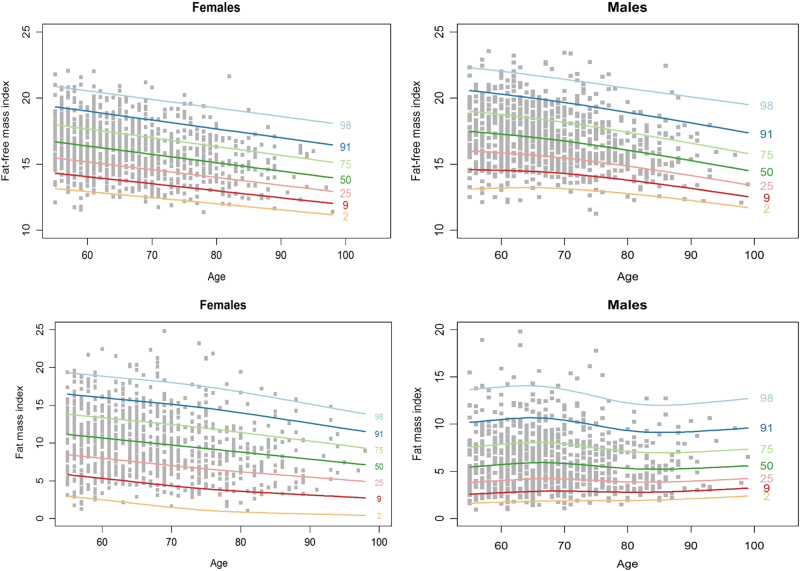
BACKGROUND/OBJECTIVES: To develop age- and sex-specific centile reference curves for fat-free mass (FFM) and fat mass (FM) adjusted for height in an adult Kenyan population and to investigate the association between FM, FFM and blood pressure (BP).
SUBJECTS/METHODS: Measures of body composition from bioimpedance analyses and BP were collected in 1995 participants aged ≥50 years in Nakuru County, Kenya. Reference curves were produced using the LMS method. Multivariable linear regression models were used to test the cross-sectional association between body composition indexes and BP.
The age- and sex-specific reference curves for body composition (FMI and FFMI) confirmed that FFMI is lower in both men and women with increasing age. FMI declines with age in women while among men the decline starts after 70 years. FFM was higher in men (47.4 ± 7.2 kg) than in women (38.8 ± 5.5 kg), while FM was lower in men (17.3 ± 8.1 kg) than in women (24.4 ± 10.2 kg). FMI, FFMI and BMI were all positively associated with systolic and diastolic BP, and after adjusting for body weight, FFMI remained positively associated with systolic BP and the FMI remained positively associated with diastolic BP. There was no evidence to suggest that FMI and FFMI were superior to measurement of BMI alone.
These body composition reference curves provide normative data on body composition for older adults in Kenya. Further research should consider the prospective associations with health, including frailty-related outcomes.
背景/目的:在肯尼亚的成年人群中,制定身高校正的去脂体重(FFM)和脂肪量(FM)的年龄和性别特异性百分位参考曲线,并探讨 FM 和 FFM 与血压(BP)之间的关系。
在肯尼亚纳库鲁县,对 1995 名年龄≥50 岁的参与者进行了身体成分的生物阻抗分析和 BP 测量。使用 LMS 方法生成参考曲线。使用多变量线性回归模型来测试身体成分指标与 BP 的横断面相关性。
身体成分(FMI 和 FFMI)的年龄和性别特异性参考曲线证实,FFMI 在男性和女性中均随年龄的增加而降低。FMI 在女性中随年龄下降,而在男性中则在 70 岁后开始下降。FFM 在男性中较高(47.4±7.2kg),在女性中较低(38.8±5.5kg),而 FM 在男性中较低(17.3±8.1kg),在女性中较高(24.4±10.2kg)。FMI、FFMI 和 BMI 与收缩压和舒张压均呈正相关,在调整体重后,FFMI 与收缩压仍呈正相关,FMI 与舒张压仍呈正相关。没有证据表明 FMI 和 FFMI 优于 BMI 单独测量。
这些身体成分参考曲线为肯尼亚的老年人提供了身体成分的正常数据。进一步的研究应考虑与健康相关的前瞻性关联,包括与虚弱相关的结局。