Joshi Neha Arun, Ajithkrishnan C G
Department of Public Health Dentistry, KM Shah Dental College and Hospital, Sumandeep Vidyapeeth, Vadodara, Gujarat, India.
Int J Trichology. 2018 Mar-Apr;10(2):71-75. doi: 10.4103/ijt.ijt_91_17.
To investigate scalp hair as biomarker for chronic fluoride exposure among fluoride endemic and low fluoride areas.
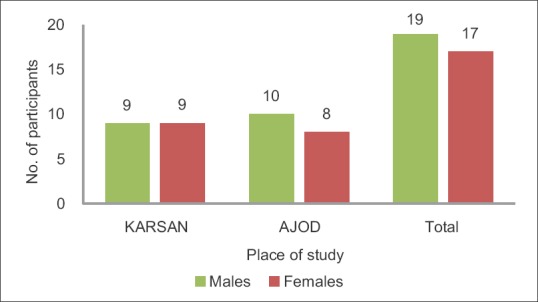
Two areas were identified in Vadodara district, Ajod, as a low fluoride area (Fluoride content of drinking water = 0.11 ppm) and Karsan, a high fluoride area (fluoride content in drinking water = 3.43 ppm). The study was performed on a total of 36 participants from the two villages, 18 from Ajod and 18 from Karsan. Thylstrup Fejerskov Index (TFI) was recorded for each of the participants and sample of hair was collected from the occipital region. Analysis of hair samples was done for assessing the fluoride content.
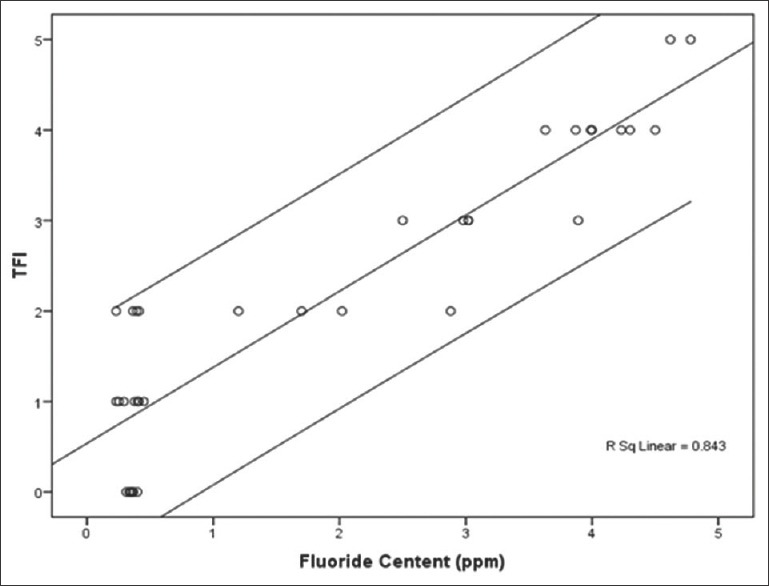
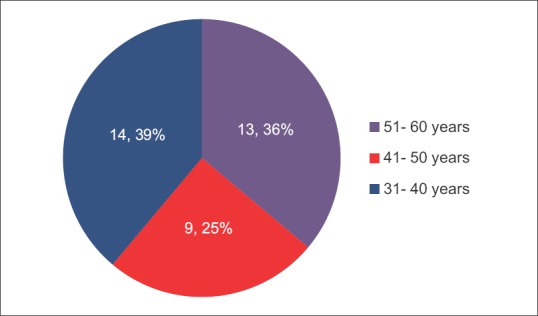
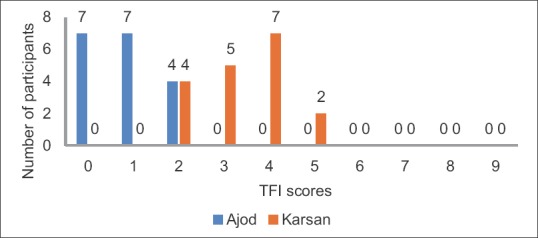
The study consisted of total 36 participants, ranging from the age of 34-60 years and a mean age of 46.53 years. The mean TFI score for the participants in Karsan was 3.39 (±0.979) and in Ajod was 0.83 (±0.786). The difference in this mean score between the two groups was found to be statistically significant. Furthermore, the average fluoride content in hair of the participants in Karsan was 3.40(±1.043) and that in Ajod was 0.35 (±0.063). This difference was statistically significant between the two groups. The TFI scores were found to be positively correlated with the fluoride content in hair.
Hair can be used as a useful biomaterial for fluoride exposure monitoring. Having certain advantages over other biomaterials such as easy to collect, store, and transport, hair also serves as a biomarker of chronic fluoride exposure. Hair analysis should thus play a greater role in routinely measuring the chronic exposure to fluorides.
研究头皮毛发作为氟化物流行地区和低氟地区慢性氟暴露生物标志物的情况。
在巴罗达区的阿霍德确定了两个区域,阿霍德为低氟地区(饮用水氟含量 = 0.11 ppm),卡尔桑为高氟地区(饮用水氟含量 = 3.43 ppm)。对来自这两个村庄的36名参与者进行了研究,其中18名来自阿霍德,18名来自卡尔桑。记录了每位参与者的蒂尔斯楚普·费耶斯科夫指数(TFI),并从枕部区域采集毛发样本。对毛发样本进行分析以评估氟含量。
该研究共有36名参与者,年龄在34至60岁之间,平均年龄为46.53岁。卡尔桑参与者的平均TFI评分为3.39(±0.979),阿霍德参与者的平均TFI评分为0.83(±0.786)。发现两组之间的平均得分差异具有统计学意义。此外,卡尔桑参与者头发中的平均氟含量为3.40(±1.043),阿霍德参与者头发中的平均氟含量为0.35(±0.063)。两组之间的这种差异具有统计学意义。发现TFI评分与头发中的氟含量呈正相关。
毛发可作为监测氟暴露的有用生物材料。与其他生物材料相比,毛发具有易于收集、储存和运输等优点,也是慢性氟暴露的生物标志物。因此,毛发分析在常规测量氟的慢性暴露方面应发挥更大作用。