Department of Biotechnology, Instituto de Agroquímica y Tecnología de Alimentos (IATA), Consejo Superior de Investigaciones Científicas (CSIC), 46980 Paterna, Valencia, Spain.
Department of Food Biotechnology; Biópolis S.L.-Archer Daniels Midland, Parc Científic Universitat de València Edif. 2, 46980 Paterna, Valencia, Spain.
Int J Mol Sci. 2018 May 16;19(5):1491. doi: 10.3390/ijms19051491.
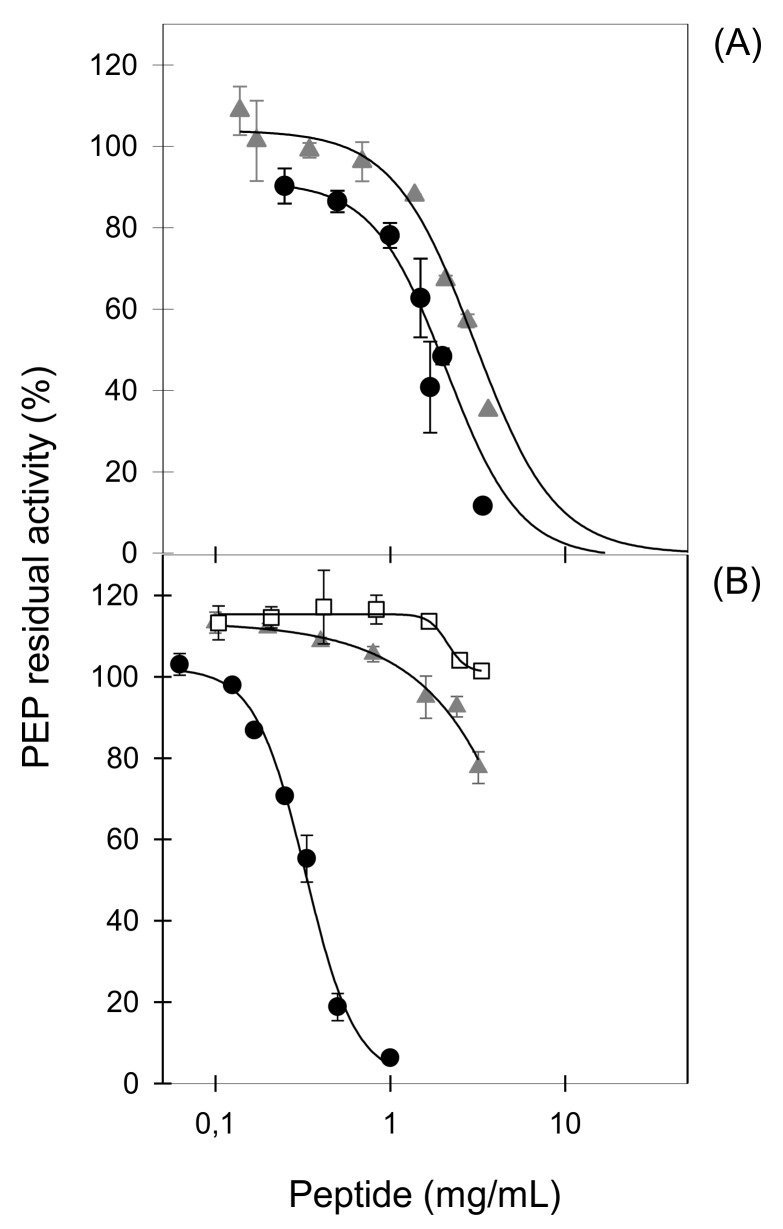
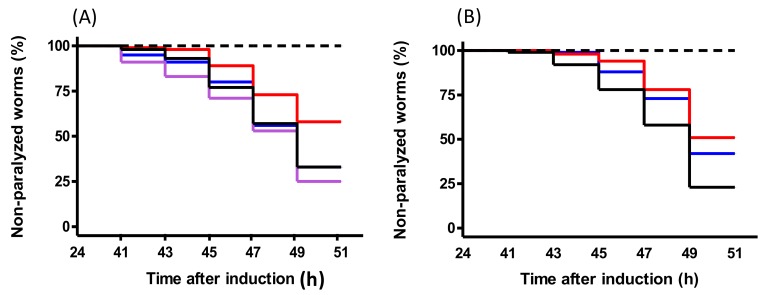
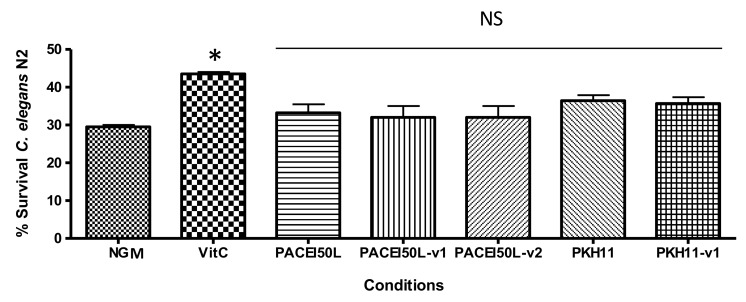
Neuroprotective peptides represent an attractive pharmacological strategy for the prevention or treatment of age-related diseases, for which there are currently few effective therapies. Lactoferrin (LF)-derived peptides (PKHs) and a set of six rationally-designed tryptophan (W)-containing heptapeptides (PACEIs) were characterized as prolyl endopeptidase (PEP) inhibitors, and their effect on β-amyloid peptide (Aβ) toxicity in a model of Alzheimer's disease (AD) was evaluated. Two LF-derived sequences, PKH8 and PKH11, sharing a W at the C-terminal end, and the six PACEI heptapeptides (PACEI48L to PACEI53L) exhibited significant in vitro PEP inhibition. The inhibitory peptides PKH11 and PACEI50L also alleviated Aβ-induced paralysis in the in vivo model of AD. Partial or total loss of the inhibitory effect on PEP was achieved by the substitution of W residues in PKH11 and PACEI50L and correlated with the loss of protection against Aβ toxicity, pointing out the relevance of W on the neuroprotective activity. Further experiments suggest that protection might not be mediated by an antioxidant mechanism but rather by inhibition of Aβ oligomerization and thus, amyloid deposition. In conclusion, novel natural and rationally-designed W-containing peptides are suitable starting leads to design effective neuroprotective agents.
神经保护肽代表了一种有吸引力的药理学策略,可用于预防或治疗与年龄相关的疾病,而目前针对这些疾病的有效治疗方法却很少。乳铁蛋白(LF)衍生肽(PKH)和一组 6 种合理设计的含色氨酸(W)的七肽(PACEI)被表征为脯氨酰内肽酶(PEP)抑制剂,并评估了它们在阿尔茨海默病(AD)模型中对β-淀粉样肽(Aβ)毒性的影响。两种 LF 衍生序列 PKH8 和 PKH11,在 C 末端共享一个 W,以及六个 PACEI 七肽(PACEI48L 到 PACEI53L)表现出显著的体外 PEP 抑制作用。抑制肽 PKH11 和 PACEI50L 也减轻了 AD 体内模型中 Aβ诱导的瘫痪。PKH11 和 PACEI50L 中 W 残基的取代导致对 PEP 的抑制作用部分或完全丧失,并且与对 Aβ毒性的保护丧失相关,这表明 W 与神经保护活性有关。进一步的实验表明,保护可能不是通过抗氧化机制介导的,而是通过抑制 Aβ寡聚化和因此淀粉样沉积来实现的。总之,新型天然和合理设计的含 W 肽是设计有效神经保护剂的合适起始先导物。