National Heart and Lung Institute, Imperial College London, London, United Kingdom; Cardiovascular Research Centre, Royal Brompton and Harefield NHS Foundation Trust London, London, United Kingdom; MRC London Institute of Medical Sciences, Imperial College London, London, United Kingdom.
Heart Failure and Inherited Cardiac Diseases Unit, Department of Cardiology, Hospital Universitario Puerta de Hierro, Madrid, Spain.
J Am Coll Cardiol. 2018 May 22;71(20):2293-2302. doi: 10.1016/j.jacc.2018.03.462.
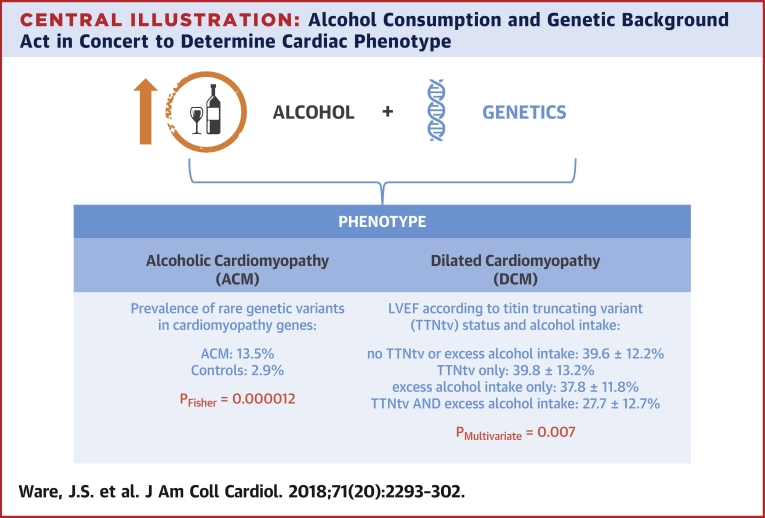
Alcoholic cardiomyopathy (ACM) is defined by a dilated and impaired left ventricle due to chronic excess alcohol consumption. It is largely unknown which factors determine cardiac toxicity on exposure to alcohol.
This study sought to evaluate the role of variation in cardiomyopathy-associated genes in the pathophysiology of ACM, and to examine the effects of alcohol intake and genotype on dilated cardiomyopathy (DCM) severity.
The authors characterized 141 ACM cases, 716 DCM cases, and 445 healthy volunteers. The authors compared the prevalence of rare, protein-altering variants in 9 genes associated with inherited DCM. They evaluated the effect of genotype and alcohol consumption on phenotype in DCM.
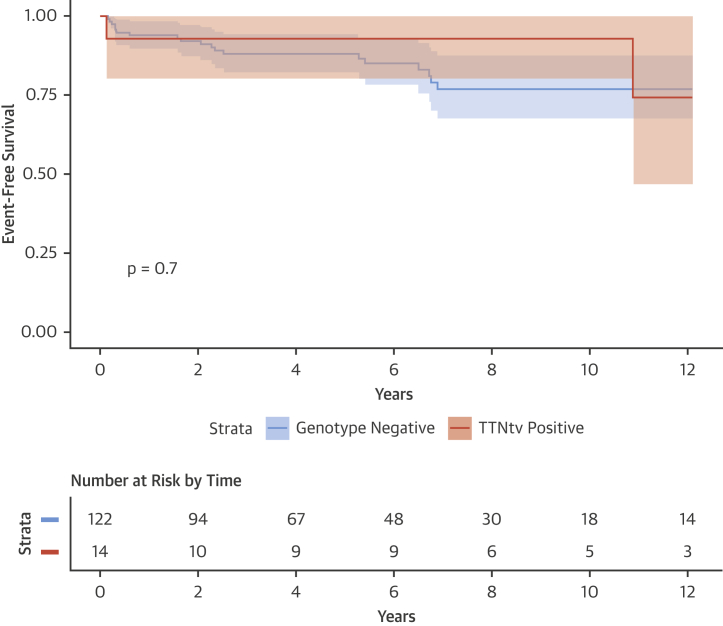
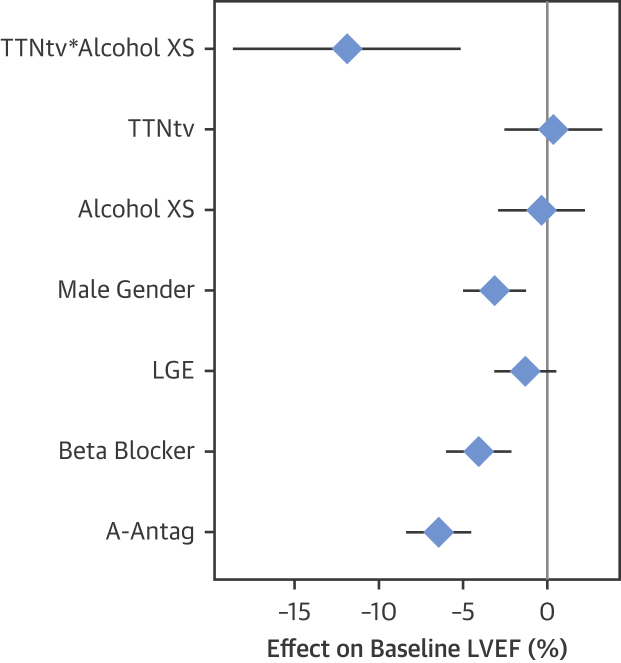
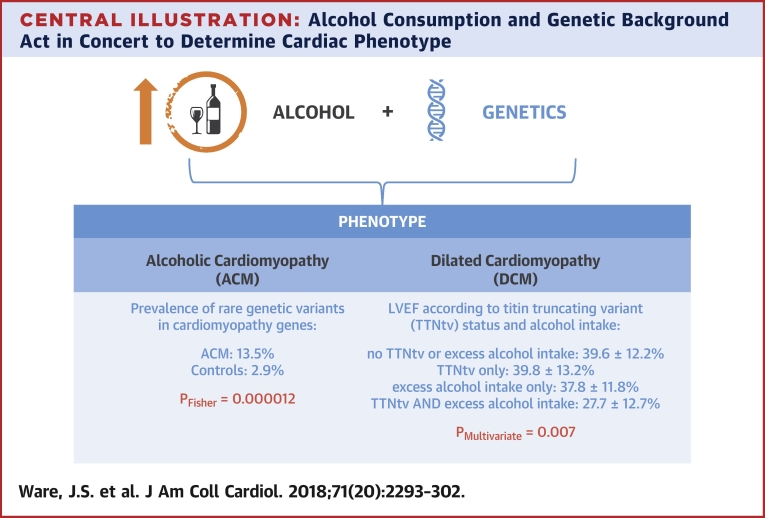
Variants in well-characterized DCM-causing genes were more prevalent in patients with ACM than control subjects (13.5% vs. 2.9%; p = 1.2 ×10), but similar between patients with ACM and DCM (19.4%; p = 0.12) and with a predominant burden of titin truncating variants (TTNtv) (9.9%). Separately, we identified an interaction between TTN genotype and excess alcohol consumption in a cohort of DCM patients not meeting ACM criteria. On multivariate analysis, DCM patients with a TTNtv who consumed excess alcohol had an 8.7% absolute reduction in ejection fraction (95% confidence interval: -2.3% to -15.1%; p < 0.007) compared with those without TTNtv and excess alcohol consumption. The presence of TTNtv did not predict phenotype, outcome, or functional recovery on treatment in ACM patients.
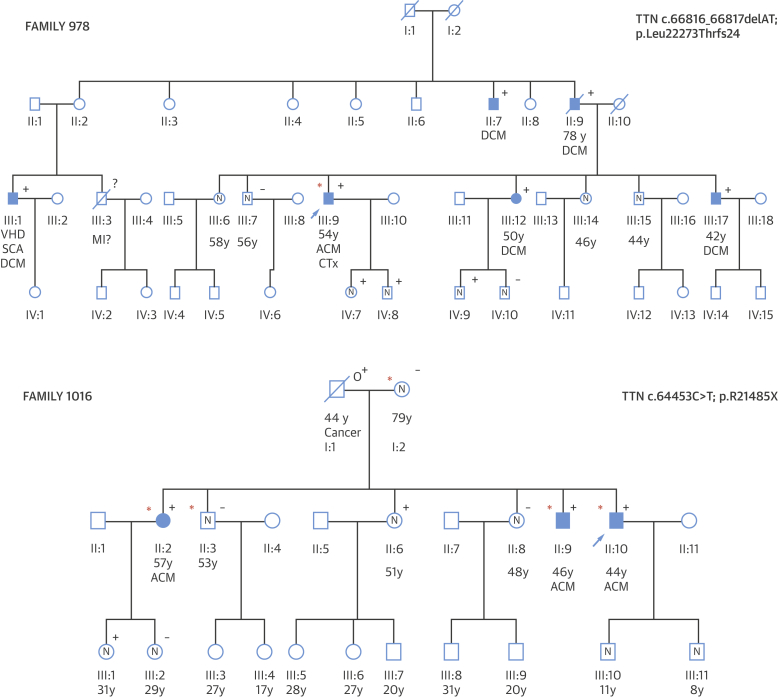
TTNtv represent a prevalent genetic predisposition for ACM, and are also associated with a worse left ventricular ejection fraction in DCM patients who consume alcohol above recommended levels. Familial evaluation and genetic testing should be considered in patients presenting with ACM.
酒精性心肌病(ACM)是由于长期过量饮酒导致左心室扩张和功能障碍而定义的。目前尚不清楚哪些因素决定了暴露于酒精时的心脏毒性。
本研究旨在评估与心肌病相关基因的变异在 ACM 病理生理学中的作用,并研究酒精摄入量和基因型对扩张型心肌病(DCM)严重程度的影响。
作者对 141 例 ACM 病例、716 例 DCM 病例和 445 名健康志愿者进行了特征描述。作者比较了 9 个与遗传性 DCM 相关基因中的罕见、蛋白改变变异的患病率。他们评估了基因型和酒精摄入对 DCM 表型的影响。
ACM 患者中常见的 DCM 致病基因的变异比对照组更常见(13.5%比 2.9%;p=1.2×10),但 ACM 患者与 DCM 患者(19.4%;p=0.12)和主要携带肌联蛋白截断变异(TTNtv)的患者(9.9%)之间无差异。此外,我们在一组不符合 ACM 标准的 DCM 患者中发现了 TTN 基因型与过量饮酒之间的相互作用。在多变量分析中,患有 TTNtv 且饮酒过量的 DCM 患者的射血分数绝对减少 8.7%(95%置信区间:-2.3%至-15.1%;p<0.007),而没有 TTNtv 和过量饮酒的患者则减少 8.7%。TTNtv 的存在并不能预测 ACM 患者的表型、预后或治疗后的功能恢复。
TTNtv 代表 ACM 的普遍遗传易感性,并且还与饮酒量超过推荐水平的 DCM 患者的左心室射血分数降低相关。在出现 ACM 的患者中,应考虑进行家族评估和基因检测。