University of Milano-Bicocca, Monza, Italy
University of Texas MD Anderson Cancer Center, Houston, TX, USA.
Haematologica. 2018 Aug;103(8):1298-1307. doi: 10.3324/haematol.2017.171249. Epub 2018 May 17.
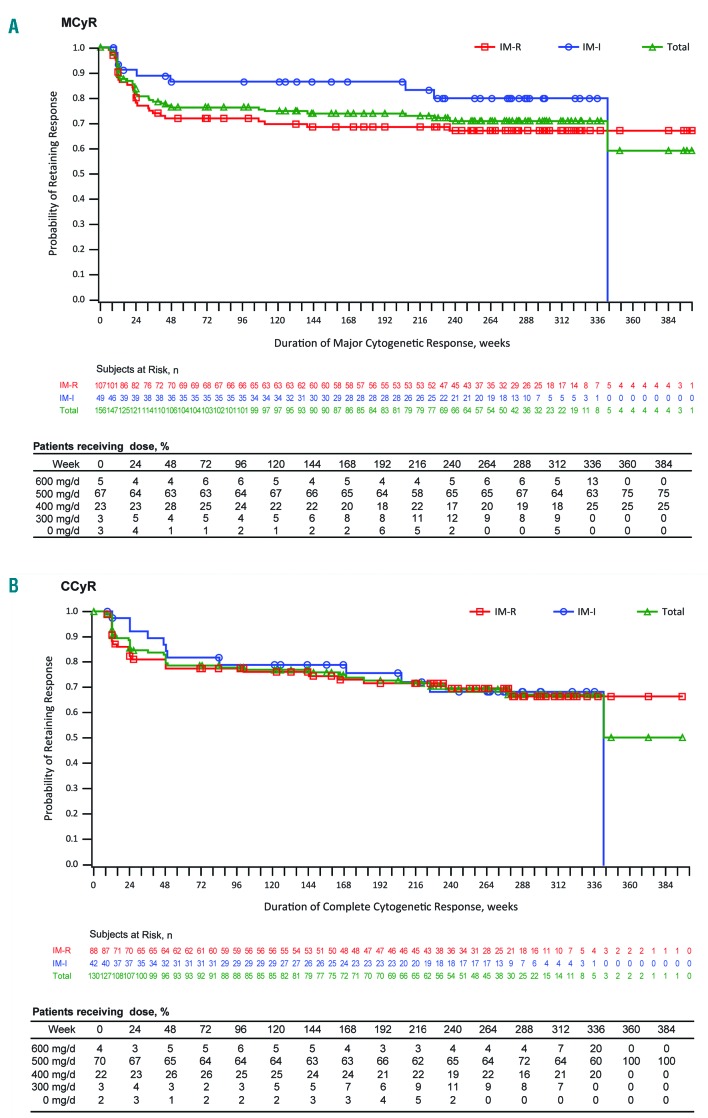
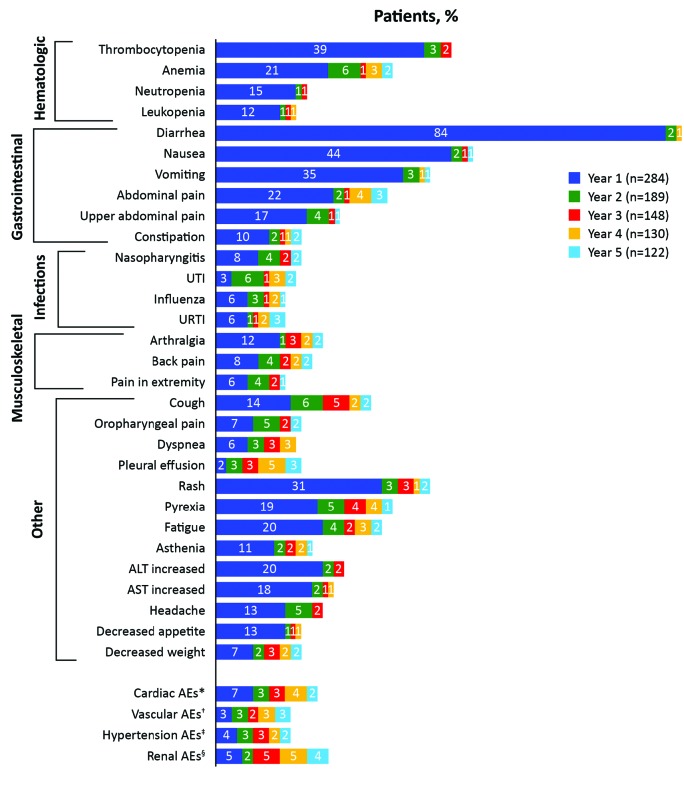
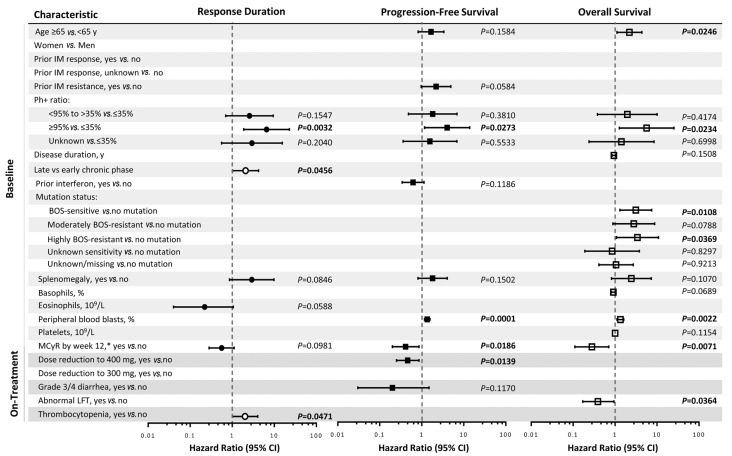
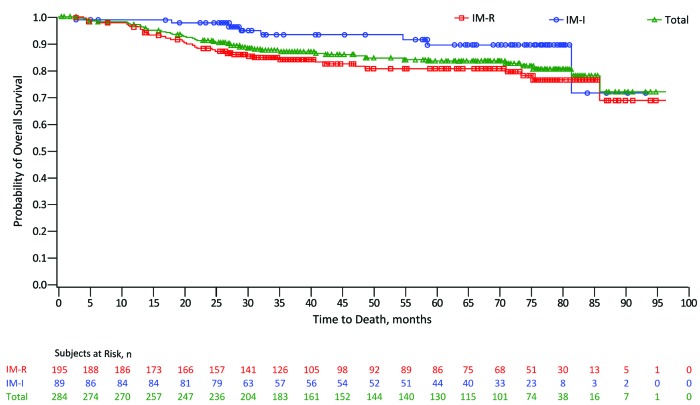
Bosutinib is a Src/Abl tyrosine kinase inhibitor indicated for adults with newly-diagnosed Philadelphia positive chronic myeloid leukemia or with resistant/intolerant disease. We report the final results of a phase I/II study of second-line bosutinib in chronic phase chronic myeloid leukemia patients after imatinib failure (n=284). Median follow up and treatment durations were 54.8 (range 0.6-96.3) and 25.6 (0.2-96.3) months, respectively. At years 2 and 5, 54% and 40% of patients, respectively, remained on bosutinib. Cumulative major cytogenetic response and complete cytogenetic response rates (newly-attained or maintained from baseline) were 58% and 46%, respectively, by year 2 and 60% and 50% by year 5. Kaplan-Meier probability of maintaining major and complete cytogenetic response was 76% and 78%, respectively, at year 2 and 71% and 69% at year 5. Cumulative incidence of on-treatment disease progression/death was similar at years 5 (19%) and 2 (15%); Kaplan-Meier overall survival was 91% at year 2 and 84% at year 5. Of 169 patients who had discontinued bosutinib by year 5, 38 did so after year 2, most commonly for disease progression (n=11). Most adverse events initially occurred within two years. Overall, gastrointestinal events were the most common (diarrhea 86%, nausea 46%, vomiting 37%); the most common grade 3/4 toxicity was thrombocytopenia (25%). None of the 4 on-treatment deaths in years 3-5 were related to bosutinib. Bosutinib demonstrated durable efficacy and manageable toxicity through year 5 confirming its importance in the treatment of chronic phase chronic myeloid leukemia patients resistant/intolerant to prior imatinib. This trial was registered at .
博舒替尼是一种Src/Abl 酪氨酸激酶抑制剂,适用于新诊断的费城阳性慢性髓性白血病成人或对伊马替尼耐药/不耐受的患者。我们报告了二线博舒替尼治疗伊马替尼失败后的慢性期慢性髓性白血病患者的一项 I/II 期研究的最终结果(n=284)。中位随访和治疗时间分别为 54.8(0.6-96.3)和 25.6(0.2-96.3)个月。在第 2 年和第 5 年,分别有 54%和 40%的患者继续接受博舒替尼治疗。第 2 年和第 5 年累积主要细胞遗传学缓解率和完全细胞遗传学缓解率(新获得或从基线维持)分别为 58%和 46%,60%和 50%。第 2 年和第 5 年维持主要和完全细胞遗传学缓解的 Kaplan-Meier 概率分别为 76%和 78%。第 5 年时,治疗期间疾病进展/死亡的累积发生率与第 2 年相似(分别为 19%和 15%);Kaplan-Meier 总生存率分别为 91%和 84%。在第 5 年,有 169 名患者停用博舒替尼,其中 38 名在第 2 年后停用,主要原因是疾病进展(n=11)。大多数不良事件最初发生在两年内。总体而言,胃肠道事件最为常见(腹泻 86%、恶心 46%、呕吐 37%);最常见的 3/4 级毒性为血小板减少症(25%)。第 3-5 年期间,治疗相关死亡 4 例均与博舒替尼无关。博舒替尼在第 5 年仍显示出持久的疗效和可管理的毒性,证实了其在治疗对伊马替尼耐药/不耐受的慢性期慢性髓性白血病患者中的重要性。该试验在注册。