• 文献检索
  • 文档翻译
  • 深度研究
  • 学术资讯
  • Suppr Zotero 插件Zotero 插件
  • 邀请有礼
  • 套餐&价格
  • 历史记录
应用&插件
Suppr Zotero 插件Zotero 插件浏览器插件Mac 客户端Windows 客户端微信小程序
定价
高级版会员购买积分包购买API积分包
服务
文献检索文档翻译深度研究API 文档MCP 服务
关于我们
关于 Suppr公司介绍联系我们用户协议隐私条款
关注我们

Suppr 超能文献

核心技术专利:CN118964589B侵权必究
粤ICP备2023148730 号-1Suppr @ 2026

文献检索

告别复杂PubMed语法,用中文像聊天一样搜索,搜遍4000万医学文献。AI智能推荐,让科研检索更轻松。

立即免费搜索

文件翻译

保留排版,准确专业,支持PDF/Word/PPT等文件格式,支持 12+语言互译。

免费翻译文档

深度研究

AI帮你快速写综述,25分钟生成高质量综述,智能提取关键信息,辅助科研写作。

立即免费体验

计算鉴定胶质母细胞瘤干细胞特性的特定基因。

Computational identification of specific genes for glioblastoma stem-like cells identity.

机构信息

Institute for Systems Analysis and Computer Science "Antonio Ruberti", National Research Council, Rome, Italy.

SysBio Centre of Systems Biology, Rome, Italy.

出版信息

Sci Rep. 2018 May 17;8(1):7769. doi: 10.1038/s41598-018-26081-5.

DOI:10.1038/s41598-018-26081-5
PMID:29773872
原文链接:https://pmc.ncbi.nlm.nih.gov/articles/PMC5958093/
Abstract

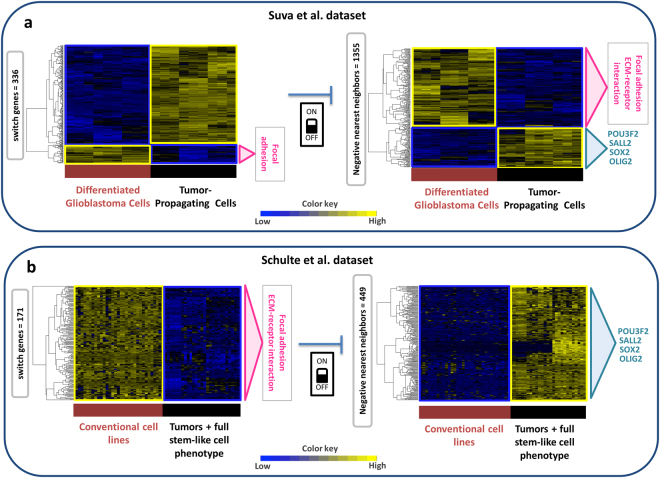
Glioblastoma, the most malignant brain cancer, contains self-renewing, stem-like cells that sustain tumor growth and therapeutic resistance. Identifying genes promoting stem-like cell differentiation might unveil targets for novel treatments. To detect them, here we apply SWIM - a software able to unveil genes (named switch genes) involved in drastic changes of cell phenotype - to public datasets of gene expression profiles from human glioblastoma cells. By analyzing matched pairs of stem-like and differentiated glioblastoma cells, SWIM identified 336 switch genes, potentially involved in the transition from stem-like to differentiated state. A subset of them was significantly related to focal adhesion and extracellular matrix and strongly down-regulated in stem-like cells, suggesting that they may promote differentiation and restrain tumor growth. Their expression in differentiated cells strongly correlated with the down-regulation of transcription factors like OLIG2, POU3F2, SALL2, SOX2, capable of reprogramming differentiated glioblastoma cells into stem-like cells. These findings were corroborated by the analysis of expression profiles from glioblastoma stem-like cell lines, the corresponding primary tumors, and conventional glioma cell lines. Switch genes represent a distinguishing feature of stem-like cells and we are persuaded that they may reveal novel potential therapeutic targets worthy of further investigation.

摘要

胶质母细胞瘤是最恶性的脑癌,其中包含自我更新的、具有干细胞样的细胞,这些细胞维持着肿瘤的生长和治疗抵抗。鉴定促进干细胞样细胞分化的基因可能揭示新的治疗靶点。为了检测这些基因,我们在这里应用了 SWIM——一种能够揭示参与细胞表型剧烈变化的基因(称为开关基因)的软件——来分析来自人类胶质母细胞瘤细胞的公共基因表达谱数据集。通过分析配对的具有干细胞样和分化特征的胶质母细胞瘤细胞,SWIM 鉴定出 336 个开关基因,这些基因可能参与从干细胞样到分化状态的转变。其中一部分与黏附斑和细胞外基质显著相关,并在干细胞样细胞中强烈下调,表明它们可能促进分化并抑制肿瘤生长。它们在分化细胞中的表达与转录因子如 OLIG2、POU3F2、SALL2、SOX2 的下调强烈相关,这些转录因子能够将分化的胶质母细胞瘤细胞重新编程为干细胞样细胞。这些发现得到了来自胶质母细胞瘤干细胞样细胞系、相应的原发性肿瘤和常规神经胶质瘤细胞系的表达谱分析的证实。开关基因是干细胞样细胞的一个显著特征,我们相信它们可能揭示新的潜在治疗靶点,值得进一步研究。
https://cdn.ncbi.nlm.nih.gov/pmc/blobs/1e33/5958093/670c513f232f/41598_2018_26081_Fig5_HTML.jpg
https://cdn.ncbi.nlm.nih.gov/pmc/blobs/1e33/5958093/9cc8620f2cc8/41598_2018_26081_Fig1_HTML.jpg
https://cdn.ncbi.nlm.nih.gov/pmc/blobs/1e33/5958093/9641fdb11eba/41598_2018_26081_Fig2_HTML.jpg
https://cdn.ncbi.nlm.nih.gov/pmc/blobs/1e33/5958093/d4b632724ed0/41598_2018_26081_Fig3_HTML.jpg
https://cdn.ncbi.nlm.nih.gov/pmc/blobs/1e33/5958093/d6d6ccb7d359/41598_2018_26081_Fig4_HTML.jpg
https://cdn.ncbi.nlm.nih.gov/pmc/blobs/1e33/5958093/670c513f232f/41598_2018_26081_Fig5_HTML.jpg
https://cdn.ncbi.nlm.nih.gov/pmc/blobs/1e33/5958093/9cc8620f2cc8/41598_2018_26081_Fig1_HTML.jpg
https://cdn.ncbi.nlm.nih.gov/pmc/blobs/1e33/5958093/9641fdb11eba/41598_2018_26081_Fig2_HTML.jpg
https://cdn.ncbi.nlm.nih.gov/pmc/blobs/1e33/5958093/d4b632724ed0/41598_2018_26081_Fig3_HTML.jpg
https://cdn.ncbi.nlm.nih.gov/pmc/blobs/1e33/5958093/d6d6ccb7d359/41598_2018_26081_Fig4_HTML.jpg
https://cdn.ncbi.nlm.nih.gov/pmc/blobs/1e33/5958093/670c513f232f/41598_2018_26081_Fig5_HTML.jpg

相似文献

1
Computational identification of specific genes for glioblastoma stem-like cells identity.计算鉴定胶质母细胞瘤干细胞特性的特定基因。
Sci Rep. 2018 May 17;8(1):7769. doi: 10.1038/s41598-018-26081-5.
2
SWIM tool application to expression data of glioblastoma stem-like cell lines, corresponding primary tumors and conventional glioma cell lines.SWIM 工具在神经胶质瘤干细胞系、相应的原发肿瘤和常规神经胶质瘤细胞系的表达数据中的应用。
BMC Bioinformatics. 2018 Nov 30;19(Suppl 15):436. doi: 10.1186/s12859-018-2421-x.
3
The role of FOSL1 in stem-like cell reprogramming processes.FOSL1 在干细胞重编程过程中的作用。
Sci Rep. 2021 Jul 19;11(1):14677. doi: 10.1038/s41598-021-94072-0.
4
Reconstructing and reprogramming the tumor-propagating potential of glioblastoma stem-like cells.重建和重编程神经胶质瘤干细胞的肿瘤增殖潜能。
Cell. 2014 Apr 24;157(3):580-94. doi: 10.1016/j.cell.2014.02.030. Epub 2014 Apr 10.
5
Podocalyxin-like protein is expressed in glioblastoma multiforme stem-like cells and is associated with poor outcome.足细胞蛋白样蛋白在多形性胶质母细胞瘤干细胞样细胞中表达,并与不良预后相关。
PLoS One. 2013 Oct 16;8(10):e75945. doi: 10.1371/journal.pone.0075945. eCollection 2013.
6
A Core Regulatory Circuit in Glioblastoma Stem Cells Links MAPK Activation to a Transcriptional Program of Neural Stem Cell Identity.胶质母细胞瘤干细胞中的核心调控回路将 MAPK 激活与神经干细胞特性的转录程序联系起来。
Sci Rep. 2017 Mar 3;7:43605. doi: 10.1038/srep43605.
7
Expression of the miR-302/367 cluster in glioblastoma cells suppresses tumorigenic gene expression patterns and abolishes transformation related phenotypes.微小RNA-302/367簇在胶质母细胞瘤细胞中的表达抑制致瘤基因表达模式并消除转化相关表型。
Int J Cancer. 2015 Nov 15;137(10):2296-309. doi: 10.1002/ijc.29606. Epub 2015 Jun 5.
8
Sox2 promotes malignancy in glioblastoma by regulating plasticity and astrocytic differentiation.Sox2通过调节可塑性和星形胶质细胞分化促进胶质母细胞瘤的恶性发展。
Neoplasia. 2014 Mar;16(3):193-206, 206.e19-25. doi: 10.1016/j.neo.2014.03.006. Epub 2014 Apr 13.
9
Integrative analysis of cell adhesion molecules in glioblastoma identified prostaglandin F2 receptor inhibitor (PTGFRN) as an essential gene.胶质母细胞瘤中细胞黏附分子的综合分析确定前列腺素 F2 受体抑制剂 (PTGFRN) 为必需基因。
BMC Cancer. 2022 Jun 11;22(1):642. doi: 10.1186/s12885-022-09682-2.
10
Involvement of miRNAs in the differentiation of human glioblastoma multiforme stem-like cells.miRNAs 参与人脑胶质母细胞瘤干细胞样细胞的分化。
PLoS One. 2013 Oct 14;8(10):e77098. doi: 10.1371/journal.pone.0077098. eCollection 2013.

引用本文的文献

1
Deciphering FOXM1 regulation: implications for stemness and metabolic adaptations in glioblastoma.解读FOXM1调控机制:对胶质母细胞瘤干性及代谢适应的影响
Med Oncol. 2025 Mar 3;42(4):88. doi: 10.1007/s12032-025-02639-y.
2
IDHwt glioblastomas can be stratified by their transcriptional response to standard treatment, with implications for targeted therapy.异柠檬酸脱氢酶野生型胶质母细胞瘤可以根据其对标准治疗的转录反应进行分层,这对靶向治疗有影响。
Genome Biol. 2024 Feb 7;25(1):45. doi: 10.1186/s13059-024-03172-3.
3
The TGF-β Family in Glioblastoma.《成胶质细胞瘤中的 TGF-β 家族》

本文引用的文献

1
JASPAR 2018: update of the open-access database of transcription factor binding profiles and its web framework.JASPAR 2018:转录因子结合谱开放获取数据库及其网络框架的更新
Nucleic Acids Res. 2018 Jan 4;46(D1):D1284. doi: 10.1093/nar/gkx1188.
2
Current status and future therapeutic perspectives of glioblastoma multiforme (GBM) therapy: A review.多形性胶质母细胞瘤 (GBM) 治疗的现状和未来治疗观点:综述。
Biomed Pharmacother. 2017 Aug;92:681-689. doi: 10.1016/j.biopha.2017.05.125. Epub 2017 Jun 3.
3
MiR-200c Inhibits the Tumor Progression of Glioma via Targeting Moesin.
Int J Mol Sci. 2024 Jan 15;25(2):1067. doi: 10.3390/ijms25021067.
4
Prediction of hub genes and key pathways associated with the radiation response of human hematopoietic stem/progenitor cells using integrated bioinformatics methods.使用综合生物信息学方法预测与人类造血干/祖细胞辐射反应相关的枢纽基因和关键途径。
Sci Rep. 2023 Jul 4;13(1):10762. doi: 10.1038/s41598-023-37981-6.
5
Co-Expression Network Analysis Identifies Molecular Determinants of Loneliness Associated with Neuropsychiatric and Neurodegenerative Diseases.共表达网络分析鉴定出与神经精神和神经退行性疾病相关的孤独感的分子决定因素。
Int J Mol Sci. 2023 Mar 21;24(6):5909. doi: 10.3390/ijms24065909.
6
A Network of MicroRNAs and mRNAs Involved in Melanosome Maturation and Trafficking Defines the Lower Response of Pigmentable Melanoma Cells to Targeted Therapy.参与黑素小体成熟和运输的微小RNA与信使RNA网络决定了可色素沉着黑素瘤细胞对靶向治疗的较低反应。
Cancers (Basel). 2023 Jan 31;15(3):894. doi: 10.3390/cancers15030894.
7
Alzheimer's disease: insights from a network medicine perspective.阿尔茨海默病:网络医学视角的洞察。
Sci Rep. 2022 Oct 7;12(1):16846. doi: 10.1038/s41598-022-20404-3.
8
Identification of pathogenic genes associated with CKD: An integrated bioinformatics approach.与慢性肾脏病相关的致病基因鉴定:一种综合生物信息学方法。
Front Genet. 2022 Aug 11;13:891055. doi: 10.3389/fgene.2022.891055. eCollection 2022.
9
A Comparison of Network-Based Methods for Drug Repurposing along with an Application to Human Complex Diseases.基于网络的药物重定位方法比较及其在人类复杂疾病中的应用。
Int J Mol Sci. 2022 Mar 28;23(7):3703. doi: 10.3390/ijms23073703.
10
Network analysis of atherosclerotic genes elucidates druggable targets.网络分析动脉粥样硬化基因阐明可药物治疗的靶点。
BMC Med Genomics. 2022 Mar 3;15(1):42. doi: 10.1186/s12920-022-01195-y.
微小RNA-200c通过靶向埃兹蛋白抑制神经胶质瘤的肿瘤进展。
Theranostics. 2017 Apr 10;7(6):1663-1673. doi: 10.7150/thno.17886. eCollection 2017.
4
SWIM: a computational tool to unveiling crucial nodes in complex biological networks.SWIM:一种揭示复杂生物网络中关键节点的计算工具。
Sci Rep. 2017 Mar 20;7:44797. doi: 10.1038/srep44797.
5
MicroRNA‑21 promotes migration and invasion of glioma cells via activation of Sox2 and β‑catenin signaling.微小RNA-21通过激活Sox2和β-连环蛋白信号通路促进胶质瘤细胞的迁移和侵袭。
Mol Med Rep. 2017 Jan;15(1):187-193. doi: 10.3892/mmr.2016.5971. Epub 2016 Nov 28.
6
Epigenetic Activation of WNT5A Drives Glioblastoma Stem Cell Differentiation and Invasive Growth.WNT5A的表观遗传激活驱动胶质母细胞瘤干细胞分化和侵袭性生长。
Cell. 2016 Nov 17;167(5):1281-1295.e18. doi: 10.1016/j.cell.2016.10.039.
7
Resetting cancer stem cell regulatory nodes upon MYC inhibition.MYC抑制后重设癌症干细胞调控节点
EMBO Rep. 2016 Dec;17(12):1872-1889. doi: 10.15252/embr.201541489. Epub 2016 Nov 16.
8
Targeting SOX2 as a Therapeutic Strategy in Glioblastoma.靶向SOX2作为胶质母细胞瘤的一种治疗策略
Front Oncol. 2016 Oct 24;6:222. doi: 10.3389/fonc.2016.00222. eCollection 2016.
9
Inhibition of carbonic anhydrase IX in glioblastoma multiforme.多形性胶质母细胞瘤中碳酸酐酶IX的抑制作用
Eur J Pharm Biopharm. 2016 Dec;109:81-92. doi: 10.1016/j.ejpb.2016.09.018. Epub 2016 Oct 1.
10
Molecular mechanisms of OLIG2 transcription factor in brain cancer.少突胶质细胞转录因子2(OLIG2)在脑癌中的分子机制
Oncotarget. 2016 Aug 16;7(33):53074-53101. doi: 10.18632/oncotarget.10628.