Department of Psychology, University of Trier, Trier, Germany.
Department of Psychological and Brain Sciences, Boston University, Boston, MA, United States.
Sci Rep. 2018 May 18;8(1):7819. doi: 10.1038/s41598-018-25953-0.
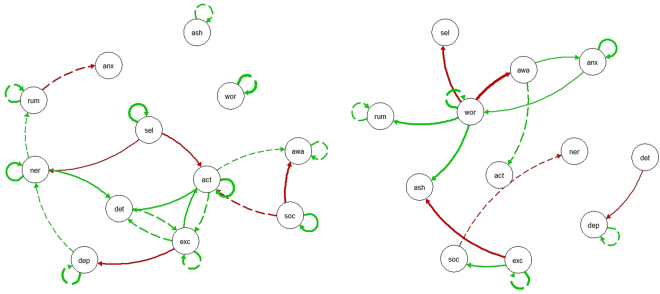
There are large health, societal, and economic costs associated with attrition from psychological services. The recently emerged, innovative statistical tool of complex network analysis was used in the present proof-of-concept study to improve the prediction of attrition. Fifty-eight patients undergoing psychological treatment for mood or anxiety disorders were assessed using Ecological Momentary Assessments four times a day for two weeks before treatment (3,248 measurements). Multilevel vector autoregressive models were employed to compute dynamic symptom networks. Intake variables and network parameters (centrality measures) were used as predictors for dropout using machine-learning algorithms. Networks for patients differed significantly between completers and dropouts. Among intake variables, initial impairment and sex predicted dropout explaining 6% of the variance. The network analysis identified four additional predictors: Expected force of being excited, outstrength of experiencing social support, betweenness of feeling nervous, and instrength of being active. The final model with the two intake and four network variables explained 32% of variance in dropout and identified 47 out of 58 patients correctly. The findings indicate that patients' dynamic network structures may improve the prediction of dropout. When implemented in routine care, such prediction models could identify patients at risk for attrition and inform personalized treatment recommendations.
与从心理服务中流失相关的健康、社会和经济成本巨大。本概念验证研究中使用了新兴的复杂网络分析创新统计工具来提高流失预测。58 名接受情绪或焦虑障碍心理治疗的患者在治疗前两周内每天进行四次生态瞬时评估(3248 次测量)。使用多层次向量自回归模型计算动态症状网络。使用机器学习算法,将摄入变量和网络参数(中心度测量)作为辍学的预测因子。完成治疗和中途退出的患者的网络存在显著差异。在摄入变量中,初始损伤和性别可预测辍学,解释了 6%的方差。网络分析确定了另外四个预测因子:兴奋预期力、体验社会支持的力量、感到紧张的介数和积极的力量。最终的模型包括两个摄入变量和四个网络变量,可解释辍学 32%的方差,并正确识别出 58 名患者中的 47 名。研究结果表明,患者的动态网络结构可以提高辍学预测的准确性。当在常规护理中实施时,此类预测模型可以识别出有辍学风险的患者,并为个性化治疗建议提供信息。