Morozov Sergey, Guseva Ekaterina, Ledikhova Natalya, Vladzymyrskyy Anton, Safronov Dmitry
Research and Practical Center of Medical Radiology, Department of Health Care of Moscow, 28-1, ul. Srednyaya Kalitnikovskaya, Moscow, 109029, Russia.
Insights Imaging. 2018 Jun;9(3):337-341. doi: 10.1007/s13244-018-0629-y. Epub 2018 May 18.
Quality assurance is the key component of modern radiology. A telemedicine-based quality assurance system helps to overcome the "scoring" approach and makes the quality control more accessible and objective.
A concept for quality assurance in radiology is developed. Its realization is a set of strategies, actions, and tools. The latter is based on telemedicine-based peer review of 23,199 computed tomography (CT) and magnetic resonance imaging (MRI) images.
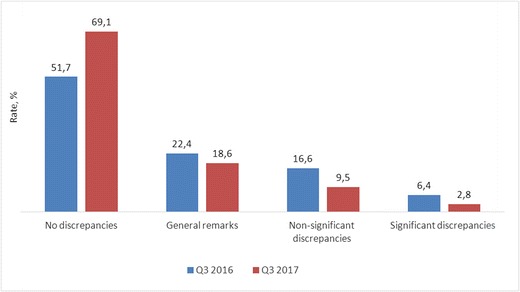
The conception of the system for quality management in radiology represents a chain of actions: "discrepancies evaluation - routine support - quality improvement activity - discrepancies evaluation". It is realized by an audit methodology, telemedicine, elearning, and other technologies. After a year of systemic telemedicine-based peer reviews, the authors have estimated that clinically significant discrepancies were detected in 6% of all cases, while clinically insignificant ones were found in 19% of cases. Most often, problems appear in musculoskeletal records; 80% of the examinations have diagnostic or technical imperfections. The presence of routine telemedicine support and personalized elearning allowed improving the diagnostics quality. The level of discrepancies has decreased significantly (p < 0.05).
The telemedicine-based peer review system allows improving radiology departments' network effectiveness.
• "Scoring" approach to radiologists' performance assessment must be changed. • Telemedicine peer review and personalized elearning significantly decrease the number of discrepancies. • Teleradiology allows linking all primary-level hospitals to a common peer review network.
质量保证是现代放射学的关键组成部分。基于远程医疗的质量保证系统有助于克服“评分”方法,使质量控制更易于实施且更客观。
制定了放射学质量保证的概念。其实现包括一系列策略、行动和工具。后者基于对23199份计算机断层扫描(CT)和磁共振成像(MRI)图像进行的基于远程医疗的同行评审。
放射学质量管理系统的概念代表了一系列行动:“差异评估 - 常规支持 - 质量改进活动 - 差异评估”。它通过审核方法、远程医疗、电子学习和其他技术来实现。经过一年基于远程医疗的系统性同行评审,作者估计在所有病例中,6%检测到具有临床意义的差异,而19%的病例中发现无临床意义的差异。问题最常出现在肌肉骨骼记录中;80%的检查存在诊断或技术缺陷。常规远程医疗支持和个性化电子学习的存在有助于提高诊断质量。差异水平显著降低(p < 0.05)。
基于远程医疗的同行评审系统有助于提高放射科的网络效能。
• 必须改变对放射科医生绩效评估的“评分”方法。• 远程医疗同行评审和个性化电子学习显著减少差异数量。• 远程放射学可将所有基层医院连接到一个共同的同行评审网络。