State Key Laboratory of Food Science and Technology, Nanchang University, Nanchang, 330047, People's Republic of China.
Sino-German Joint Research Institute, Nanchang University, Nanchang, 330047, People's Republic of China.
Microb Cell Fact. 2018 May 19;17(1):80. doi: 10.1186/s12934-018-0919-6.
Gamma-aminobutyric acid (GABA) plays a significant role in the food and drug industries. Our previous study established an efficient fed-batch fermentation process for Lactobacillus brevis NCL912 production of GABA from monosodium L-glutamate; however, monosodium L-glutamate may not be an ideal substrate, as it can result in the rapid increase of pH due to decarboxylation. Thus, in this study, L-glutamic acid was proposed as a substrate. To evaluate its potential, key components of the fermentation medium affecting GABA synthesis were re-screened and re-optimized to enhance GABA production from L. brevis NCL912.
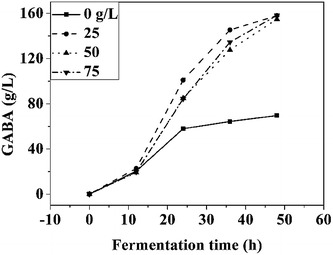
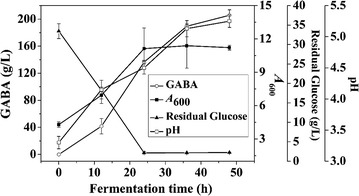
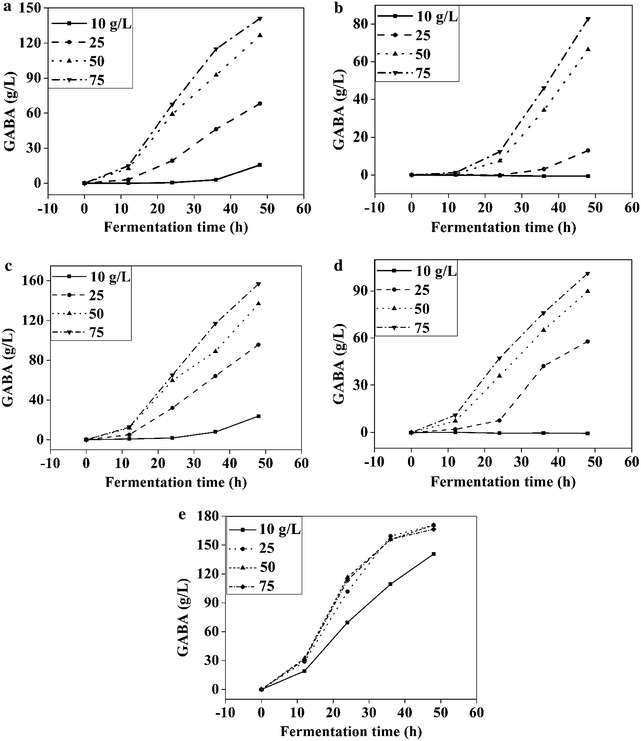
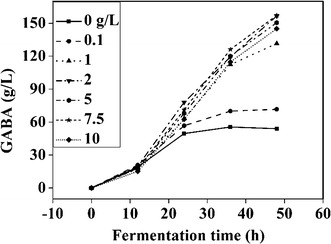
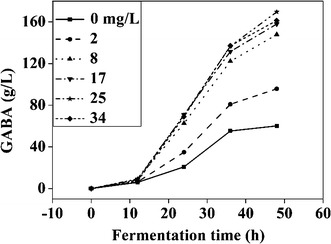
The initial fermentation medium (pH 3.3) used for optimization was: 50 g/L glucose, 25 g/L yeast extract, 10 mg/L manganese sulfate (MnSO·HO), 2 g/L Tween-80, and 220 g/L L-glutamic acid. Glucose, a nitrogen source, magnesium, and Tween-80 had notable effects on GABA production from the L-glutamic acid-based process; other factors showed no or marginal effects. The optimized levels of the four key components in the fermentation medium were 25 g/L glucose, 25 g/L yeast extract FM408, 25 mg/L MnSO·HO, and 2 g/L Tween-80. A simple and efficient fermentation process for the bioconversion of GABA by L. brevis NCL912 was subsequently developed in a 10 L fermenter as follows: fermentation medium, 5 L; glutamic acid, 295 g/L; inoculum, 10% (v/v); incubation temperature, 32 °C; and agitation, 100 rpm. After 48 h of fermentation, the final GABA concentration increased up to 205.8 ± 8.0 g/L.
L-Glutamic acid was superior to monosodium L-glutamate as a substrate in the bioproduction of GABA. Thus, a high efficacy bioprocess with 205 g/L GABA for L. brevis NCL912 was established. This strategy may provide an alternative for increasing the bioconversion of GABA.
γ-氨基丁酸(GABA)在食品和制药行业中发挥着重要作用。我们之前的研究建立了一种从 L-谷氨酸单钠高效分批发酵生产短乳杆菌 NCL912 GABA 的方法;然而,L-谷氨酸单钠可能不是一种理想的底物,因为它会由于脱羧而导致 pH 值迅速升高。因此,在本研究中,提出了 L-谷氨酸作为底物。为了评估其潜力,重新筛选和优化了影响 GABA 合成的发酵培养基的关键成分,以提高短乳杆菌 NCL912 从 L-谷氨酸生产 GABA 的能力。
用于优化的初始发酵培养基(pH 3.3)为:50 g/L 葡萄糖、25 g/L 酵母提取物、10 mg/L 硫酸锰(MnSO·H2O)、2 g/L Tween-80 和 220 g/L L-谷氨酸。葡萄糖、氮源、镁和 Tween-80 对基于 L-谷氨酸的过程中 GABA 生产有显著影响;其他因素没有影响或影响较小。发酵培养基中四个关键成分的优化水平分别为 25 g/L 葡萄糖、25 g/L 酵母提取物 FM408、25 mg/L 硫酸锰(MnSO·H2O)和 2 g/L Tween-80。随后在 10 L 发酵罐中开发了一种简单高效的发酵工艺,用于短乳杆菌 NCL912 生物转化 GABA,如下所示:发酵培养基,5 L;谷氨酸,295 g/L;接种量,10%(v/v);培养温度,32°C;搅拌速度,100 rpm。发酵 48 h 后,最终 GABA 浓度增加到 205.8 ± 8.0 g/L。
与 L-谷氨酸单钠相比,L-谷氨酸作为生物合成 GABA 的底物具有优势。因此,建立了一种用于短乳杆菌 NCL912 的高效生物过程,GABA 产量为 205 g/L。该策略可能为增加 GABA 的生物转化提供一种替代方法。