Phosphorus, Inc., 1140 Broadway St, New York, NY, 10001, USA.
J Assist Reprod Genet. 2018 Aug;35(8):1489-1496. doi: 10.1007/s10815-018-1204-7. Epub 2018 May 19.
To develop a comprehensive genetic test for female and male infertility in support of medical decisions during assisted reproductive technology (ART) protocols.
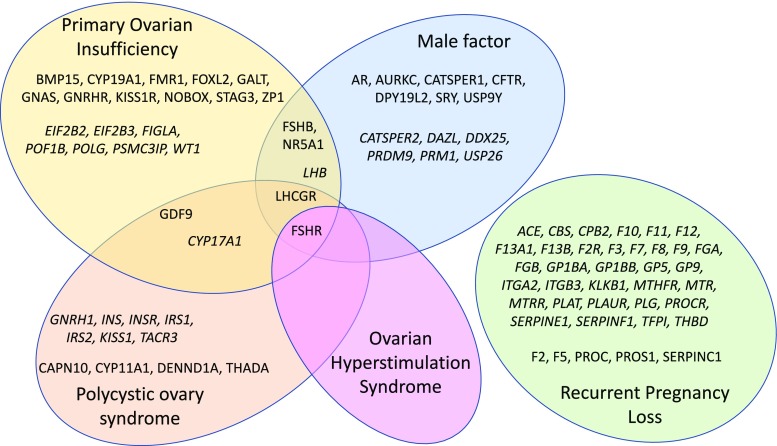
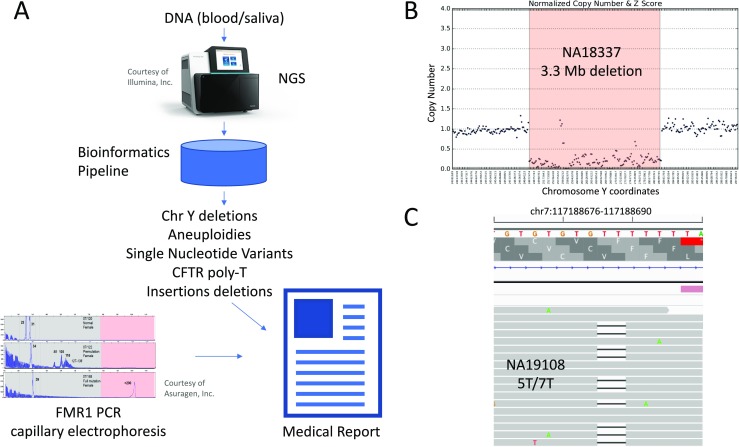
We developed a next-generation sequencing (NGS) gene panel consisting of 87 genes including promoters, 5' and 3' untranslated regions, exons, and selected introns. In addition, sex chromosome aneuploidies and Y chromosome microdeletions were analyzed concomitantly using the same panel.
The NGS panel was analytically validated by retrospective analysis of 118 genomic DNA samples with known variants in loci representative of female and male infertility. Our results showed analytical accuracy of > 99%, with > 98% sensitivity for single-nucleotide variants (SNVs) and > 91% sensitivity for insertions/deletions (indels). Clinical sensitivity was assessed with samples containing variants representative of male and female infertility, and it was 100% for SNVs/indels, CFTR IVS8-5T variants, sex chromosome aneuploidies, and copy number variants (CNVs) and > 93% for Y chromosome microdeletions. Cost analysis shows potential savings when comparing this single NGS assay with the standard approach, which includes multiple assays.
A single, comprehensive, NGS panel can simplify the ordering process for healthcare providers, reduce turnaround time, and lower the overall cost of testing for genetic assessment of infertility in females and males, while maintaining accuracy.
开发一种全面的女性和男性不育症遗传检测方法,以支持辅助生殖技术(ART)方案中的医学决策。
我们开发了一种下一代测序(NGS)基因panel,其中包含 87 个基因,包括启动子、5'和 3'非翻译区、外显子和选定的内含子。此外,还同时使用相同的panel 分析性染色体非整倍体和 Y 染色体微缺失。
通过对具有代表性的女性和男性不育症基因座的已知变异的 118 个基因组 DNA 样本进行回顾性分析,验证了 NGS panel 的分析准确性。我们的结果表明,分析准确性>99%,单核苷酸变异(SNV)的敏感性>98%,插入/缺失(indels)的敏感性>91%。使用含有男性和女性不育症代表性变异的样本评估临床敏感性,SNV/indels、CFTR IVS8-5T 变异、性染色体非整倍体和拷贝数变异(CNVs)的敏感性为 100%,Y 染色体微缺失的敏感性>93%。成本分析表明,与包括多个检测在内的标准方法相比,这种单一的 NGS 检测具有潜在的节省成本的优势。
单个全面的 NGS panel 可以简化医疗服务提供者的订购流程,缩短周转时间,并降低女性和男性不育症遗传评估的总体检测成本,同时保持准确性。