School of BioSciences and Bio21 Institute, The University of Melbourne, Parkville, VIC, Australia.
Andrology Department, Fundació Puigvert, Universitat Autònoma de Barcelona, Instituto de Investigaciones Biomédicas Sant Pau (IIB-Sant Pau), Barcelona, Catalonia, Spain.
Hum Reprod Update. 2021 Dec 21;28(1):15-29. doi: 10.1093/humupd/dmab030.
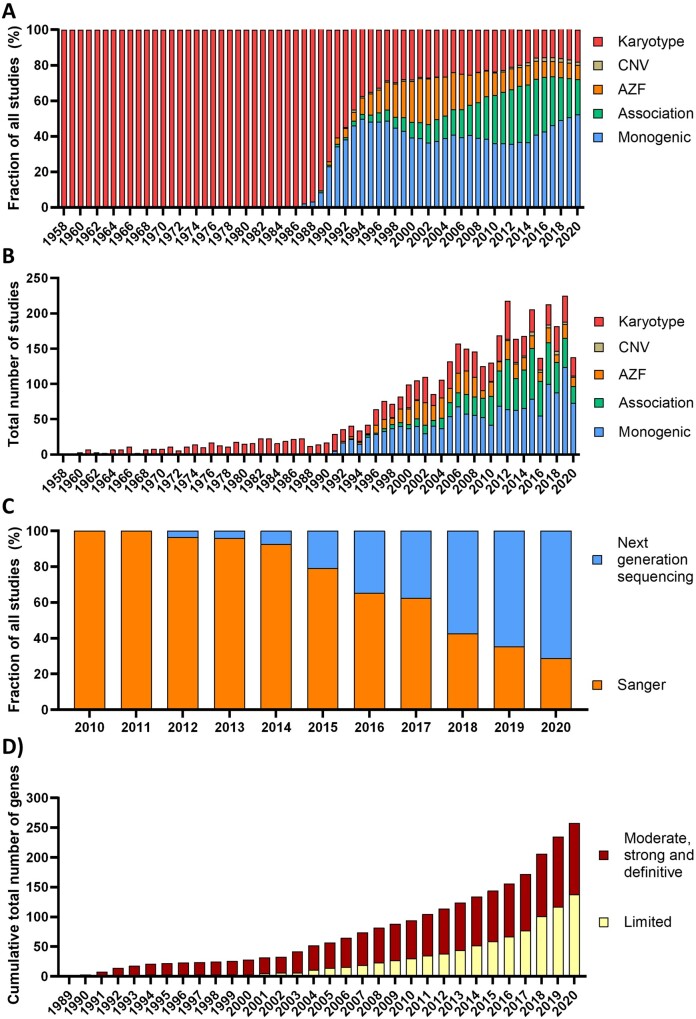
Human male infertility has a notable genetic component, including well-established diagnoses such as Klinefelter syndrome, Y-chromosome microdeletions and monogenic causes. Approximately 4% of all infertile men are now diagnosed with a genetic cause, but a majority (60-70%) remain without a clear diagnosis and are classified as unexplained. This is likely in large part due to a delay in the field adopting next-generation sequencing (NGS) technologies, and the absence of clear statements from field leaders as to what constitutes a validated cause of human male infertility (the current paper aims to address this). Fortunately, there has been a significant increase in the number of male infertility NGS studies. These have revealed a considerable number of novel gene-disease relationships (GDRs), which each require stringent assessment to validate the strength of genotype-phenotype associations. To definitively assess which of these GDRs are clinically relevant, the International Male Infertility Genomics Consortium (IMIGC) has identified the need for a systematic review and a comprehensive overview of known male infertility genes and an assessment of the evidence for reported GDRs.
In 2019, the first standardised clinical validity assessment of monogenic causes of male infertility was published. Here, we provide a comprehensive update of the subsequent 1.5 years, employing the joint expertise of the IMIGC to systematically evaluate all available evidence (as of 1 July 2020) for monogenic causes of isolated or syndromic male infertility, endocrine disorders or reproductive system abnormalities affecting the male sex organs. In addition, we systematically assessed the evidence for all previously reported possible monogenic causes of male infertility, using a framework designed for a more appropriate clinical interpretation of disease genes.
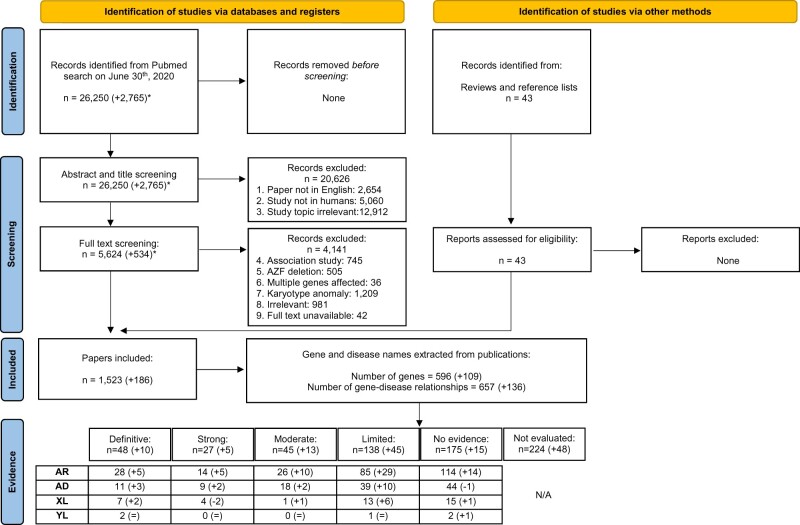
We performed a literature search according to the PRISMA guidelines up until 1 July 2020 for publications in English, using search terms related to 'male infertility' in combination with the word 'genetics' in PubMed. Next, the quality and the extent of all evidence supporting selected genes were assessed using an established and standardised scoring method. We assessed the experimental quality, patient phenotype assessment and functional evidence based on gene expression, mutant in-vitro cell and in-vivo animal model phenotypes. A final score was used to determine the clinical validity of each GDR, across the following five categories: no evidence, limited, moderate, strong or definitive. Variants were also reclassified according to the American College of Medical Genetics and Genomics-Association for Molecular Pathology (ACMG-AMP) guidelines and were recorded in spreadsheets for each GDR, which are available at imigc.org.
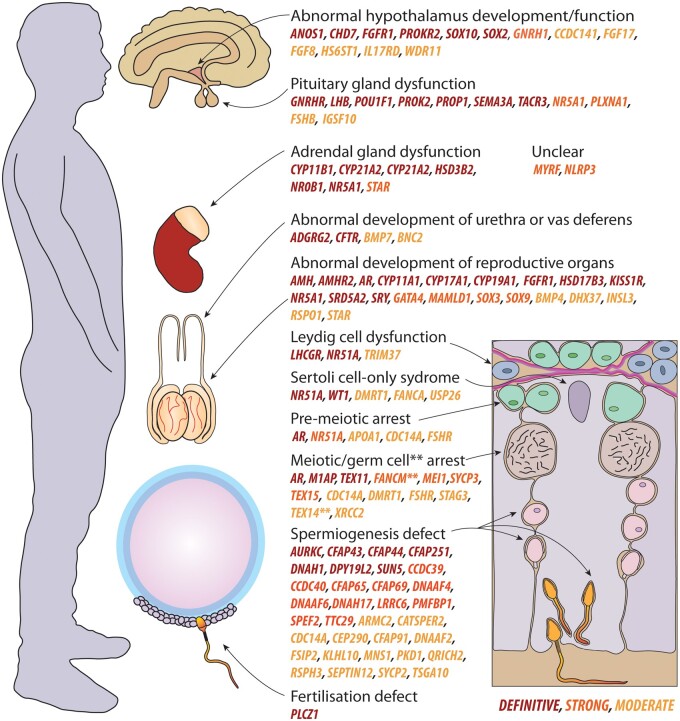
The primary outcome of this review was an overview of all known GDRs for monogenic causes of human male infertility and their clinical validity. We identified a total of 120 genes that were moderately, strongly or definitively linked to 104 infertility phenotypes.
Our systematic review curates all currently available evidence to reveal the strength of GDRs in male infertility. The existing guidelines for genetic testing in male infertility cases are based on studies published 25 years ago, and an update is far overdue. The identification of 104 high-probability 'human male infertility genes' is a 33% increase from the number identified in 2019. The insights generated in the current review will provide the impetus for an update of existing guidelines, will inform novel evidence-based genetic testing strategies used in clinics, and will identify gaps in our knowledge of male infertility genetics. We discuss the relevant international guidelines regarding research related to gene discovery and provide specific recommendations to the field of male infertility. Based on our findings, the IMIGC consortium recommend several updates to the genetic testing standards currently employed in the field of human male infertility, most important being the adoption of exome sequencing, or at least sequencing of the genes validated in this study, and expanding the patient groups for which genetic testing is recommended.
男性不育具有显著的遗传成分,包括已确立的诊断,如克莱恩费尔特综合征、Y 染色体微缺失和单基因病因。现在约有 4%的不育男性被诊断为遗传原因,但大多数(60-70%)仍没有明确的诊断,并被归类为原因不明。这很可能在很大程度上是由于该领域采用下一代测序(NGS)技术的延迟,以及领域领导者没有明确说明什么构成人类男性不育的有效病因(本文旨在解决这一问题)。幸运的是,男性不育 NGS 研究的数量显著增加。这些研究揭示了相当数量的新基因-疾病关系(GDR),每个 GDR 都需要严格评估,以验证基因型-表型关联的强度。为了明确评估这些 GDR 中有哪些具有临床相关性,国际男性不育基因组学联盟(IMIGC)已经确定需要进行系统审查和对已知男性不育基因进行全面概述,并评估报告的 GDR 的证据。
2019 年,发表了第一个关于男性不育单基因病因的标准化临床有效性评估。在这里,我们提供了随后 1.5 年的全面更新,利用 IMIGC 的联合专业知识,系统评估了所有可用的证据(截至 2020 年 7 月 1 日),以确定孤立或综合征性男性不育、内分泌紊乱或影响男性生殖器官的生殖系统异常的单基因病因。此外,我们还使用专为更适当的疾病基因临床解释而设计的框架,系统地评估了所有以前报告的可能的男性不育单基因病因的证据。
我们按照 PRISMA 指南进行了文献搜索,截至 2020 年 7 月 1 日,在 PubMed 中使用与“男性不育”相关的术语与“遗传学”一词结合进行英语文献搜索。接下来,使用既定的标准化评分方法评估支持选定基因的所有证据的质量和程度。我们根据基因表达、突变体外细胞和体内动物模型表型评估实验质量和患者表型评估以及功能证据。最后,根据美国医学遗传学与基因组学学会-分子病理学协会(ACMG-AMP)指南对每个 GDR 的临床有效性进行分类,分为无证据、有限、中等、强或明确。根据 ACMG-AMP 指南对变体进行重新分类,并将其记录在每个 GDR 的电子表格中,可在 imigc.org 上获取。
本综述的主要结果是概述了所有已知的人类男性不育单基因病因的 GDR 及其临床有效性。我们确定了 120 个基因与 104 种不育表型中度、强或明确相关。
我们的系统综述对所有目前可用的证据进行了梳理,以揭示 GDR 在男性不育中的强度。目前男性不育遗传检测的指南是基于 25 年前发表的研究,早就应该更新了。与 2019 年相比,确定了 104 个高概率的“人类男性不育基因”,增加了 33%。本综述产生的见解将为更新现有指南提供动力,为诊所使用的新的基于证据的遗传检测策略提供信息,并确定男性不育遗传学知识的差距。我们讨论了与基因发现相关的相关国际指南,并为男性不育领域提供了具体建议。基于我们的发现,IMIGC 联盟建议对当前在人类男性不育领域使用的遗传检测标准进行几项更新,最重要的是采用外显子组测序,或至少对本研究中验证的基因进行测序,并扩大推荐进行遗传检测的患者群体。