China National Rice Research Institution, Hangzhou, China.
PLoS One. 2018 May 21;13(5):e0196703. doi: 10.1371/journal.pone.0196703. eCollection 2018.
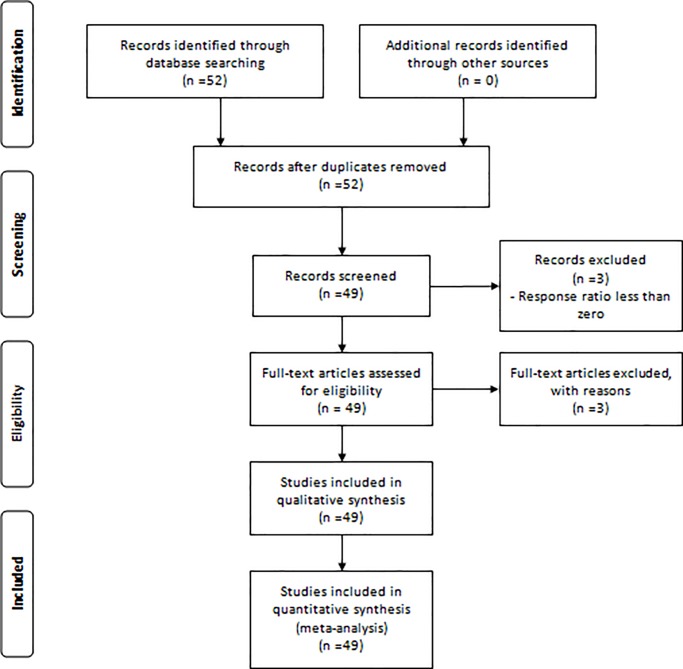
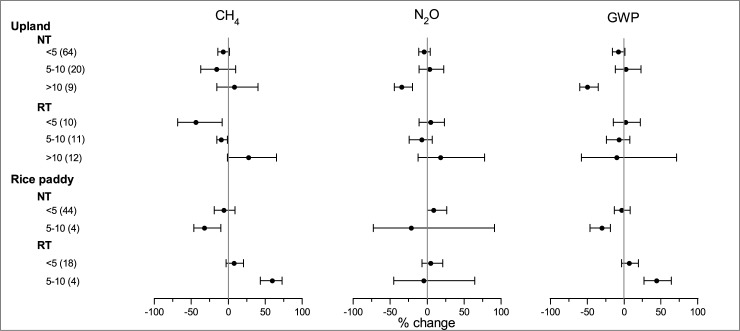
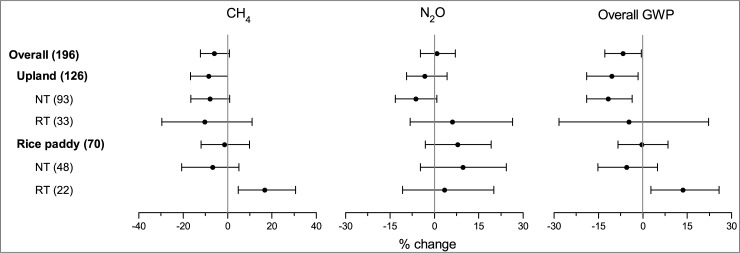
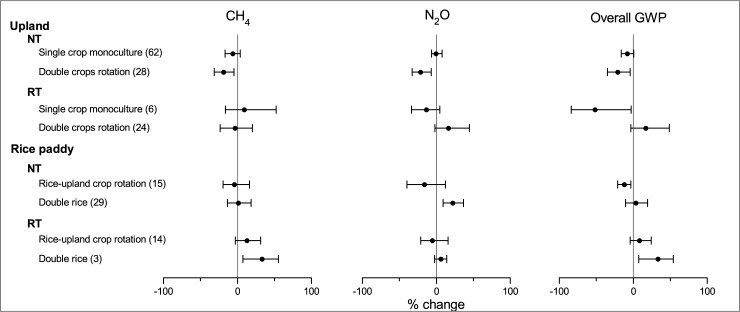
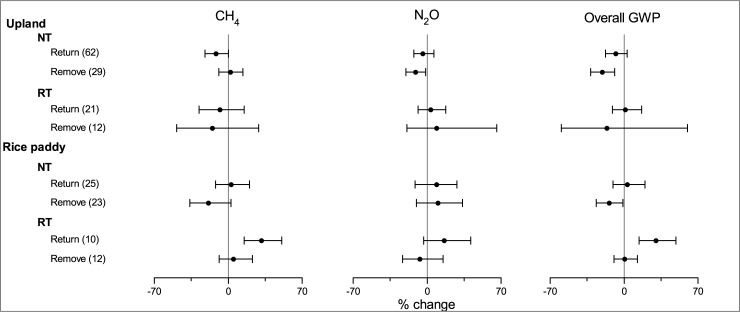
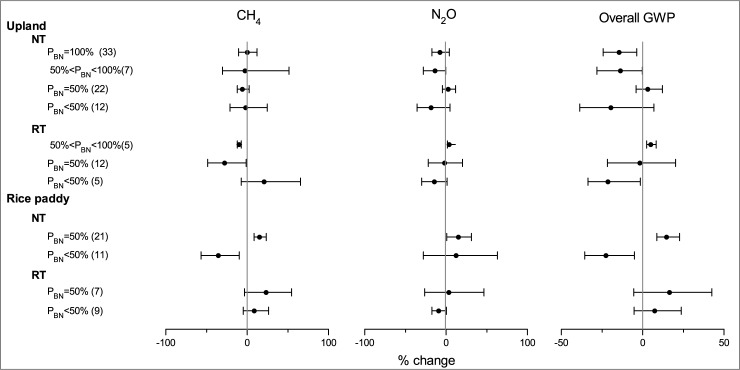
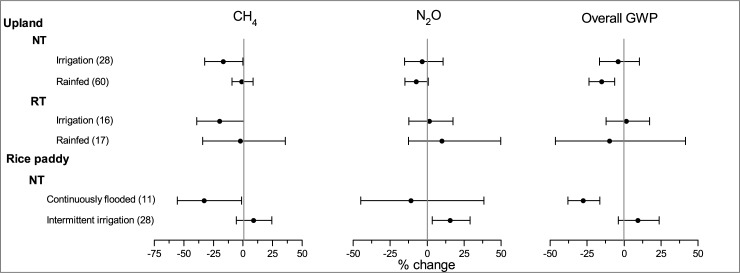
The effect of no- and reduced tillage (NT/RT) on greenhouse gas (GHG) emission was highly variable and may depend on other agronomy practices. However, how the other practices affect the effect of NT/RT on GHG emission remains elusive. Therefore, we conducted a global meta-analysis (including 49 papers with 196 comparisons) to assess the effect of five options (i.e. cropping system, crop residue management, split application of N fertilizer, irrigation, and tillage duration) on the effect of NT/RT on CH4 and N2O emissions from agricultural fields. The results showed that NT/RT significantly mitigated the overall global warming potential (GWP) of CH4 and N2O emissions by 6.6% as compared with conventional tillage (CT). Rotation cropping systems and crop straw remove facilitated no-tillage (NT) to reduce the CH4, N2O, or overall GWP both in upland and paddy field. NT significantly mitigated the overall GWP when the percentage of basal N fertilizer (PBN) >50%, when tillage duration > 10 years or rainfed in upland, while when PBN <50%, when duration between 5 and 10 years, or with continuous flooding in paddy field. RT significantly reduced the overall GWP under single crop monoculture system in upland. These results suggested that assessing the effectiveness of NT/RT on the mitigation of GHG emission should consider the interaction of NT/RT with other agronomy practices and land use type.
免耕和少耕(NT/RT)对温室气体(GHG)排放的影响差异很大,可能取决于其他农业实践。然而,其他实践如何影响 NT/RT 对 GHG 排放的影响仍不清楚。因此,我们进行了一项全球荟萃分析(包括 49 篇论文,共 196 个比较),以评估五种选择(即种植制度、作物残茬管理、氮肥分期施用、灌溉和耕作时间)对 NT/RT 对农田 CH4 和 N2O 排放的影响。结果表明,与常规耕作(CT)相比,NT/RT 可显著降低 CH4 和 N2O 排放的整体全球变暖潜势(GWP)6.6%。轮作制度和作物秸秆去除有利于免耕(NT)减少旱地和水田的 CH4、N2O 或整体 GWP。当基施氮肥比例(PBN)>50%、耕作时间>10 年或旱地雨养时,NT 可显著降低整体 GWP,而当 PBN<50%、耕作时间为 5-10 年或水田连续淹水时,NT 可显著降低整体 GWP。旱地单一种植制度下,RT 可显著降低整体 GWP。这些结果表明,评估 NT/RT 对 GHG 减排的有效性应考虑 NT/RT 与其他农业实践和土地利用类型的相互作用。