Sevignani Gabriela, Pavanelli Giovana Memari, Milano Sibele Sauzem, Ferronato Bianca Ramos, Pachaly Maria Aparecida, Ii Cheong Hae, Carvalho Mauricio de, Barreto Fellype Carvalho
Universidade Federal do Paraná, Departamento de Medicina Interna, Divisão de Nefrologia, Curitiba, PR, Brasil.
Universidade Federal do Paraná, Hospital das Clínicas, Departamento de Medicina Interna, Curitiba, PR, Brasil.
J Bras Nefrol. 2018 Apr-Jun;40(2):198-200. doi: 10.1590/2175-8239-jbn-3879. Epub 2018 May 17.
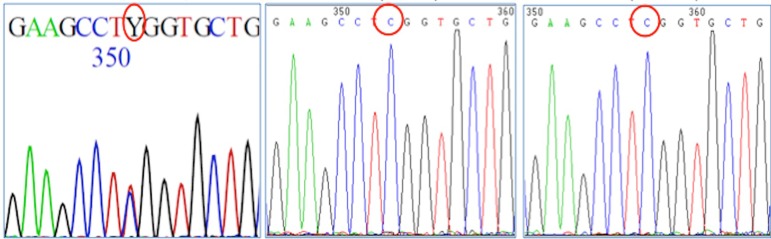
MYH9-related disease is an autosomal dominant disorder caused by mutations of the MYH9 gene, which encodes the non-muscle myosin heavy chain IIA on chromosome 22q12. It is characterized by congenital macrothrombocytopenia, bleeding tendency, hearing loss, and cataracts. Nephropathy occurs in approximately 30% of MYH9-related disease in a male patient carrier of a de novo missense mutation in exon 1 of the MYH9 gene [c.287C > T; p.Ser(TCG)96(TTG)Leu]. He presented all phenotypic manifestations of the disease, but cataracts. Renal alterations were microhematuria, nephrotic-range proteinuria (up to 7.5 g/24h), and rapid loss of renal function. The decline per year of the glomerular filtration rate was 20 mL/min/1.73m2 for five years. Blockade of the renin-angiotensin system, the only recommended therapy for slowing the progression of this nephropathy, was prescribed. Although MYH9-related disease is a rare cause of glomerulopathy and end-stage renal disease, awareness of rare genetic kidney disorders is essential to ensure accurate diagnosis and proper management of orphan disease patients.
MYH9相关疾病是一种常染色体显性疾病,由MYH9基因突变引起,该基因在22q12染色体上编码非肌肉肌球蛋白重链IIA。其特征为先天性大血小板减少、出血倾向、听力丧失和白内障。在携带MYH9基因第1外显子新发错义突变[c.287C>T;p.Ser(TCG)96(TTG)Leu]的男性患者中,约30%的MYH9相关疾病会出现肾病。他呈现出该疾病的所有表型表现,但没有白内障。肾脏改变为镜下血尿、肾病范围蛋白尿(高达7.5 g/24小时)和肾功能快速丧失。五年间肾小球滤过率每年下降20 mL/min/1.73m2。给予了肾素-血管紧张素系统阻滞剂治疗,这是唯一推荐的减缓该肾病进展的疗法。尽管MYH9相关疾病是肾小球病和终末期肾病的罕见病因,但认识罕见的遗传性肾脏疾病对于确保准确诊断和妥善管理罕见病患者至关重要。