Department of Radiation Oncology, The Ohio State University James Comprehensive Cancer Center and College of Medicine, Columbus, OH, 43210, USA.
Cancer Commun (Lond). 2018 May 21;38(1):27. doi: 10.1186/s40880-018-0301-4.
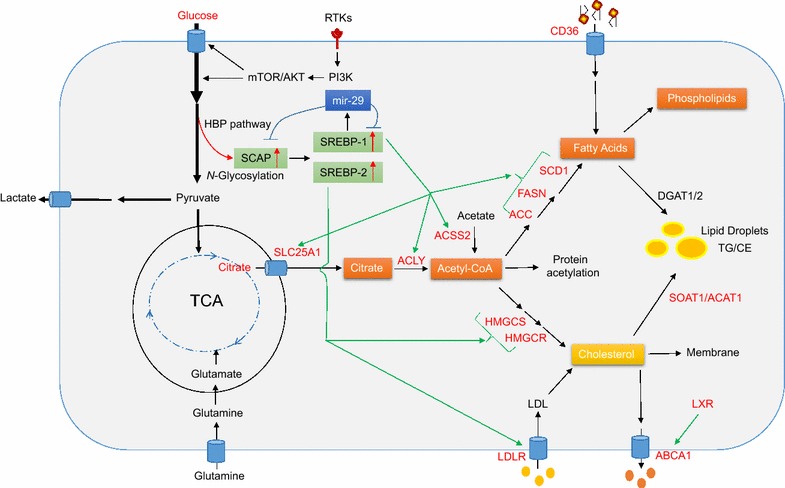
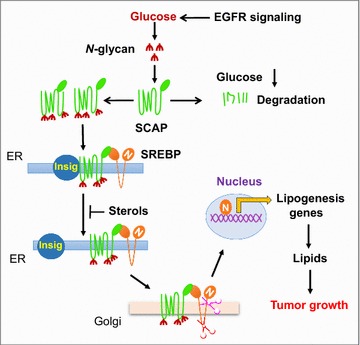
Reprogramming of lipid metabolism is a newly recognized hallmark of malignancy. Increased lipid uptake, storage and lipogenesis occur in a variety of cancers and contribute to rapid tumor growth. Lipids constitute the basic structure of membranes and also function as signaling molecules and energy sources. Sterol regulatory element-binding proteins (SREBPs), a family of membrane-bound transcription factors in the endoplasmic reticulum, play a central role in the regulation of lipid metabolism. Recent studies have revealed that SREBPs are highly up-regulated in various cancers and promote tumor growth. SREBP cleavage-activating protein is a key transporter in the trafficking and activation of SREBPs as well as a critical glucose sensor, thus linking glucose metabolism and de novo lipid synthesis. Targeting altered lipid metabolic pathways has become a promising anti-cancer strategy. This review summarizes recent progress in our understanding of lipid metabolism regulation in malignancy, and highlights potential molecular targets and their inhibitors for cancer treatment.
脂质代谢重编程是恶性肿瘤的一个新的公认特征。在各种癌症中,脂质摄取、储存和脂肪生成增加,并有助于肿瘤的快速生长。脂质构成了膜的基本结构,也作为信号分子和能量来源发挥作用。固醇调节元件结合蛋白(SREBPs)是内质网中一种膜结合转录因子家族,在脂质代谢调节中发挥核心作用。最近的研究表明,SREBPs 在各种癌症中高度上调,并促进肿瘤生长。SREBP 切割激活蛋白是 SREBPs 运输和激活的关键转运蛋白,也是关键的葡萄糖传感器,从而将葡萄糖代谢和从头合成脂质联系起来。针对改变的脂质代谢途径已成为一种有前途的抗癌策略。本文综述了恶性肿瘤中脂质代谢调控的最新研究进展,并强调了癌症治疗的潜在分子靶点及其抑制剂。