Tong Qing, Du Xiao-Peng, Hu Zong-Fu, Cui Li-Yong, Wang Hong-Bin
College of Veterinary Medicine, Northeast Agricultural University, Harbin, China.
Hejiang Forestry Research Institute of Heilongjiang Province, Jiamusi, China.
PeerJ. 2018 May 16;6:e4587. doi: 10.7717/peerj.4587. eCollection 2018.
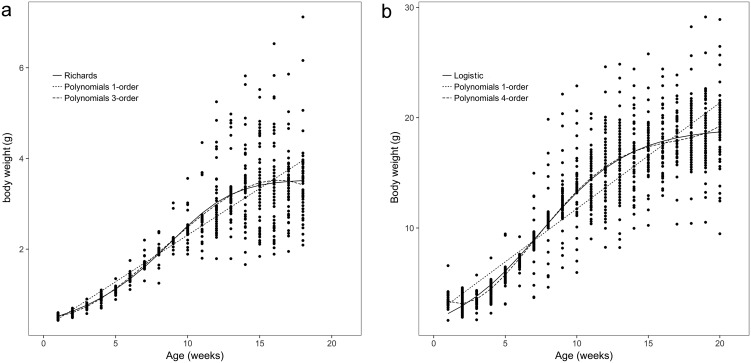
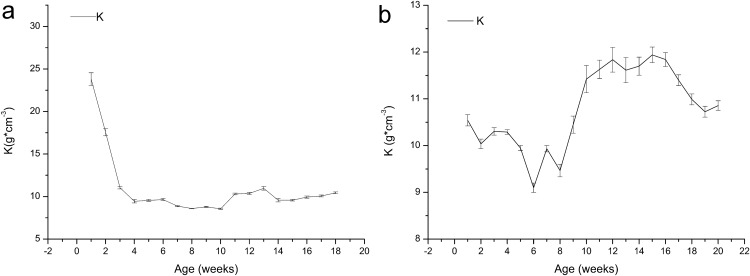
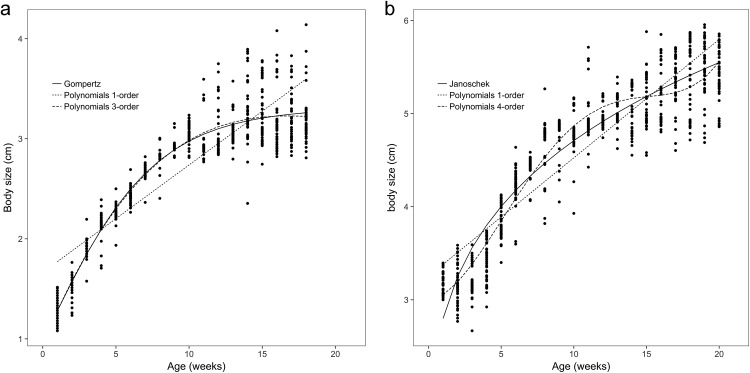
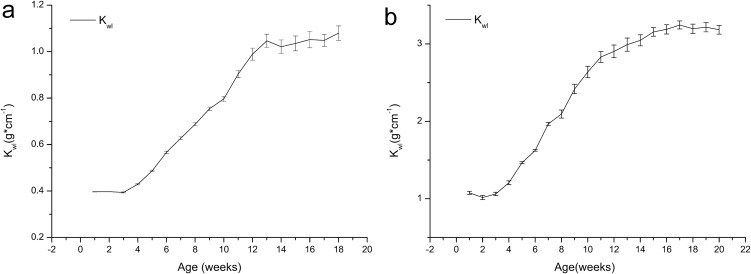
Well-controlled development leads to uniform body size and a better growth rate; therefore, the ability to determine the growth rate of frogs and their period of sexual maturity is essential for producing healthy, high-quality descendant frogs. To establish a working model that can best predict the growth performance of frogs, the present study examined the growth of one-year-old and two-year-old brown frogs () from metamorphosis to hibernation (18 weeks) and out-hibernation to hibernation (20 weeks) under the same environmental conditions. Brown frog growth was studied and mathematically modelled using various nonlinear, linear, and polynomial functions. The model input values were statistically evaluated using parameters such as the Akaike's information criterion. The body weight/size ratio () and Fulton's condition factor () were used to compare the weight and size of groups of frogs during the growth period. The results showed that the third- and fourth-order polynomial models provided the most consistent predictions of body weight for age 1 and age 2 brown frogs, respectively. Both the Gompertz and third-order polynomial models yielded similarly adequate results for the body size of age 1 brown frogs, while the Janoschek model produced a similarly adequate result for the body size of age 2 brown frogs. The Brody and Janoschek models yielded the highest and lowest estimates of asymptotic weight, respectively, for the body weights of all frogs. The value of all frogs increased from 0.40 to 3.18. The value of age 1 frogs decreased from 23.81 to 9.45 in the first four weeks. The value of age 2 frogs remained close to 10. Graphically, a sigmoidal trend was observed for body weight and body size with increasing age. The results of this study will be useful not only for amphibian research but also for frog farming management strategies and decisions.
良好的生长控制会带来均匀的体型和更好的生长速度;因此,确定青蛙的生长速度及其性成熟时期的能力对于培育健康、高质量的后代青蛙至关重要。为了建立一个能够最佳预测青蛙生长性能的工作模型,本研究在相同环境条件下,考察了一岁和两岁的棕蛙从变态到冬眠(18周)以及出蛰到冬眠(20周)的生长情况。使用各种非线性、线性和多项式函数对棕蛙的生长进行了研究并建立了数学模型。模型输入值使用赤池信息准则等参数进行统计评估。体重/体长比()和富尔顿条件因子()用于比较青蛙群体在生长期间的体重和体长。结果表明,三阶和四阶多项式模型分别对一岁和两岁棕蛙的体重提供了最一致的预测。对于一岁棕蛙的体型,冈珀茨模型和三阶多项式模型产生的结果同样合适,而雅诺谢克模型对两岁棕蛙的体型产生了类似合适的结果。对于所有青蛙的体重,布罗迪模型和雅诺谢克模型分别给出了最高和最低渐近体重估计值。所有青蛙的 值从0.40增加到3.18。一岁青蛙的 值在最初四周从23.81降至9.45。两岁青蛙的 值保持接近10。从图形上看,随着年龄增长,体重和体型呈现出S形趋势。本研究结果不仅对两栖动物研究有用,而且对青蛙养殖管理策略和决策也有用。