Department of Biochemistry, Molecular Biology and Biophysics, University of Minnesota, Minneapolis, MN 55455, USA; Masonic Cancer Center, University of Minnesota, Minneapolis, MN 55455, USA; Institute for Molecular Virology, University of Minnesota, Minneapolis, MN 55455, USA.
Department of Chemistry and Biochemistry, University of San Diego, La Jolla 92093, CA, USA.
J Mol Biol. 2018 Aug 17;430(17):2695-2708. doi: 10.1016/j.jmb.2018.04.044. Epub 2018 May 19.
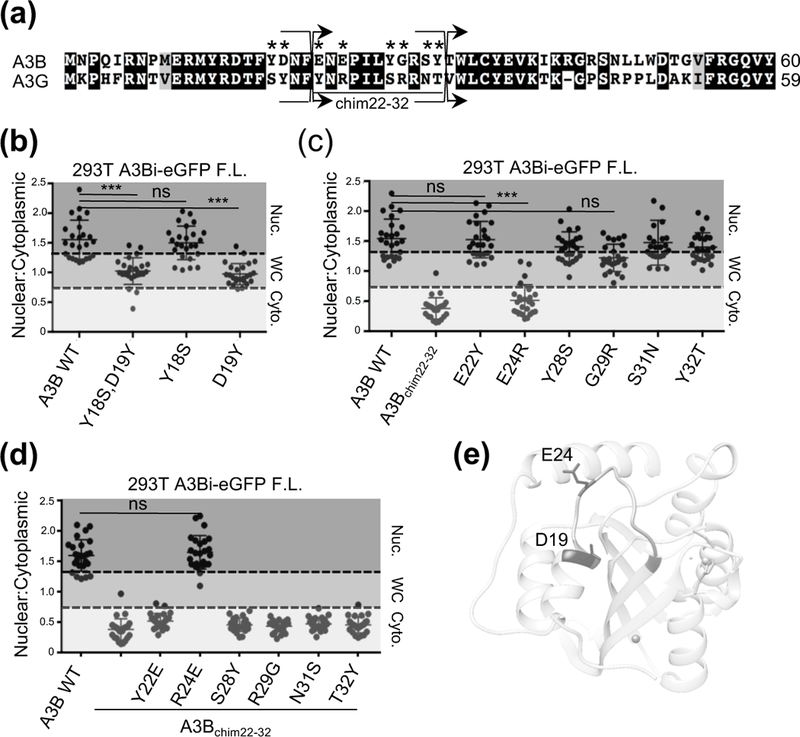
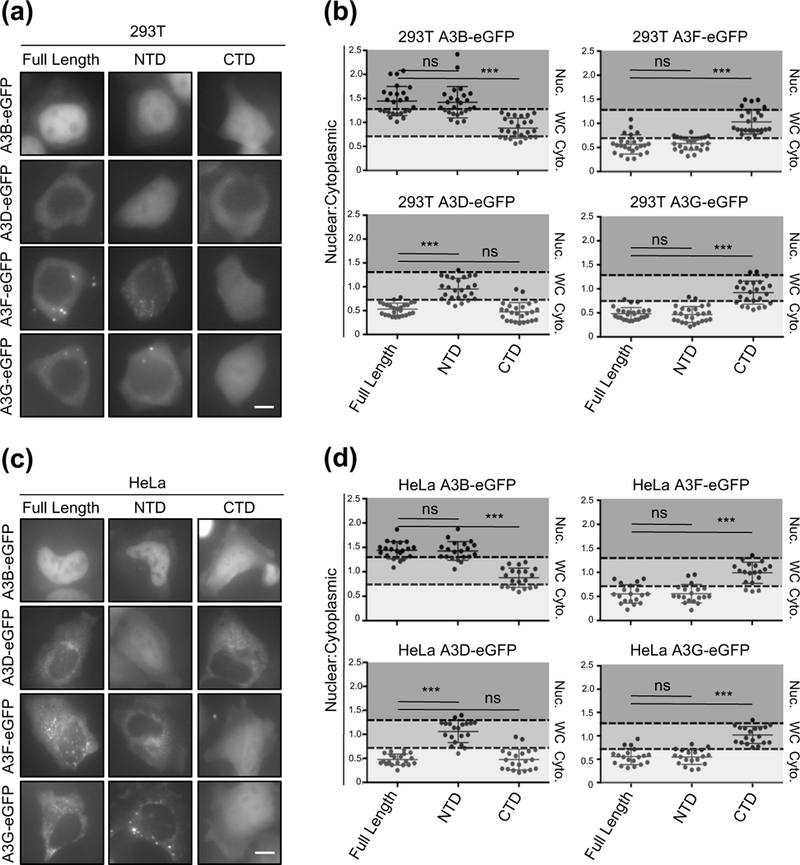
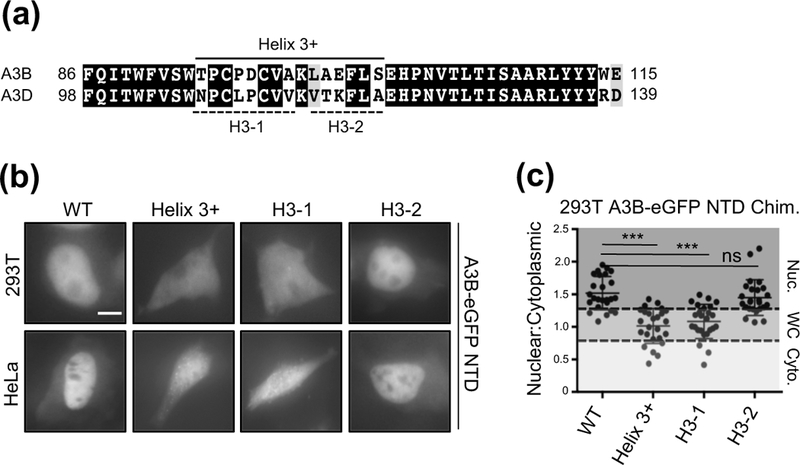
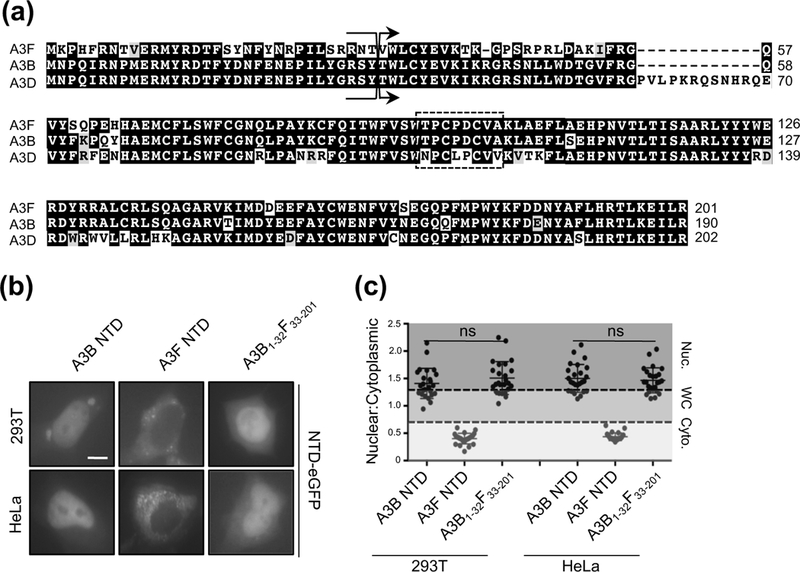
The APOBEC3 family of cytosine deaminases catalyzes the conversion of cytosines-to-uracils in single-stranded DNA. Traditionally, these enzymes are associated with antiviral immunity and restriction of DNA-based pathogens. However, a role for these enzymes in tumor evolution and metastatic disease has also become evident. The primary APOBEC3 candidate in cancer mutagenesis is APOBEC3B (A3B) for three reasons: (1) A3B mRNA is upregulated in several different cancers, (2) A3B expression and mutational loads correlate with poor clinical outcomes, and (3) A3B is the only family member known to be constitutively nuclear. Previous studies have mapped non-canonical A3B nuclear localization determinants to a single surface-exposed patch within the N-terminal domain (NTD). Here, we show that A3B has an additional, distinct, surface-exposed NTD region that contributes to nuclear localization. Disruption of residues within the first 30 amino acids of A3B (import surface 1) or loop 5/α-helix 3 (import surface 2) completely abolish nuclear localization. These import determinants also graft into NTDs of related family members and mediate re-localization from cell-wide-to-nucleus or cytoplasm-to-nucleus. These findings demonstrate that both sets of residues are required for non-canonical A3B nuclear localization and describe unique surfaces that may serve as novel therapeutic targets.
APOBEC3 家族的胞嘧啶脱氨酶催化单链 DNA 中的胞嘧啶向尿嘧啶的转化。传统上,这些酶与抗病毒免疫和限制基于 DNA 的病原体有关。然而,这些酶在肿瘤进化和转移疾病中的作用也变得明显。在癌症诱变中,主要的 APOBEC3 候选物是 APOBEC3B(A3B),原因有三:(1)A3B mRNA 在几种不同的癌症中上调,(2)A3B 的表达和突变负荷与不良的临床结局相关,(3)A3B 是唯一已知的组成型核的家族成员。以前的研究已经将非典型的 A3B 核定位决定因素映射到 N 端结构域(NTD)内的单个表面暴露补丁上。在这里,我们表明 A3B 具有另一个独特的、表面暴露的 NTD 区域,有助于核定位。破坏 A3B 的前 30 个氨基酸内的残基(输入表面 1)或环 5/α-螺旋 3(输入表面 2)完全消除核定位。这些输入决定因素也可以嫁接进入相关家族成员的 NTD 中,并介导从全细胞到核或细胞质到核的重新定位。这些发现表明,这两组残基都需要非典型的 A3B 核定位,并描述了可能作为新型治疗靶点的独特表面。