Department of Chemistry, Indiana University, Bloomington, IN, 47405, USA; Interdisciplinary Biochemistry Graduate Program, Indiana University, Bloomington, IN, 47405, USA.
Novo Nordisk Research Center Indianapolis, Indianapolis, IN, 46241, USA.
Mol Metab. 2018 Jul;13:45-55. doi: 10.1016/j.molmet.2018.05.003. Epub 2018 May 11.
To signal, FGF19 and FGF21 require co-receptor βKlotho (KLB) to act in concert with FGF receptors, and yet there is appreciable variance in the C-terminal sequences of these two novel metabolic hormones where binding is believed to be primary. We seek to determine the functional consequences for these amino acid differences and determine whether such information can be used to design high potency antagonists and agonists.
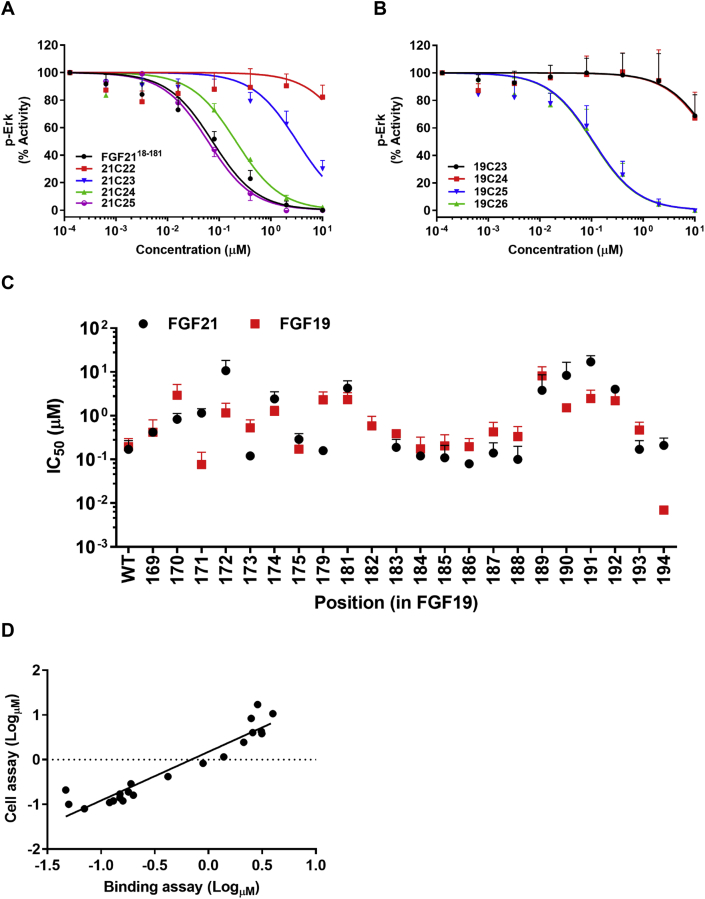
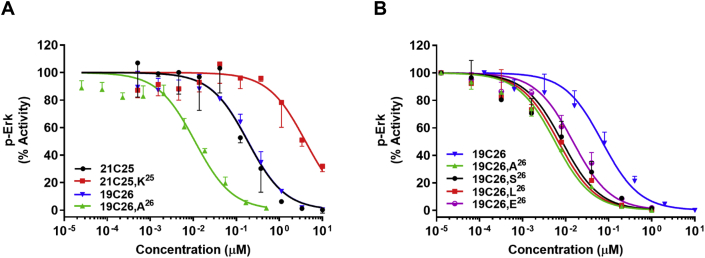
We employed a functional in vitro assay to identify C-terminal protein fragments capable of fully blocking KLB-mediated FGF19 and 21 receptor signaling. The key residues in each hormone responsible for support full bioactivity were identified through peptide-based Ala-scanning. Chemical optimization of the peptides was employed to increase their antagonistic potency. An optimized sequence as a substituted part of a full length FGF21 was assessed for enhanced FGFR/KLB-mediated agonism using tissue culture and obese mice.
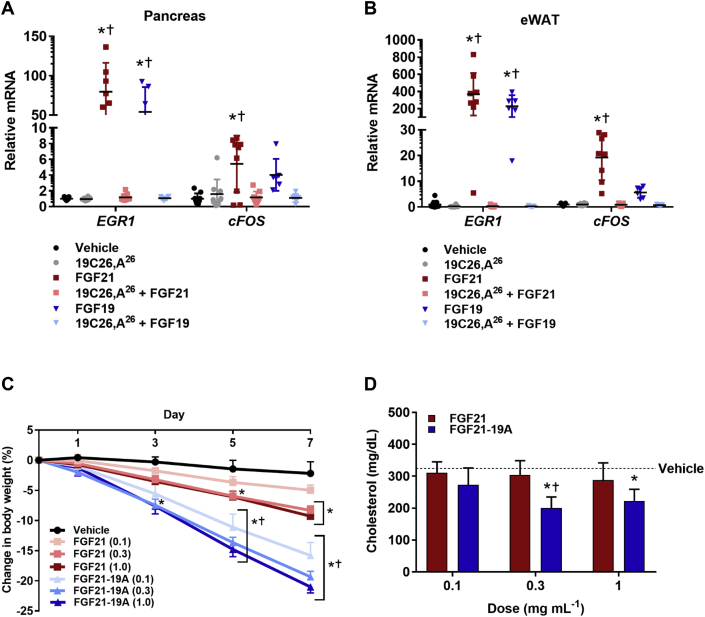
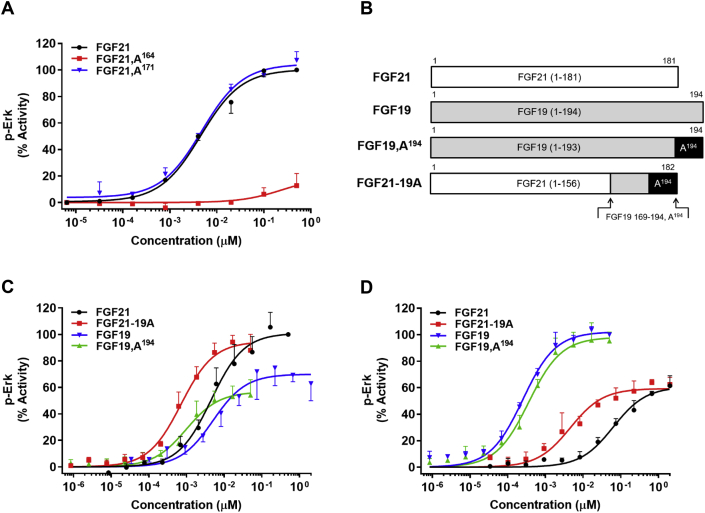
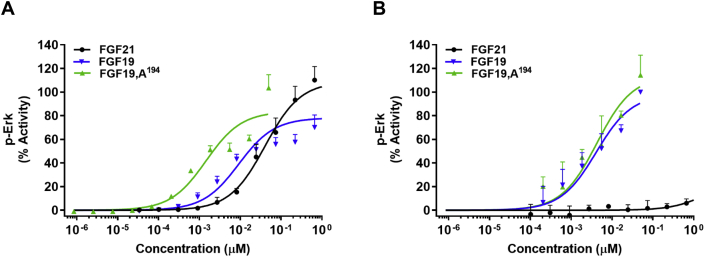
C-terminal FGF19 and FGF21 peptides of relatively short length were observed to potently inhibit the activity of these two hormones, in vitro and in vivo. These FGFs of different sequence also demonstrated a striking conservation of structural determinants to maintain KLB binding. A single C-terminal amino acid in FGF19 was observed to modulate relative activity through FGFR1 and FGFR4. The substitution of native FGF21 C-terminal sequence with a peptide optimized for the highest antagonistic activity resulted in significantly enhanced FGF potency, as measured by in vitro signaling and improvements in metabolic outcomes in diet-induced obese mice.
We report here the ability of short C-terminal peptides to bind KLB and function as antagonists of FGF19 and 21 actions. These proteins maintain high conservation of sequence in those residues central to KLB binding. An FGF21 chimeric protein possessing an optimized C-terminal sequence proved to be a super-agonist in delivery of beneficial metabolic effects in obese mice.
成纤维细胞生长因子 19(FGF19)和 21(FGF21)需要共同受体βKlotho(KLB)与成纤维细胞生长因子受体协同作用,而这两种新型代谢激素的 C 末端序列存在明显差异,据信这些差异是结合的主要部位。我们旨在确定这些氨基酸差异的功能后果,并确定这些信息是否可用于设计高效的拮抗剂和激动剂。
我们采用了一种功能性体外测定法,以鉴定能够完全阻断 KLB 介导的 FGF19 和 21 受体信号传导的 C 末端蛋白片段。通过基于肽的丙氨酸扫描确定了每种激素中负责支持全部生物活性的关键残基。对肽进行化学优化,以提高其拮抗效力。评估优化序列作为全长 FGF21 的替代部分,以增强 FGFR/KLB 介导的激动作用,使用组织培养和肥胖小鼠进行评估。
观察到相对较短长度的 C 末端 FGF19 和 FGF21 肽能够在体外和体内强烈抑制这两种激素的活性。这些不同序列的 FGF 也表现出维持 KLB 结合的结构决定因素的惊人保守性。FGF19 中的单个 C 末端氨基酸被观察到通过 FGFR1 和 FGFR4 调节相对活性。用针对最高拮抗活性进行优化的肽替代天然 FGF21 C 末端序列,导致 FGF 效力显著增强,如通过体外信号传导和改善饮食诱导肥胖小鼠的代谢结果来衡量。
我们在此报告了短 C 末端肽结合 KLB 并作为 FGF19 和 21 作用的拮抗剂的能力。这些蛋白质在对 KLB 结合至关重要的残基中保持序列的高度保守性。具有优化的 C 末端序列的 FGF21 嵌合蛋白在肥胖小鼠中显示出能够传递有益的代谢效果的超级激动剂作用。