VA Boston Healthcare System.
Boston University School of Medicine.
J Cogn Neurosci. 2018 Sep;30(9):1323-1329. doi: 10.1162/jocn_a_01285. Epub 2018 May 23.
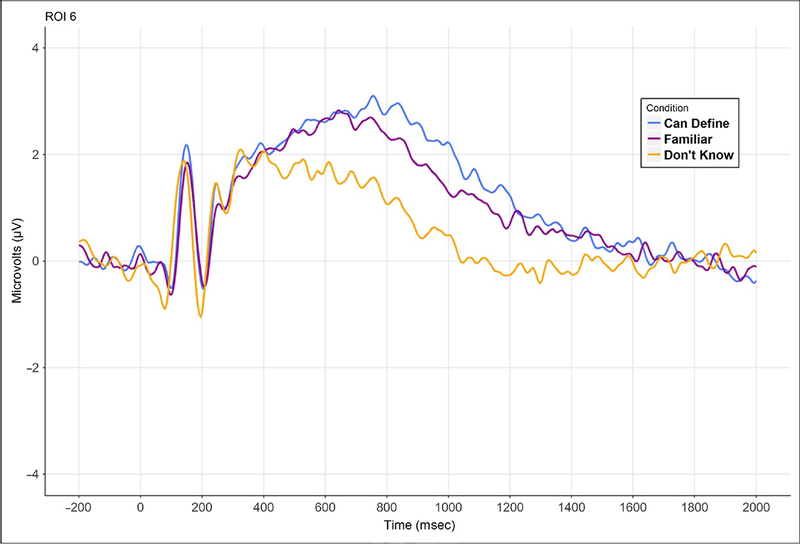
It is difficult to predict whether newly learned information will be retrievable in the future. A biomarker of long-lasting learning, capable of predicting an individual's future ability to retrieve a particular memory, could positively influence teaching and educational methods. ERPs were investigated as a potential biomarker of long-lasting learning. Prior ERP studies have supported a dual-process model of recognition memory that categorizes recollection and familiarity as distinct memorial processes with distinct ERP correlates. The late positive component is thought to underlie conscious recollection and the frontal N400 signal is thought to reflect familiarity [Yonelinas, A. P. Components of episodic memory: The contribution of recollection and familiarity. Philosophical Transactions of the Royal Society of London, Series B, Biological Sciences, 356, 1363-1374, 2001]. Here we show that the magnitude of the late positive component, soon after initial learning, is predictive of subsequent recollection of anatomical terms among medical students 6 months later.
很难预测新学到的信息是否在未来可以被检索到。如果有一种能够预测个体未来特定记忆检索能力的长期学习的生物标志物,它可能会积极地影响教学和教育方法。事件相关电位(ERP)被作为长期学习的潜在生物标志物进行研究。先前的 ERP 研究支持了识别记忆的双加工模型,该模型将再认和熟悉度归类为不同的记忆过程,具有不同的 ERP 相关物。晚期正成分被认为是意识再认的基础,而额部 N400 信号被认为反映了熟悉度[Yonelinas, A. P. 情景记忆的成分:再认和熟悉度的贡献。英国皇家学会会刊 B 辑:生物科学,356, 1363-1374, 2001]。在这里,我们表明,在初始学习后不久,晚期正成分的幅度可以预测 6 个月后医学生对解剖学术语的后续再认。