Lazzarini Thomas Adriano, Gonçalves Crhistinne Cavalheiro Maymone, Benites Walter Martins, Silva Liliane Ferreira da, Tsuha Daniel Henrique, Ko Albert Icksang, Rohrbaugh Robert, Andrews Jason Randolph, Croda Julio
School of Medicine, Yale University, New Haven, Connecticut, USA.
Faculdade de Medicina, Universidade Federal de Mato Grosso do Sul, Campo Grande, MS, Brasil.
Rev Saude Publica. 2018;52:56. doi: 10.11606/s1518-8787.2018052000541. Epub 2018 May 17.
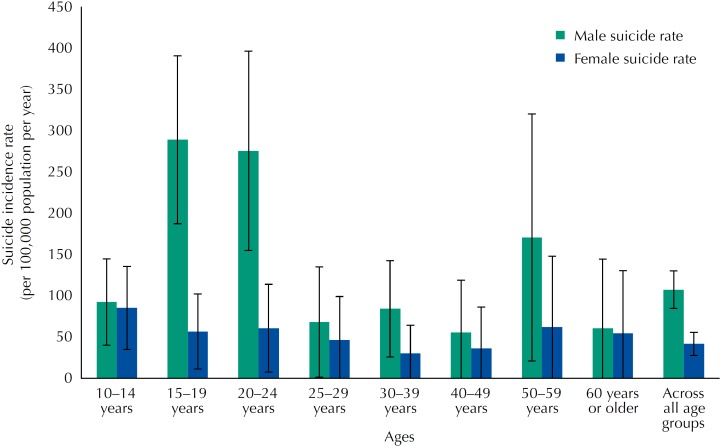
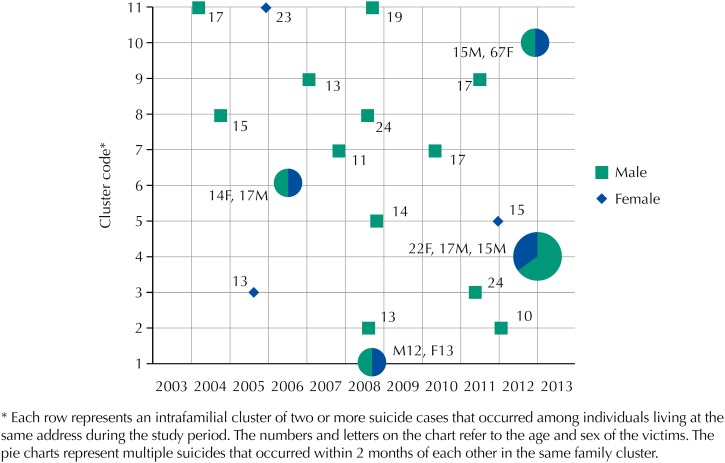
OBJECTIVE To estimate age and sex-specific suicide rates, compare suicide rates between indigenous communities, and quantify the frequency of intrafamilial suicide clustering. METHODS We performed a retrospective cohort study involving 14,666 indigenous individuals in reservations in Dourados, state of Mato Grosso do Sul, Brazil, from 2003 through 2013 using national and local census. RESULTS The overall suicide rate was 73.4 per 100,000 person-years. Adolescent males aged 15-19 and girls aged 10-14 had the highest rates for each sex at 289.3 (95%CI 187.5-391.2) and 85.3 (95%CI 34.9-135.7), respectively. Comparing the largest reservations, Bororo had a higher suicide rate than Jaguapiru (RR = 4.83, 95%CI 2.85-8.16) and had significantly lower socioeconomic indicators including income and access to electricity. Nine of 19 suicides among children under 15 occurred in household clusters. Compared with adult suicides, a greater proportion of child (OR = 5.12, 95%CI 1.89-13.86, p = 0.001) and adolescent (OR = 3.48, 95%CI 1.29-9.44, p = 0.017) suicides occurred within household clusters. CONCLUSIONS High rates of suicide occur among children and adolescents in these indigenous reservations, particularly in poor communities. Nearly half of child suicides occur within household clusters. These findings underscore the need for broad public health interventions and focused mental health interventions in households following a suicide.
目的 估计特定年龄和性别的自杀率,比较不同原住民社区的自杀率,并量化家庭内部自杀聚集的频率。方法 我们进行了一项回顾性队列研究,利用国家和地方人口普查数据,对2003年至2013年期间巴西南马托格罗索州多拉杜斯保留地的14,666名原住民个体进行了研究。结果 总体自杀率为每10万人年73.4例。15 - 19岁的青少年男性和10 - 14岁的女孩自杀率在各性别中最高,分别为289.3(95%置信区间187.5 - 391.2)和85.3(95%置信区间34.9 - 135.7)。比较最大的保留地,博罗罗的自杀率高于雅瓜皮鲁(相对危险度 = 4.83,95%置信区间2.85 - 8.16),且其社会经济指标(包括收入和电力供应)显著较低。15岁以下儿童的19例自杀中有9例发生在家庭聚集情况中。与成人自杀相比,儿童(比值比 = 5.12,95%置信区间1.89 - 13.86,p = 0.001)和青少年(比值比 = 3.48,95%置信区间1.29 - 9.44,p = 0.017)自杀在家庭聚集情况中发生的比例更高。结论 在这些原住民保留地,儿童和青少年自杀率很高,尤其是在贫困社区。近一半的儿童自杀发生在家庭聚集情况中。这些发现强调了需要采取广泛的公共卫生干预措施以及在自杀事件发生后对家庭进行有针对性的心理健康干预。