Dana-Farber Cancer Institute and Harvard Medical School, Boston, Massachusetts, USA.
Blood Cancer J. 2018 May 24;8(5):47. doi: 10.1038/s41408-018-0085-4.
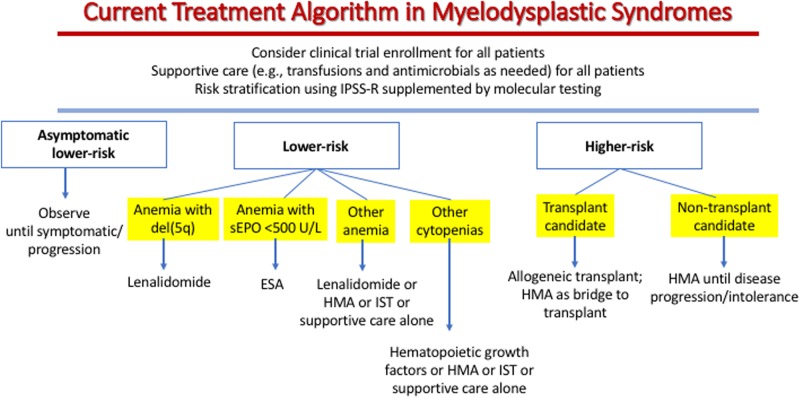
Myelodysplastic syndromes (MDS) include a group of clonal myeloid neoplasms characterized by cytopenias due to ineffective hematopoiesis, abnormal blood and marrow cell morphology, and a risk of clonal evolution and progression to acute myeloid leukemia (AML). Because outcomes for patients with MDS are heterogeneous, individual risk stratification using tools such as the revised International Prognostic Scoring System (IPSS-R) is important in managing patients-including selecting candidates for allogeneic hematopoietic stem cell transplantation (ASCT), the only potentially curative therapy for MDS. The IPSS-R can be supplemented by molecular genetic testing, since certain gene mutations such as TP53 influence risk independent of established clinicopathological variables. For lower risk patients with symptomatic anemia, treatment with erythropoiesis-stimulating agents (ESAs) or lenalidomide (especially for those with deletion of chromosome 5q) can ameliorate symptoms. Some lower risk patients may be candidates for immunosuppressive therapy, thrombopoiesis-stimulating agents, or a DNA hypomethylating agent (HMA; azacitidine or decitabine). Among higher risk patients, transplant candidates should undergo ASCT as soon as possible, with HMAs useful as a bridge to transplant. Non-transplant candidates should initiate HMA therapy and continue if tolerated until disease progression. Supportive care with transfusions and antimicrobial drugs as needed remains important in all groups.
骨髓增生异常综合征(MDS)包括一组克隆性髓系肿瘤,其特征为无效造血导致血细胞减少、血和骨髓细胞形态异常,以及向急性髓系白血病(AML)克隆演变和进展的风险。由于 MDS 患者的结局存在异质性,因此使用修订的国际预后评分系统(IPSS-R)等工具进行个体风险分层对于患者管理非常重要,包括选择异基因造血干细胞移植(ASCT)的候选者,这是 MDS 唯一潜在的治愈性治疗方法。IPSS-R 可以通过分子遗传学检测来补充,因为某些基因突变,如 TP53,独立于既定的临床病理变量影响风险。对于有症状性贫血的低危患者,使用促红细胞生成素刺激剂(ESA)或来那度胺(特别是对于染色体 5q 缺失的患者)可以改善症状。一些低危患者可能是免疫抑制治疗、血小板生成素刺激剂或 DNA 低甲基化剂(HMA;阿扎胞苷或地西他滨)的候选者。在高危患者中,移植候选者应尽快进行 ASCT,HMA 可作为移植的桥梁。非移植候选者应开始 HMA 治疗,如果耐受则继续治疗,直到疾病进展。在所有患者中,输血和抗菌药物等支持性治疗仍然很重要。