Zhao Wenshu, Zeng Xiangzong, Pan Danqi, Xuan Li, Fan Zhiping, Huang Fen, Xu Na, Sun Jing, Liu Qifa, Dai Min
Department of Hematology, Nanfang Hospital, Southern Medical University, Guangzhou, China.
Department of Hematology, The Affiliated Qingyuan Hospital (Qingyuan People's Hospital), Guangzhou Medical University, Guangzhou, China.
Ther Adv Hematol. 2024 Nov 21;15:20406207241292451. doi: 10.1177/20406207241292451. eCollection 2024.
Iron overload is considered an unfavorable prognosis in myelodysplastic syndrome (MDS) even in those undergoing allogeneic hematopoietic stem cell transplantation (allo-HSCT). Although iron chelation therapy has improved the prognosis of these patients to some extent, the effect has not yet been satisfactory.
This study aimed to investigate the impact of granulocyte colony-stimulating factor and decitabine (G-DAC)-containing conditioning in iron-overloaded MDS patients undergoing allo-HSCT.
This was a retrospective study.
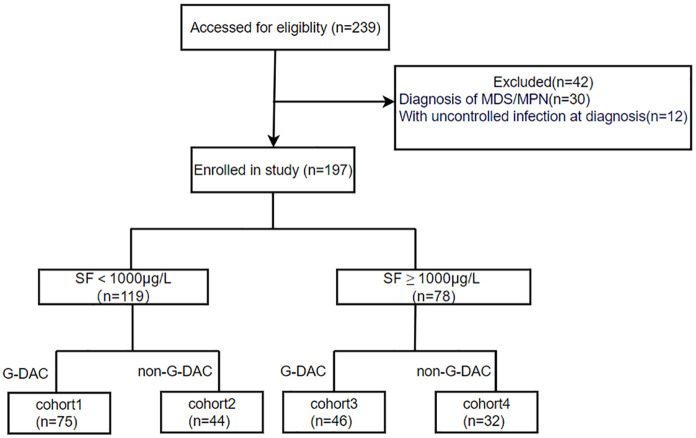
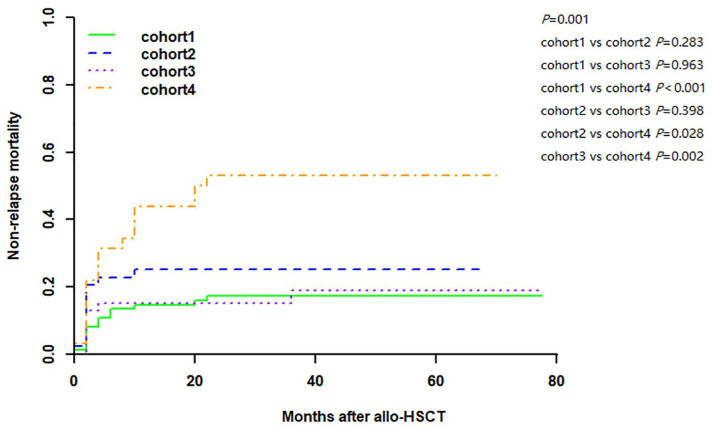
One hundred and ninety-seven patients were enrolled in this retrospective study. Based on the level of serum ferritin (SF) and conditioning regimen, all patients enrolled were divided into four groups: SF < 1000 µg/L with G-DAC conditioning (cohort 1), SF < 1000 µg/L with non-G-DAC conditioning (cohort 2), SF ⩾ 1000 µg/L with G-DAC conditioning (cohort 3), and SF ⩾ 1000 µg/L with non-G-DAC conditioning (cohort 4). The clinical features and prognosis of the four groups were analyzed.
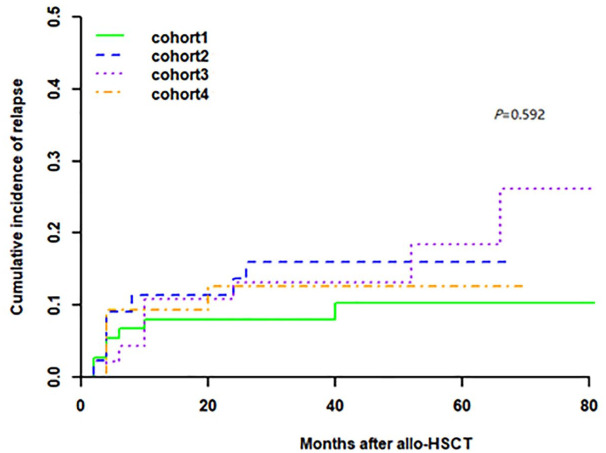
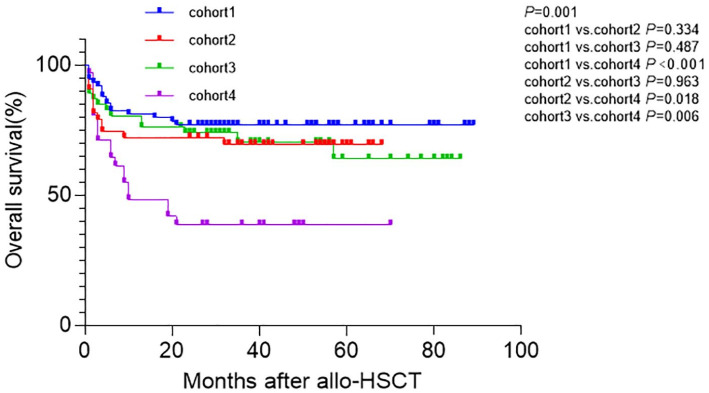
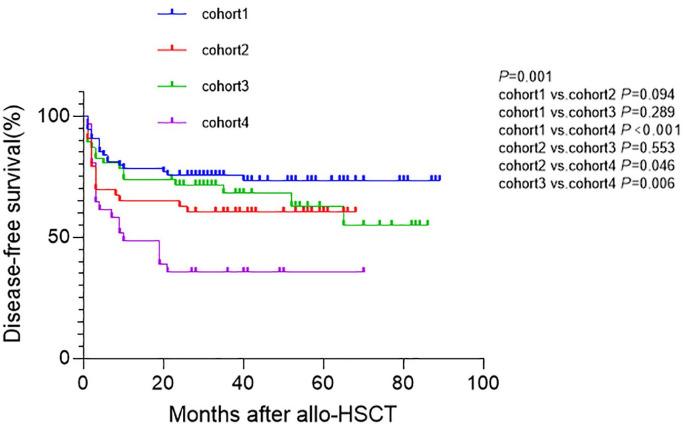
Significant differences in the 2-year overall survival (OS), disease-free survival (DFS), and the cumulative incidence of non-relapse mortality (NRM) were observed between the four groups. Multivariate analysis revealed that SF ⩾ 1000 µg/L was a risk factor for OS, DFS, and NRM while G-DAC-containing conditioning was a protective factor. Intriguingly, when cohort 1 to cohort 4 were included in the multivariate analysis, only cohort 4 was a risk factor for OS, DFS, and NRM, cohort 3 had no difference in prognosis compared with patients with SF < 1000 µg/L.
The poor prognosis of patients with iron overload may be overcome by G-DAC-containing conditioning partly.
铁过载被认为是骨髓增生异常综合征(MDS)患者不良预后的因素,即使是接受异基因造血干细胞移植(allo-HSCT)的患者也是如此。尽管铁螯合疗法在一定程度上改善了这些患者的预后,但效果仍不尽人意。
本研究旨在探讨含粒细胞集落刺激因子和地西他滨(G-DAC)的预处理方案对接受allo-HSCT的铁过载MDS患者的影响。
这是一项回顾性研究。
197例患者纳入本回顾性研究。根据血清铁蛋白(SF)水平和预处理方案,将所有纳入患者分为四组:SF<1000μg/L且采用G-DAC预处理(队列1)、SF<1000μg/L且采用非G-DAC预处理(队列2)、SF≥1000μg/L且采用G-DAC预处理(队列3)、SF≥1000μg/L且采用非G-DAC预处理(队列4)。分析四组患者的临床特征和预后。
四组患者的2年总生存(OS)、无病生存(DFS)和非复发死亡率(NRM)累积发生率存在显著差异。多因素分析显示,SF≥1000μg/L是OS、DFS和NRM的危险因素,而含G-DAC的预处理是保护因素。有趣的是,当将队列1至队列4纳入多因素分析时,只有队列4是OS、DFS和NRM的危险因素,队列3与SF<1000μg/L的患者相比预后无差异。
含G-DAC的预处理方案可部分克服铁过载患者的不良预后。