Department of Chemical and Biological Engineering and Center for Biomedical Engineering, University of New Mexico, Albuquerque, NM, 87131, USA.
Advanced Materials Lab, Sandia National Laboratories, Albuquerque, NM, 87106, USA.
Sci Rep. 2018 May 24;8(1):7538. doi: 10.1038/s41598-018-25878-8.
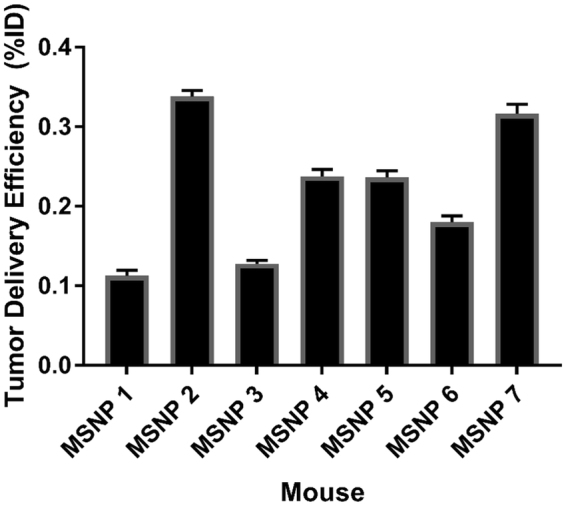
Nanoparticles have shown great promise in improving cancer treatment efficacy while reducing toxicity and treatment side effects. Predicting the treatment outcome for nanoparticle systems by measuring nanoparticle biodistribution has been challenging due to the commonly unmatched, heterogeneous distribution of nanoparticles relative to free drug distribution. We here present a proof-of-concept study that uses mathematical modeling together with experimentation to address this challenge. Individual mice with 4T1 breast cancer were treated with either nanoparticle-delivered or free doxorubicin, with results demonstrating improved cancer kill efficacy of doxorubicin loaded nanoparticles in comparison to free doxorubicin. We then developed a mathematical theory to render model predictions from measured nanoparticle biodistribution, as determined using graphite furnace atomic absorption. Model analysis finds that treatment efficacy increased exponentially with increased nanoparticle accumulation within the tumor, emphasizing the significance of developing new ways to optimize the delivery efficiency of nanoparticles to the tumor microenvironment.
纳米颗粒在提高癌症治疗效果的同时降低毒性和治疗副作用方面显示出巨大的潜力。由于纳米颗粒相对于游离药物的分布通常不匹配、不均匀,因此通过测量纳米颗粒的生物分布来预测纳米颗粒系统的治疗效果一直具有挑战性。我们在这里提出了一项概念验证研究,该研究使用数学建模和实验来解决这一挑战。将载有或未载有阿霉素的纳米颗粒分别用于患有 4T1 乳腺癌的个体小鼠,结果表明,与游离阿霉素相比,负载阿霉素的纳米颗粒可提高阿霉素的抗癌疗效。然后,我们开发了一种数学理论,用于根据使用石墨炉原子吸收法测定的测量的纳米颗粒生物分布来呈现模型预测。模型分析发现,随着肿瘤内纳米颗粒积累的增加,治疗效果呈指数级增长,这强调了开发新方法来优化纳米颗粒向肿瘤微环境的输送效率的重要性。