Curtis Louis T, Wu Min, Lowengrub John, Decuzzi Paolo, Frieboes Hermann B
Department of Bioengineering, University of Louisville, Louisville, Kentucky, United States of America.
Department of Engineering Sciences and Applied Mathematics, Northwestern University, Chicago, Illinois, United States of America.
PLoS One. 2015 Dec 14;10(12):e0144888. doi: 10.1371/journal.pone.0144888. eCollection 2015.
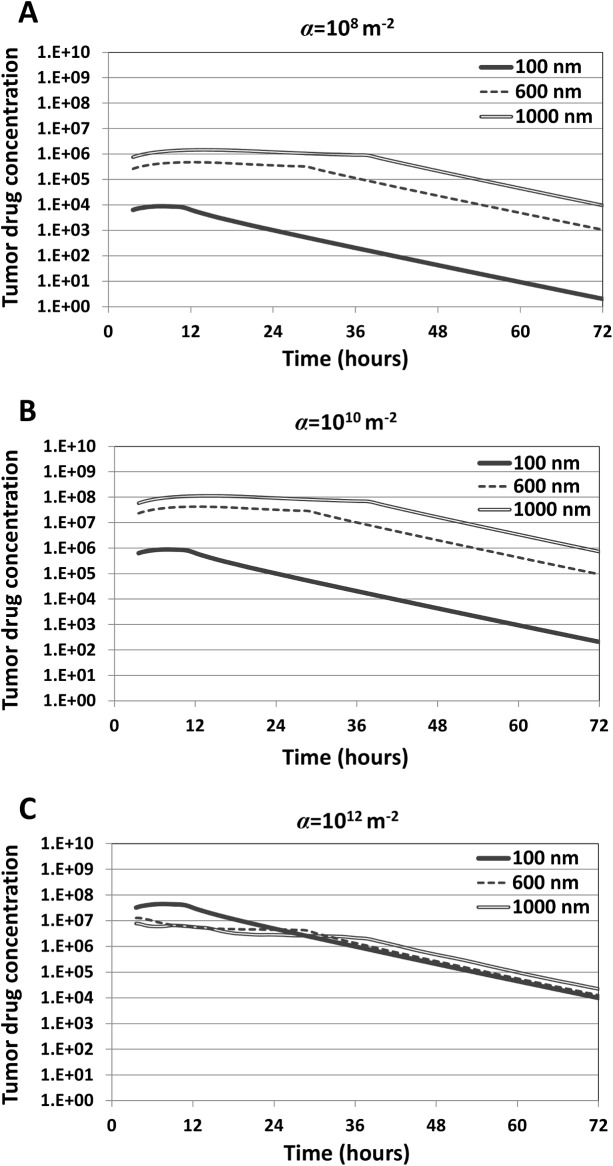
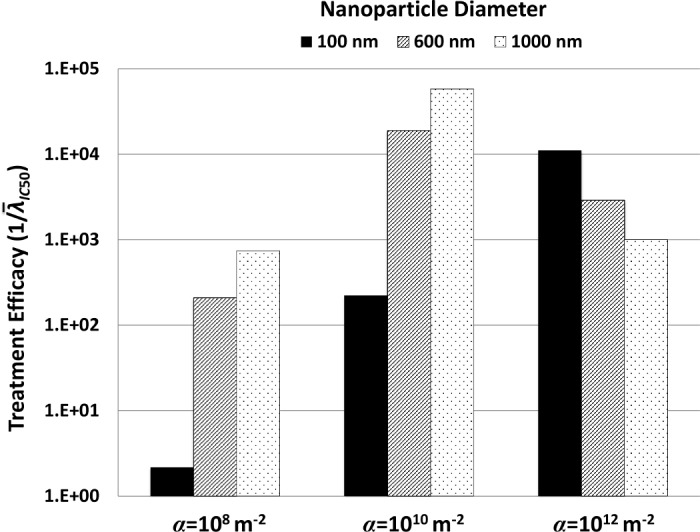
Systemically injected nanoparticle (NPs) targeting tumor vasculature offer a venue for anti-angiogenic therapies as well as cancer detection and imaging. Clinical application has been limited, however, due to the challenge of elucidating the complex interplay of nanotechnology, drug, and tumor parameters. A critical factor representing the likelihood of endothelial adhesion is the NP vascular affinity, a function of vascular receptor expression and NP size and surface-bound ligand density. We propose a theoretical framework to simulate the tumor response to vasculature-bound drug-loaded NPs and examine the interplay between NP distribution and accumulation as a function of NP vascular affinity, size, and drug loading and release characteristics. The results show that uniform spatial distribution coupled with high vascular affinity is achievable for smaller NPs but not for larger sizes. Consequently, small (100 nm) NPs with high vascular affinity are predicted to be more effective than larger (1000 nm) NPs with similar affinity, even though small NPs have lower drug loading and local drug release compared to the larger NPs. Medium vascular affinity coupled with medium or larger sized NPs is also effective due to a more uniform distribution with higher drug loading and release. Low vascular affinity hampered treatment efficacy regardless of NP size, with larger NPs additionally impeded by heterogeneous distribution and drug release. The results further show that increased drug diffusivity mainly benefits heterogeneously distributed NPs, and would negatively affect efficacy otherwise due to increased wash-out. This model system enables evaluation of efficacy for vascular-targeted drug-loaded NPs as a function of critical NP, drug, and tumor parameters.
系统注射靶向肿瘤血管的纳米颗粒(NPs)为抗血管生成治疗以及癌症检测和成像提供了途径。然而,由于难以阐明纳米技术、药物和肿瘤参数之间复杂的相互作用,其临床应用受到了限制。代表内皮细胞黏附可能性的一个关键因素是NP血管亲和力,它是血管受体表达、NP大小和表面结合配体密度的函数。我们提出了一个理论框架,以模拟肿瘤对血管结合的载药纳米颗粒的反应,并研究NP分布和积累之间的相互作用,作为NP血管亲和力、大小以及药物负载和释放特性的函数。结果表明,对于较小的NP可以实现均匀的空间分布和高血管亲和力,但较大尺寸的NP则不行。因此,预测具有高血管亲和力的小(100 nm)NP比具有相似亲和力的大(1000 nm)NP更有效,尽管与大NP相比,小NP的药物负载量和局部药物释放较低。中等血管亲和力与中等或更大尺寸的NP相结合也有效,因为其分布更均匀,药物负载和释放更高。无论NP大小如何,低血管亲和力都会阻碍治疗效果,大NP还会因分布不均和药物释放而受到额外阻碍。结果还表明,增加药物扩散率主要有利于分布不均的NP,否则会因洗脱增加而对疗效产生负面影响。该模型系统能够评估血管靶向载药NP的疗效,作为关键NP、药物和肿瘤参数的函数。