Imataki Osamu, Uemura Makiko
Division of Hematology, Department of Internal Medicine, Faculty of Medicine, Kagawa University, 1750-1 Ikenobe, Miki-town, Kita-county, Kagawa, 761-0793 Japan.
BMC Clin Pathol. 2018 May 22;18:5. doi: 10.1186/s12907-018-0072-5. eCollection 2018.
Chronic lymphocytic leukemia (CLL) is a mature lymphoid neoplasm currently categorized as an indolent type of malignant lymphoma. CLL progresses slowly over years, but it eventually transforms to a more aggressive lymphoma such as the diffuse large B-cell (DLBCL) type, also known as Richter's syndrome.
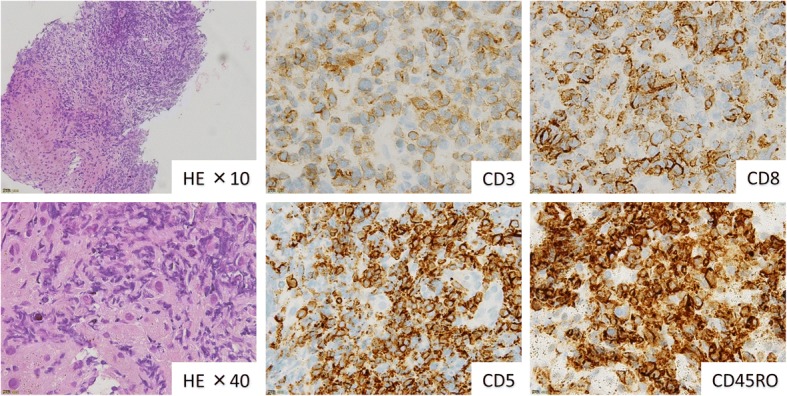
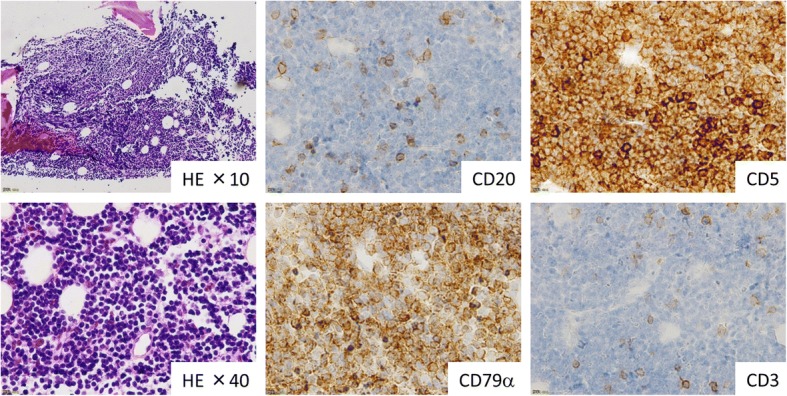
We treated a 69-year-old Japanese male who was histologically diagnosed with Richter's syndrome after 6 years of CLL. His lymphadenopathy had systemically progressed for years, with lymphocyte counts of less than 10,000 cells/μL and a disease status of Rai classification stage I and Binet classification B. He had high fever and hepatosplenomegaly upon Richter's transformation. The patient was treated with ofatumumab for refractory CLL, which relieved his febrile lymphadenopathy. He received a total of 11 ofatumumab courses and achieved partial remission. On the day of the 12th course of ofatumumab, his disease relapsed with febrile lymphadenopathy. Computed tomography revealed multiple liver masses and systemic lymphadenopathy, while a liver biopsy confirmed T-cell lymphoma. Concomitantly, CD20-lacking CLL cells were detected in his peripheral blood and bone marrow, and pathological examination of his left cervical lymph node biopsy showed CD20-positive DLBCL. The final diagnosis was three different types of lymphoma pathologies: (1) CD20-positive DLBCL of the lymph nodes, (2) CD20-lacking CLL of the peripheral blood and bone marrow, and (3) peripheral T-cell lymphoma (PTCL) of the liver. He received intravenous and oral dexamethasone therapy as palliative care. He died because of the rapid progression of abdominal masses 2 months after the diagnosis of triple transformation CLL. An autopsy revealed aggressive PTCL with aggressive systemic involvement of the liver, spleen, gall bladder, pericardium, bone marrow, and mediastinal-paraaortic-intraceliac lymph nodes. T-cell receptor study of an autopsy specimen supported the diagnosis of PTCL that spread to the intraceliac organs and lymph nodes. We concluded that his pathogenicity progressed to a mixture of triple lymphoma as a result of double malignant transformations, which included PTCL from CLL, CD20-negative CLL, and CD20-positive DLBCL by Richter's transformation.
Our case provides information on the biology of CLL, to transform from a low-grade chemosensitive status to a malignant chemoresistant status.
慢性淋巴细胞白血病(CLL)是一种成熟淋巴细胞肿瘤,目前归类为惰性恶性淋巴瘤。CLL多年来进展缓慢,但最终会转变为侵袭性更强的淋巴瘤,如弥漫性大B细胞(DLBCL)型,即里氏综合征。
我们治疗了一名69岁的日本男性,他在患CLL 6年后经组织学诊断为里氏综合征。他的淋巴结病全身性进展多年,淋巴细胞计数低于10,000个细胞/μL,疾病状态为Rai分期I期和Binet分期B期。里氏转化时他出现高热和肝脾肿大。该患者接受奥法木单抗治疗难治性CLL,其发热性淋巴结病得到缓解。他总共接受了11个疗程的奥法木单抗治疗并实现部分缓解。在第12个奥法木单抗疗程当天,他的疾病因发热性淋巴结病复发。计算机断层扫描显示肝脏有多个肿块和全身性淋巴结病,而肝脏活检证实为T细胞淋巴瘤。同时,在他的外周血和骨髓中检测到缺乏CD20的CLL细胞,左侧颈部淋巴结活检的病理检查显示为CD20阳性的DLBCL。最终诊断为三种不同类型的淋巴瘤病理:(1)淋巴结的CD20阳性DLBCL,(2)外周血和骨髓的缺乏CD20的CLL,(3)肝脏的外周T细胞淋巴瘤(PTCL)。他接受了静脉和口服地塞米松治疗作为姑息治疗。他在诊断为三重转化CLL后2个月因腹部肿块迅速进展而死亡。尸检显示侵袭性PTCL伴肝脏、脾脏、胆囊、心包膜、骨髓以及纵隔 - 腹主动脉旁 - 腹腔内淋巴结的侵袭性全身性受累。对尸检标本的T细胞受体研究支持了PTCL扩散至腹腔内器官和淋巴结的诊断。我们得出结论,由于双重恶性转化,他的致病性进展为三重淋巴瘤的混合,包括由CLL转化而来的PTCL、CD20阴性CLL以及通过里氏转化形成的CD20阳性DLBCL。
我们的病例提供了关于CLL生物学特性的信息,即从低度化疗敏感状态转变为恶性化疗耐药状态。