Boujaoude Marie-Anne, Mirelman Andrew J, Dalziel Kim, Carvalho Natalie
1Faculty of Economics, University of Bologna, Bologna, Italy.
2Centre for Health Economics, University of York, York, UK.
Cost Eff Resour Alloc. 2018 May 18;16:18. doi: 10.1186/s12962-018-0102-2. eCollection 2018.
Cost-effectiveness analysis (CEA) is frequently used as an input for guiding priority setting in health. However, CEA seldom incorporates information about trade-offs between total health gains and equity impacts of interventions. This study investigates to what extent equity considerations have been taken into account in CEA in low- and middle-income countries (LMICs), using rotavirus vaccination as a case study.
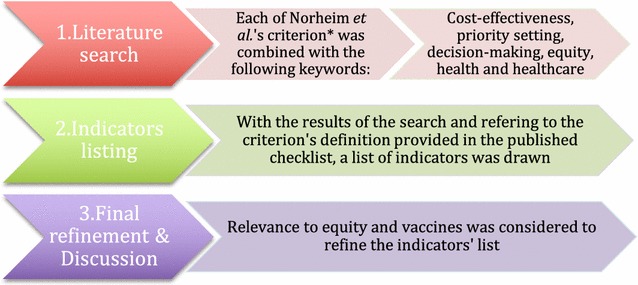
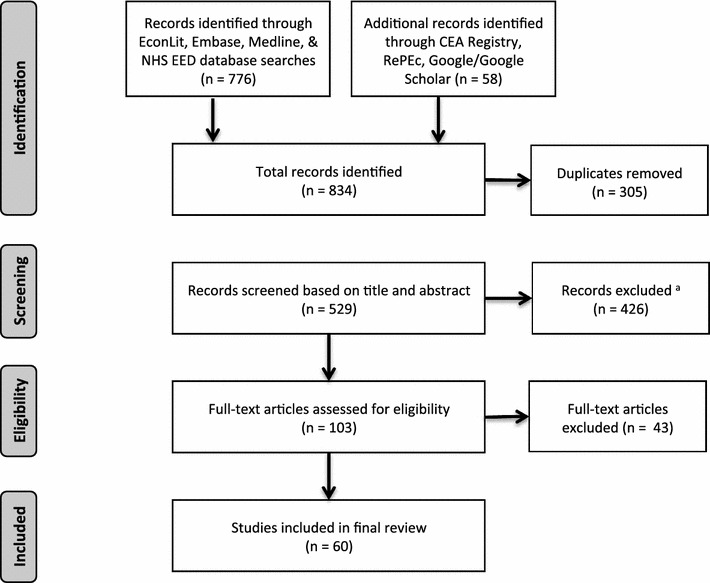
Specific equity-related indicators for vaccination were first mapped to the Guidance on Priority Setting in Health Care (GPS-Health) checklist criteria. Economic evaluations of rotavirus vaccine in LMICs identified via a systematic review of the literature were assessed to explore the extent to which equity was considered in the research objectives and analysis, and whether it was reflected in the evaluation results.
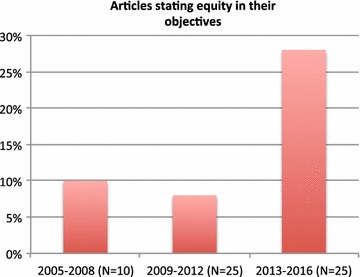
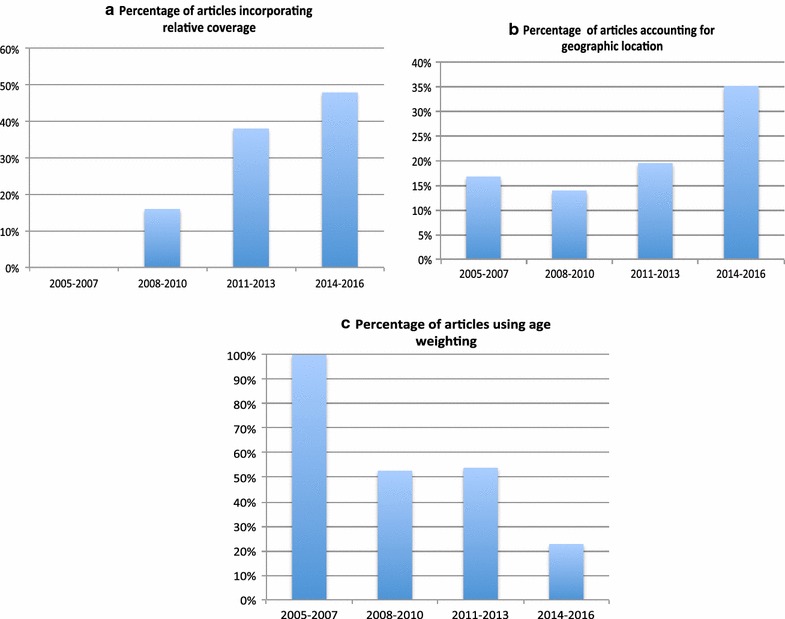
The mapping process resulted in 18 unique indicators. Under the 'disease and intervention' criteria, severity of illness was incorporated in 75% of the articles, age distribution of the disease in 70%, and presence of comorbidities in 5%. For the 'social groups' criteria, relative coverage reflecting wealth-based coverage inequality was taken into account in 30% of the articles, geographic location in 27%, household income level in 8%, and sex at birth in 5%. For the criteria of 'protection against the financial and social effects of ill health', age weighting was incorporated in 43% of the articles, societal perspective in 58%, caregiver's loss of productivity in 45%, and financial risk protection in 5%. Overall, some articles incorporated the indicators in their model inputs (20%) while the majority (80%) presented results (costs, health outcomes, or incremental cost-effectiveness ratios) differentiated according to the indicators. Critically, less than a fifth (17%) of articles incorporating indicators did so due to an explicit study objective related to capturing equity considerations. Most indicators were increasingly incorporated over time, with a notable exception of age-weighting of DALYs.
Integrating equity criteria in CEA can help policy-makers better understand the distributional impact of health interventions. This study illustrates how equity considerations are currently being incorporated within CEA of rotavirus vaccination and highlights the components of equity that have been used in studies in LMICs. Areas for further improvement are identified.
成本效益分析(CEA)经常被用作指导卫生领域资源优先配置的一项依据。然而,CEA很少纳入关于干预措施在总体健康收益与公平影响之间权衡的信息。本研究以轮状病毒疫苗接种为例,调查了低收入和中等收入国家(LMICs)的CEA在多大程度上考虑了公平因素。
首先将与疫苗接种相关的特定公平指标映射到《卫生保健优先事项设定指南》(GPS-Health)清单标准。通过对文献的系统综述确定了LMICs中轮状病毒疫苗的经济评估,以探讨在研究目标和分析中考虑公平的程度,以及公平是否反映在评估结果中。
映射过程产生了18个独特的指标。在“疾病与干预”标准下,75%的文章纳入了疾病严重程度,70%纳入了疾病的年龄分布,5%纳入了合并症的存在情况。对于“社会群体”标准,30%的文章考虑了反映基于财富的覆盖不平等的相对覆盖率,27%考虑了地理位置,8%考虑了家庭收入水平,5%考虑了出生性别。对于“防范健康不良的经济和社会影响”标准,43%的文章纳入了年龄加权,58%纳入了社会视角,45%纳入了照顾者的生产力损失,5%纳入了经济风险保护。总体而言,一些文章在其模型输入中纳入了这些指标(20%),而大多数(80%)呈现的结果(成本、健康结果或增量成本效益比)根据这些指标进行了区分。至关重要的是,纳入指标的文章中不到五分之一(17%)这样做是由于与考虑公平因素相关的明确研究目标。随着时间的推移,大多数指标越来越多地被纳入,DALYs的年龄加权是一个明显的例外。
在CEA中纳入公平标准有助于政策制定者更好地理解卫生干预措施的分配影响。本研究说明了目前在轮状病毒疫苗接种的CEA中如何考虑公平因素,并突出了LMICs研究中使用的公平组成部分。确定了需要进一步改进的领域。