Public Health Informatics, Computational, and Operations Research (PHICOR), City University of New York (CUNY) Graduate School of Public Health and Health Policy, New York City, NY, United States.
Global Immunization Division, Centers for Disease Control and Prevention (CDC), Atlanta, GA, United States.
Vaccine. 2021 Nov 5;39(46):6796-6804. doi: 10.1016/j.vaccine.2021.05.033. Epub 2021 May 25.
Understanding the economics of vaccination is essential to developing immunization strategies that can be employed successfully with limited resources, especially when vaccinating populations that are hard-to-reach.
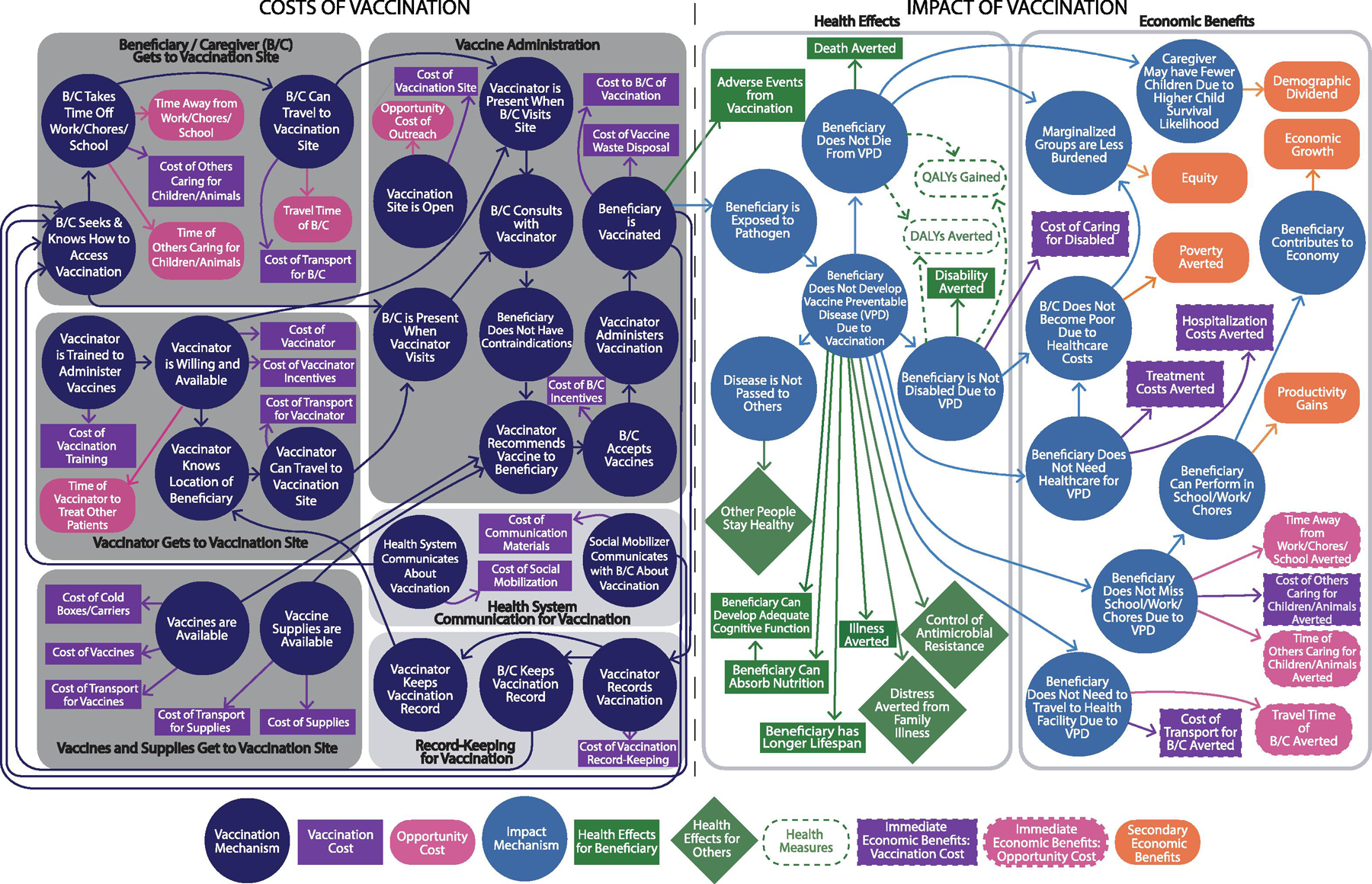
Based on the input from interviews with 24 global experts on immunization economics, we developed a systems map of the mechanisms (i.e., necessary steps or components) involved in vaccination, and associated costs and benefits, focused at the service delivery level. We used this to identify the mechanisms that may be different for hard-to-reach populations.
The systems map shows different mechanisms that determine whether a person may or may not get vaccinated and the potential health and economic impacts of doing so. The map is divided into two parts: 1) the costs of vaccination, representing each of the mechanisms involved in getting vaccinated (n = 23 vaccination mechanisms), their associated direct vaccination costs (n = 18 vaccination costs), and opportunity costs (n = 5 opportunity costs), 2) the impact of vaccination, representing mechanisms after vaccine delivery (n = 13 impact mechanisms), their associated health effects (n = 10 health effects for beneficiary and others), and economic benefits (n = 13 immediate and secondary economic benefits and costs). Mechanisms that, when interrupted or delayed, can result in populations becoming hard-to-reach include getting vaccines and key stakeholders (e.g., beneficiaries/caregivers, vaccinators) to a vaccination site, as well as vaccine administration at the site.
Decision-makers can use this systems map to understand where steps in the vaccination process may be interrupted or weak and identify where gaps exist in the understanding of the economics of vaccination. With improved understanding of system-wide effects, this map can help decision-makers inform targeted interventions and policies to increase vaccination coverage in hard-to-reach populations.
了解疫苗接种的经济学对于制定能够在有限资源下成功实施的免疫策略至关重要,尤其是在为难以接触到的人群接种疫苗时。
根据对 24 名全球免疫经济学专家的访谈内容,我们制定了一个疫苗接种机制系统图,包括与服务提供层面相关的机制(即必要步骤或组成部分)及其相关成本和收益。我们利用这一系统图来确定针对难以接触到的人群的不同机制。
系统图展示了决定一个人是否接种疫苗以及接种疫苗的潜在健康和经济效益的不同机制。该图分为两部分:1)疫苗接种成本,代表了接种疫苗所涉及的各个机制(共 23 个疫苗接种机制)、其相关的直接疫苗接种成本(共 18 个疫苗接种成本)和机会成本(共 5 个机会成本);2)疫苗接种的影响,代表疫苗接种后发生的机制(共 13 个影响机制)、其相关的健康效果(共 10 个受益人和其他人的健康效果)和经济效益(共 13 个直接和二次经济效益和成本)。当疫苗接种和关键利益相关者(如受益人/照顾者、接种者)到达接种地点以及在接种点进行疫苗接种等机制受到干扰或延迟时,可能导致人群变得难以接触。
决策者可以使用这个系统图来了解疫苗接种过程中的哪些步骤可能会中断或薄弱,并确定在疫苗接种经济学理解方面存在哪些差距。通过对系统整体效果的更好理解,该图可以帮助决策者为难以接触到的人群提供有针对性的干预措施和政策,以提高疫苗接种覆盖率。