Thornton Stephen L, Oller Lisa, Coons Doyle M
University of Kansas Health System Poison Control Center, Kansas City, KS.
Kans J Med. 2018 May 18;11(2):1-23. eCollection 2018 May.
This is the 2016 Annual Report of the University of Kansas Health System Poison Control Center (PCC). The PCC is one of 55 certified poison control centers in the United States and serves the state of Kansas 24-hours a day, 365 days a year, with certified specialists in poison information and medical toxicologists. The PCC receives calls from the public, law enforcement, health care professionals, and public health agencies. All calls to the PCC are recorded electronically in the Toxicall® data management system and uploaded in near real-time to the National Poison Data System (NPDS), which is the data repository for all poison control centers in the United States.
All encounters reported to the PCC from January 1, 2016 to December 31, 2016 were analyzed. Data recorded for each exposure includes caller location, age, weight, gender, substance exposed to, nature of exposure, route of exposure, interventions, medical outcome, disposition and location of care. Encounters were classified further as human exposure, animal exposure, confirmed non-exposure, or information call (no exposure reported).
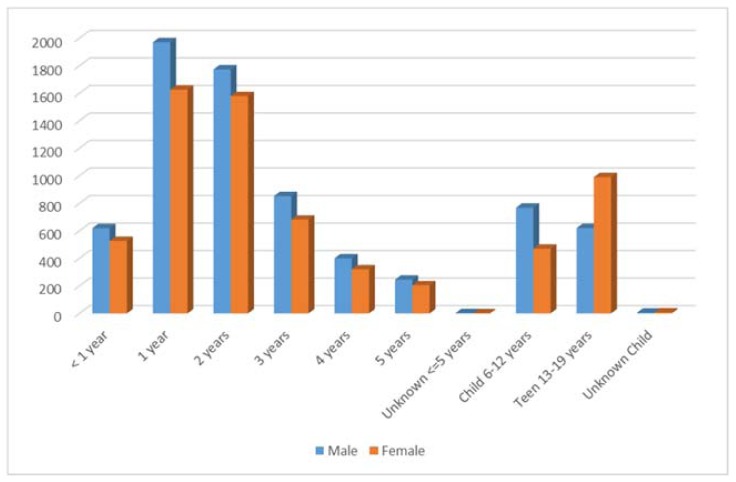
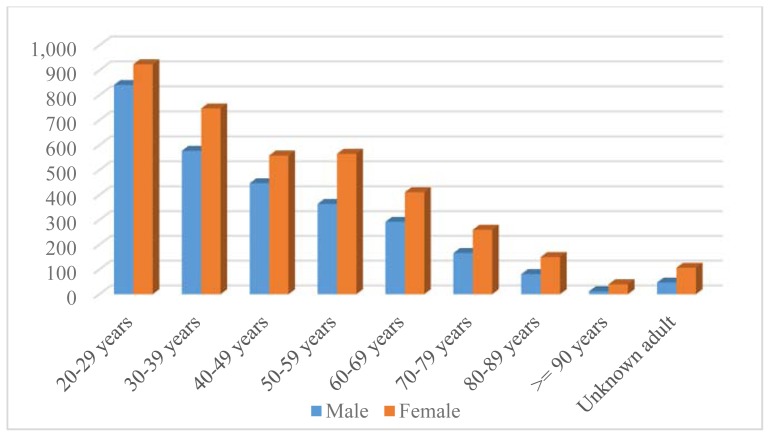
The PCC logged 21,965 total encounters in 2016, including 20,713 human exposure cases. The PCC received calls from every county in Kansas. The majority of human exposure cases (50.4%, n = 10,174) were female. Approximately 67% (n = 13,903) of human exposures involved a child (defined as age 19 years or less). Most encounters occurred at a residence (94.0%, n = 19,476) and most calls (72.3%, n = 14,964) originated from a residence. The majority of human exposures (n = 18,233) were acute cases (exposures occurring over eight hours or less). Ingestion was the most common route of exposure documented (86.3%, n = 17,882). The most common reported substance in pediatric encounters was cosmetics/personal care products (n = 1,362), followed by household cleaning product (n = 1,301). For adult encounters, sedatives/hypnotics/antipsychotics (n = 1,130) and analgesics (n = 1,103) were the most frequently involved substances. Unintentional exposures were the most common reason for exposures (81.3%, n = 16,836). Most encounters (71.1%, n = 14,732) were managed in a non-healthcare facility (i.e., a residence). Among human exposures, 14,679 involved exposures to pharmaceutical agents while 10,176 involved exposure to non-pharmaceuticals. Medical outcomes were 32% (n = 6,582) no effect, 19% (n = 3,911) minor effect, 8% (n = 1,623) moderate effect, and 2% (n = 348) major effects. There were 15 deaths in 2016 reported to the PCC. Number of exposures, calls from healthcare facilities, cases with moderate or major medical outcomes, and deaths all increased in 2016 compared to 2015.
The results of the 2016 University of Kansas Health System Poison Control annual report demonstrates that the center receives calls from the entire state of Kansas totaling over 20,000 human exposures per year. While pediatric exposures remain the most common, there is an increasing number of calls from healthcare facilities and for cases with serious outcomes. The experience of the PCC is similar to national data. This report supports the continued value of the PCC to both public and acute health care in the state of Kansas.
这是堪萨斯大学健康系统中毒控制中心(PCC)2016年年度报告。该中毒控制中心是美国55个获得认证的中毒控制中心之一,一年365天、一天24小时为堪萨斯州服务,配备有中毒信息认证专家和医学毒理学家。中毒控制中心接听来自公众、执法部门、医疗保健专业人员和公共卫生机构的电话。所有打到中毒控制中心的电话都通过电子方式记录在Toxicall®数据管理系统中,并几乎实时上传到国家中毒数据系统(NPDS),该系统是美国所有中毒控制中心的数据存储库。
对2016年1月1日至2016年12月31日报告给中毒控制中心的所有接触情况进行分析。为每次接触记录的数据包括来电者位置、年龄、体重、性别、接触的物质、接触性质、接触途径、干预措施、医疗结果、处置方式和护理地点。接触情况进一步分为人类接触、动物接触、确认未接触或信息咨询电话(未报告接触情况)。
2016年中毒控制中心共记录了21965次接触情况,其中包括20713例人类接触病例。中毒控制中心接到了堪萨斯州每个县的电话。大多数人类接触病例(50.4%,n = 10174)为女性。约67%(n = 13903)的人类接触涉及儿童(定义为19岁及以下)。大多数接触情况发生在住所(94.0%,n = 19476),大多数电话(72.3%,n = 14964)来自住所。大多数人类接触(n = 18233)为急性病例(接触发生在八小时或更短时间内)。摄入是记录在案的最常见接触途径(86.3%,n = 17882)。儿科接触中报告最常见的物质是化妆品/个人护理产品(n = 1362),其次是家用清洁产品(n = 1301)。对于成人接触,镇静剂/催眠药/抗精神病药(n = 1130)和镇痛药(n = 1103)是最常涉及的物质。无意接触是接触最常见原因(81.3%,n = 16836)。大多数接触情况(71.1% = 14732)在非医疗机构(即住所)进行处理。在人类接触中,14679例涉及接触药剂,10176例涉及接触非药剂。医疗结果为32%(n = 6582)无影响,19%(n = 3911)有轻微影响,8%(n = 1623)有中度影响,2%(n = 348)有重大影响。2016年向中毒控制中心报告了15例死亡病例。与2015年相比,2016年接触次数、来自医疗机构的电话、有中度或重大医疗结果的病例以及死亡人数均有所增加。
2016年堪萨斯大学健康系统中毒控制年度报告结果表明,该中心接到来自堪萨斯州全州的电话,每年有超过20000例人类接触。虽然儿科接触仍然最为常见,但来自医疗机构的电话以及有严重后果的病例数量在增加。中毒控制中心的情况与全国数据相似。本报告支持中毒控制中心对堪萨斯州公共卫生和急性医疗保健的持续价值。