Mulcahey Mary K, Hayes Meghan K, Smith Christopher M, Kraeutler Matthew J, Trojan Jeffrey D, McCarty Eric C
Department of Orthopaedics, Tulane University School of Medicine, New Orleans, Louisiana, USA.
Drexel University College of Medicine, Philadelphia, Pennsylvania, USA.
Orthop J Sports Med. 2018 May 15;6(5):2325967118771845. doi: 10.1177/2325967118771845. eCollection 2018 May.
Sports medicine is one of the most competitive fellowships in orthopaedic surgery. Despite its popularity, fellowship applicants have limited understanding of the orthopaedic sports medicine fellowship match process.
To define key outcomes in the orthopaedic sports medicine fellowship match, including the overall match rate, number of programs filled, and number of applicants ranked by programs that filled between 2010 and 2017.
Cross-sectional study.
This study utilized data regarding the orthopaedic sports medicine fellowship match collected by the American Orthopaedic Society for Sports Medicine (AOSSM) from 2010 through 2017. Applicant data included number of applicants, number of matched and unmatched applicants, and percentage of applicants matching into their top choices. Fellowship program data included number of programs participating in the match and number of applicants ranked by filled and unfilled programs.
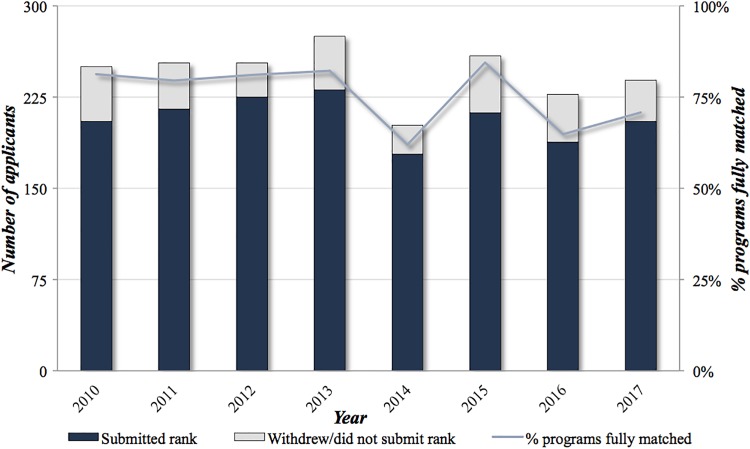
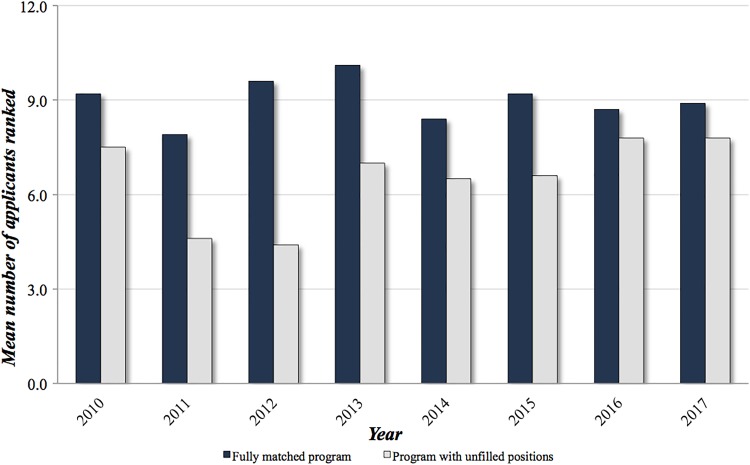
Between 2010 and 2017, the mean number of orthopaedic sports medicine fellowship applicants was 244.8. On average, 92.0% of applicants matched into a fellowship program. The mean number of programs participating in the fellowship match was 92.9, with a mean of 219.9 accredited positions and 5.4 nonaccredited positions. Over the time period studied, a mean of 75.8% of programs matched all available positions. Programs that matched fully ranked 9.0 applicants per position, on average, compared with a mean of 6.5 applicants ranked per position among programs that did not fully match ( = .0016).
From 2010 to 2017, the number of applicants, positions available, overall match rate, and number of programs participating in the orthopaedic sports medicine fellowship match have remained consistent. The mean number of applicants per position ranked by fully matched fellowship programs was 9.0 compared with a mean of 6.5 applicants per position ranked by programs that did not fully match. These data may be helpful as we look to the future of orthopaedic sports medicine fellowship positions and the match process. In addition, this study reveals characteristics that divide sports medicine fellowship programs that fully match from those that do not. Applicants and/or fellowship program directors may utilize this information to modify their approach to the match process going forward.
运动医学是骨科手术中竞争最为激烈的专科之一。尽管其很受欢迎,但专科申请人员对骨科运动医学专科匹配过程的了解有限。
确定骨科运动医学专科匹配中的关键结果,包括总体匹配率、填补的项目数量以及2010年至2017年期间填补项目所排名的申请人数量。
横断面研究。
本研究利用了美国运动医学骨科协会(AOSSM)收集的2010年至2017年期间骨科运动医学专科匹配的数据。申请人数据包括申请人数量、匹配和未匹配的申请人数量以及匹配到其首选项目的申请人百分比。专科项目数据包括参与匹配的项目数量以及已填补和未填补项目所排名的申请人数量。
2010年至2017年期间,骨科运动医学专科申请人的平均数量为244.8人。平均而言,92.0%的申请人匹配到了专科项目。参与专科匹配的项目平均数量为92.9个,平均有219.9个认证职位和5.4个非认证职位。在研究期间,平均75.8%的项目填补了所有可用职位。完全匹配的项目平均每个职位排名9.0名申请人,而未完全匹配的项目平均每个职位排名6.5名申请人(P = 0.0016)。
2010年至2017年期间,骨科运动医学专科匹配中的申请人数量、可用职位数量、总体匹配率以及参与的项目数量保持一致。完全匹配的专科项目每个职位排名的申请人平均数量为9.0名,而未完全匹配的项目每个职位排名的申请人平均数量为6.5名。当我们展望骨科运动医学专科职位和匹配过程的未来时,这些数据可能会有所帮助。此外,本研究揭示了将完全匹配的运动医学专科项目与未完全匹配的项目区分开来的特征。申请人和/或专科项目主任可以利用这些信息来调整他们未来的匹配过程方法。