Walton Courtney C, Mowszowski Loren, Gilat Moran, Hall Julie M, O'Callaghan Claire, Muller Alana J, Georgiades Matthew, Szeto Jennifer Y Y, Ehgoetz Martens Kaylena A, Shine James M, Naismith Sharon L, Lewis Simon J G
1Parkinson's Disease Research Clinic, Brain and Mind Centre, University of Sydney, Camperdown, NSW Australia.
2Healthy Brain Ageing Program, Brain and Mind Centre & Charles Perkins Centre, University of Sydney, Sydney, NSW Australia.
NPJ Parkinsons Dis. 2018 May 18;4:15. doi: 10.1038/s41531-018-0052-6. eCollection 2018.
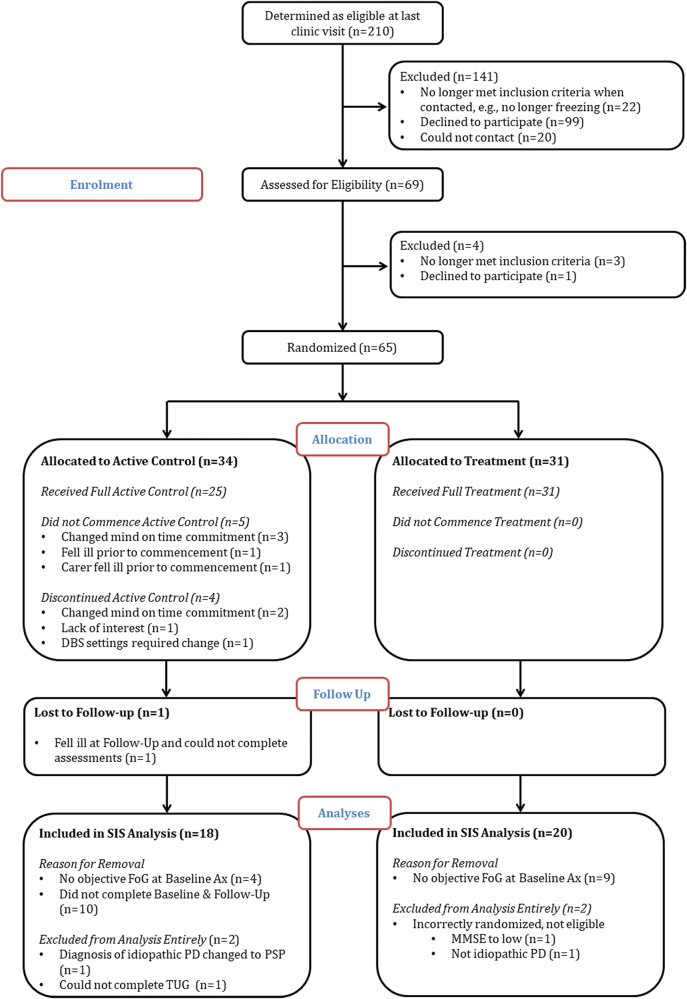
The pathophysiological mechanism of freezing of gait (FoG) has been linked to executive dysfunction. Cognitive training (CT) is a non-pharmacological intervention which has been shown to improve executive functioning in Parkinson's disease (PD). This study aimed to explore whether targeted CT can reduce the severity of FoG in PD. Patients with PD who self-reported FoG and were free from dementia were randomly allocated to receive either a CT intervention or an active control. Both groups were clinician-facilitated and conducted twice-weekly for seven weeks. The primary outcome was percentage of time spent frozen during a Timed Up and Go task, assessed both on and off dopaminergic medications. Secondary outcomes included multiple neuropsychological and psychosocial measures. A full analysis was first conducted on all participants randomized, followed by a sample of interest including only those who had objective FoG at baseline, and completed the intervention. Sixty-five patients were randomized into the study. The sample of interest included 20 in the CT group and 18 in the active control group. The primary outcome of percentage time spent frozen during a gait task was significantly improved in the CT group compared to active controls in the on-state. There were no differences in the off-state. Patients who received CT also demonstrated improved processing speed and reduced daytime sleepiness compared to those in the active control. The findings suggest that CT can reduce the severity of FoG in the on-state, however replication in a larger sample is required.
冻结步态(FoG)的病理生理机制已与执行功能障碍相关联。认知训练(CT)是一种非药物干预措施,已被证明可改善帕金森病(PD)患者的执行功能。本研究旨在探讨针对性的CT是否能降低PD患者FoG的严重程度。自我报告有FoG且无痴呆的PD患者被随机分配接受CT干预或积极对照。两组均由临床医生指导,每周进行两次,共七周。主要结局是在计时起立行走任务中冻结所花费时间的百分比,分别在服用和未服用多巴胺能药物的情况下进行评估。次要结局包括多项神经心理学和社会心理指标。首先对所有随机分组的参与者进行全面分析,然后对一个感兴趣的样本进行分析,该样本仅包括那些在基线时有客观FoG且完成干预的患者。65名患者被随机纳入研究。感兴趣的样本包括CT组的20名患者和积极对照组的18名患者。与积极对照组相比,CT组在服用多巴胺能药物状态下,步态任务中冻结所花费时间百分比这一主要结局有显著改善。在未服用药物状态下没有差异。与积极对照组相比,接受CT的患者还表现出处理速度提高和白天嗜睡减少。研究结果表明,CT可以降低服用多巴胺能药物状态下FoG的严重程度,然而需要在更大样本中进行重复验证。