Anselmo Natassia Alberici, Paskakulis Leticia Colombo, Garcias Renata Correia, Botelho Fernanda Fortuci Resende, Toledo Giovana Queda, Cury Maria Fernanda Ribeiro, Carvalho Natiele Zanardo, Mendes Glória Elisa Florido, Iembo Tatiane, Bizotto Thaís Santana Gastardelo, Cury Patricia Maluf, Chies Agnaldo Bruno, Carlos Carla Patrícia
Faculdade de Medicina de São José do Rio Preto - FACERES, Laboratório de Pesquisa Experimental, São José do Rio Preto, SP, Brasil.
Faculdade de Medicina de Marília, Laboratório de Farmacologia, Marília, SP, Brasil.
J Bras Nefrol. 2018 Jan-Mar;40(1):10-17. doi: 10.1590/1678-46a85-JBN-3819. Epub 2018 Apr 19.
Ischemia-reperfusion (IR) injury results from inflammation and oxidative stress, among other factors. Because of its anti-inflammatory and antioxidant properties, the Brazil nut (BN) might attenuate IR renal injury.
The aim of the present study was to investigate whether the intake of BN prevents or reduces IR kidney injury and inflammation, improving renal function and decreasing oxidative stress.
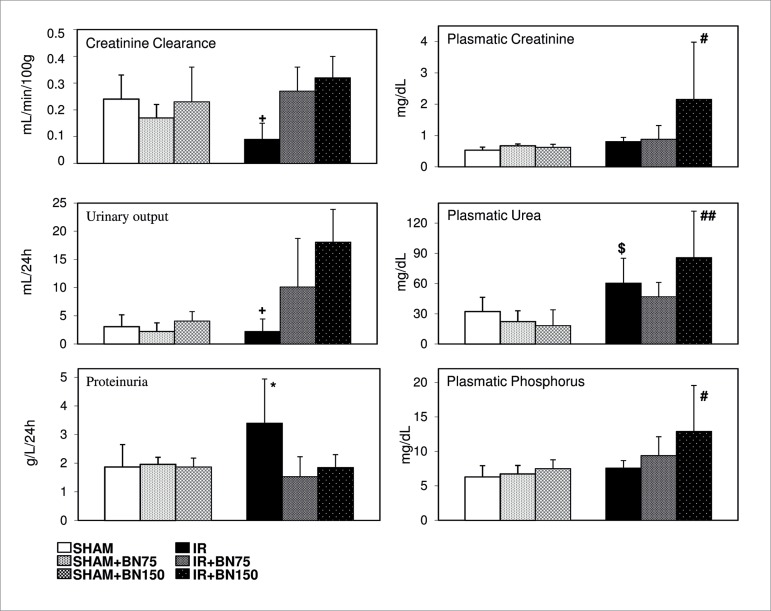
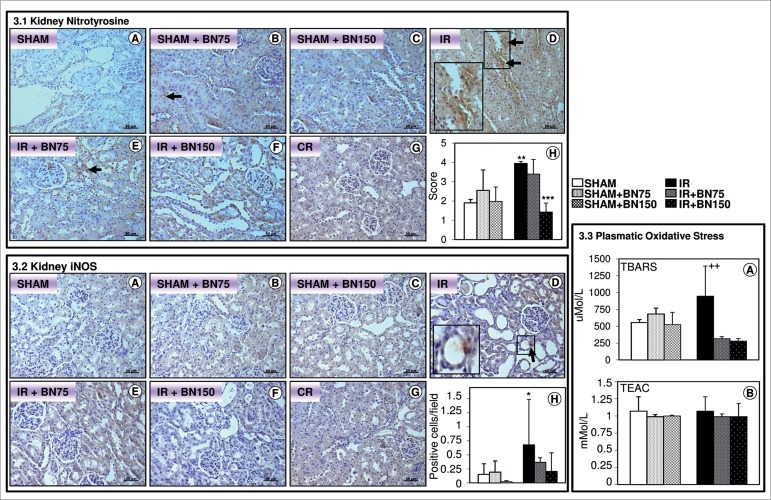
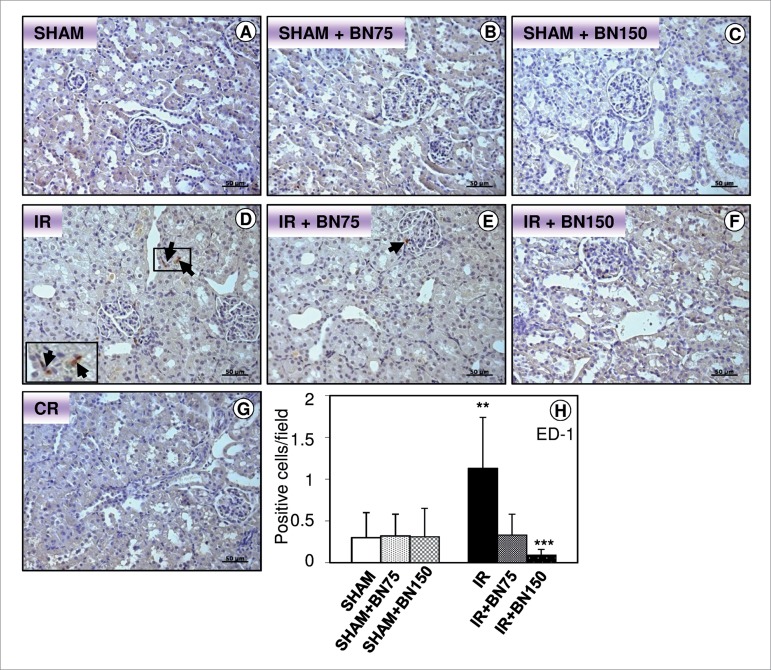
Male Wistar rats were distributed into six groups (N=6/group): SHAM (control), SHAM treated with 75 or 150 mg of BN, IR, and IR treated with 75 or 150 mg of BN. The IR procedure consisted of right nephrectomy and occlusion of the left renal artery with a non-traumatic vascular clamp for 30 min. BN was given daily and individually for 7 days before surgery (SHAM or IR) and maintained until animal sacrifice (48h after surgery). We evaluated the following parameters: plasma creatinine, urea, and phosphorus; proteinuria, urinary output, and creatinine clearance; plasmatic TBARS and TEAC; kidney expression of iNOS and nitrotyrosine, and macrophage influx.
Pre-treatment with 75 mg of BN attenuated IR-induced renal changes, with elevation of creatinine clearance and urinary output, reducing proteinuria, urea, and plasmatic phosphorus as well as reducing kidney expression of iNOS, nitrotyrosine, and macrophage influx.
Low intake of BN prior to IR-induced kidney injury improves renal function by inhibition of macrophage infiltration and oxidative stress.
缺血再灌注(IR)损伤是由炎症和氧化应激等多种因素引起的。由于巴西坚果(BN)具有抗炎和抗氧化特性,它可能减轻IR肾损伤。
本研究旨在探讨摄入BN是否能预防或减轻IR肾损伤和炎症,改善肾功能并降低氧化应激。
将雄性Wistar大鼠分为六组(每组N = 6):假手术组(对照组)、接受75或150 mg BN治疗的假手术组、IR组以及接受75或150 mg BN治疗的IR组。IR操作包括右肾切除术和用无创血管夹夹闭左肾动脉30分钟。在手术(假手术或IR)前7天每天单独给予BN,持续7天,并维持至动物处死(手术后48小时)。我们评估了以下参数:血浆肌酐、尿素和磷;蛋白尿、尿量和肌酐清除率;血浆丙二醛(TBARS)和总抗氧化能力(TEAC);肾脏中诱导型一氧化氮合酶(iNOS)和硝基酪氨酸的表达以及巨噬细胞浸润情况。
用75 mg BN预处理可减轻IR诱导的肾脏变化,使肌酐清除率和尿量升高,减少蛋白尿、尿素和血浆磷,并降低肾脏中iNOS、硝基酪氨酸的表达以及巨噬细胞浸润。
在IR诱导的肾损伤之前低剂量摄入BN可通过抑制巨噬细胞浸润和氧化应激来改善肾功能。