The Third Affiliated Hospital, Central of DAMP Biology, Guangzhou Medical University, Guangzhou, Guangdong 510150, China; Department of Surgery, University of Pittsburgh, Pittsburgh, PA 15213, USA.
Université Paris Descartes, Sorbonne Paris Cité, 75006 Paris, France; Equipe 11 labellisée Ligue Nationale contre le Cancer, Centre de Recherche des Cordeliers, 75006 Paris, France; Institut National de la Santé et de la Recherche Médicale, U1138, Paris, France; Université Pierre et Marie Curie, 75006 Paris, France; Metabolomics and Cell Biology Platforms, Gustave Roussy Cancer Campus, 94800 Villejuif, France; Pôle de Biologie, Hôpital Européen Georges Pompidou, AP-HP, 75015 Paris, France; Department of Women's and Children's Health, Karolinska University Hospital, 17176 Stockholm, Sweden.
Free Radic Biol Med. 2019 Mar;133:162-168. doi: 10.1016/j.freeradbiomed.2018.05.074. Epub 2018 May 23.
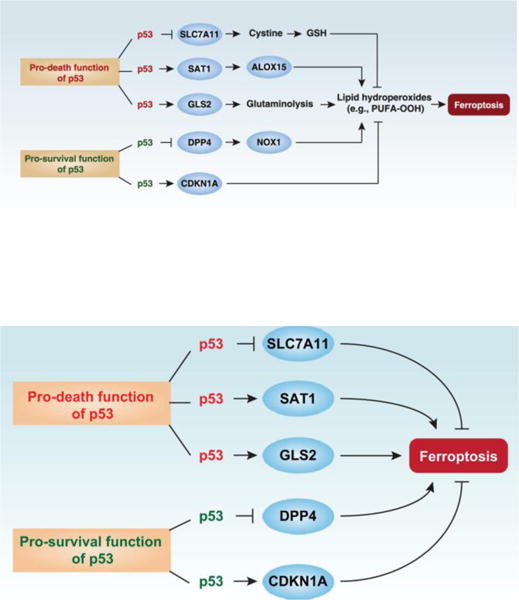
Ferroptosis is a form of lipid peroxidation-induced cell death that can be regulated in many ways, from altering the activity of antioxidant enzymes to the level of transcription factors. The p53 tumor suppressor is 'the guardian of the genome' that participates in the control of cell survival and division under various stresses. Beyond its effects on apoptosis, autophagy, and cell cycle, p53 also regulates ferroptosis either through a transcriptional or posttranslational mechanism. On one hand, p53 can enhance ferroptosis by inhibiting the expression of SLC7A11 (solute carrier family 7 member 11) or by enhancing that of SAT1 (spermidine/spermine N1-acetyltransferase 1) and GLS2 (glutaminase 2). On the other hand, p53 suppresses ferroptosis through the direct inhibition of DPP4 (dipeptidyl peptidase 4) activity or by the induction of CDKN1A/p21 (cyclin dependent kinase inhibitor 1 A) expression. Here, we review recent discoveries and emerging trends in the study of the ferroptosis network and highlight the context-dependent impact of p53 on ferroptosis and oxidative stress.
铁死亡是一种脂质过氧化诱导的细胞死亡形式,可以通过多种方式进行调节,从改变抗氧化酶的活性到转录因子的水平。p53 肿瘤抑制因子是“基因组的守护者”,参与各种应激下细胞存活和分裂的控制。除了对细胞凋亡、自噬和细胞周期的影响外,p53 还通过转录或翻译后机制调节铁死亡。一方面,p53 可以通过抑制 SLC7A11(溶质载体家族 7 成员 11)的表达或通过增强 SAT1(精脒/精胺 N1-乙酰转移酶 1)和 GLS2(谷氨酰胺酶 2)的表达来增强铁死亡。另一方面,p53 通过直接抑制 DPP4(二肽基肽酶 4)活性或诱导 CDKN1A/p21(细胞周期蛋白依赖性激酶抑制剂 1A)表达来抑制铁死亡。在这里,我们回顾了铁死亡网络研究的最新发现和新兴趋势,并强调了 p53 对铁死亡和氧化应激的上下文依赖性影响。