Department of Forensic and Neurodevelopmental Sciences, Institute of Psychiatry, Psychology and Neuroscience, King's College London, De Crespigny Park, London, SE5 8AF, UK.
Roche Pharma Research & Early Development, Neuroscience, Roche Innovation Center Basel, F. Hoffmann-La Roche Ltd, Grenzacherstrasse 124, CH-4070, Basel, Switzerland.
Transl Psychiatry. 2018 May 25;8(1):106. doi: 10.1038/s41398-018-0155-1.
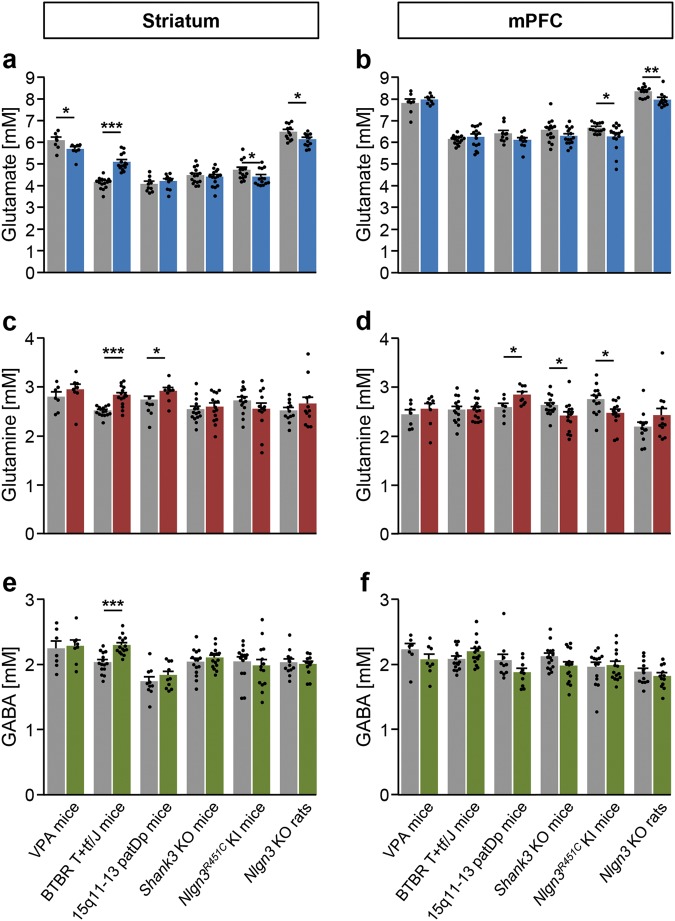
Autism spectrum disorder (ASD) is a pervasive neurodevelopmental syndrome with a high human and economic burden. The pathophysiology of ASD is largely unclear, thus hampering development of pharmacological treatments for the core symptoms of the disorder. Abnormalities in glutamate and GABA signaling have been hypothesized to underlie ASD symptoms, and may form a therapeutic target, but it is not known whether these abnormalities are recapitulated in humans with ASD, as well as in rodent models of the disorder. We used translational proton magnetic resonance spectroscopy ([1H]MRS) to compare glutamate and GABA levels in adult humans with ASD and in a panel of six diverse rodent ASD models, encompassing genetic and environmental etiologies. [1H]MRS was performed in the striatum and the medial prefrontal cortex, of the humans, mice, and rats in order to allow for direct cross-species comparisons in specific cortical and subcortical brain regions implicated in ASD. In humans with ASD, glutamate concentration was reduced in the striatum and this was correlated with the severity of social symptoms. GABA levels were not altered in either brain region. The reduction in striatal glutamate was recapitulated in mice prenatally exposed to valproate, and in mice and rats carrying Nlgn3 mutations, but not in rodent ASD models with other etiologies. Our findings suggest that glutamate/GABA abnormalities in the corticostriatal circuitry may be a key pathological mechanism in ASD; and may be linked to alterations in the neuroligin-neurexin signaling complex.
自闭症谱系障碍(ASD)是一种普遍存在的神经发育综合征,给人类和经济带来了沉重负担。ASD 的病理生理学在很大程度上尚不清楚,这阻碍了针对该疾病核心症状的药物治疗的发展。谷氨酸和 GABA 信号的异常被假设是 ASD 症状的基础,并且可能形成治疗靶点,但尚不清楚这些异常是否在 ASD 患者中重现,以及在该疾病的啮齿动物模型中是否重现。我们使用转化质子磁共振波谱([1H]MRS)来比较 ASD 成人和六种不同的 ASD 啮齿动物模型中的谷氨酸和 GABA 水平,这些模型涵盖了遗传和环境病因。为了能够在特定的与 ASD 相关的皮质和皮质下脑区进行直接的跨物种比较,我们在人类、小鼠和大鼠的纹状体和内侧前额叶皮层进行了[1H]MRS。在 ASD 患者中,纹状体中的谷氨酸浓度降低,这与社会症状的严重程度相关。两个脑区的 GABA 水平均未改变。在产前暴露于丙戊酸的小鼠中,以及在携带 Nlgn3 突变的小鼠和大鼠中,纹状体谷氨酸的减少得到了重现,但在具有其他病因的啮齿动物 ASD 模型中则没有重现。我们的研究结果表明,皮质纹状体回路中的谷氨酸/GABA 异常可能是 ASD 的关键病理机制;并且可能与神经连接蛋白-神经递质受体信号复合物的改变有关。