Department of Forensic and Neurodevelopmental Sciences, Institute of Psychiatry, Psychology & Neuroscience, King's College London, London, UK.
Department of Neuroimaging Sciences, Institute of Psychiatry, Psychology & Neuroscience, King's College London, London, UK.
Neuropsychopharmacology. 2019 Jul;44(8):1398-1405. doi: 10.1038/s41386-019-0333-8. Epub 2019 Feb 6.
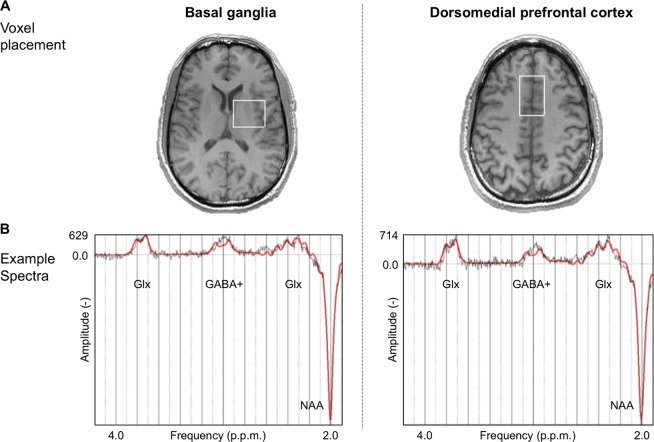
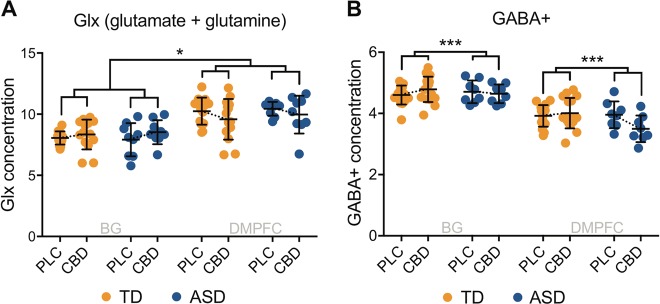
There is increasing interest in the use of cannabis and its major non-intoxicating component cannabidiol (CBD) as a treatment for mental health and neurodevelopmental disorders, such as autism spectrum disorder (ASD). However, before launching large-scale clinical trials, a better understanding of the effects of CBD on brain would be desirable. Preclinical evidence suggests that one aspect of the polypharmacy of CBD is that it modulates brain excitatory glutamate and inhibitory γ-aminobutyric acid (GABA) levels, including in brain regions linked to ASD, such as the basal ganglia (BG) and the dorsomedial prefrontal cortex (DMPFC). However, differences in glutamate and GABA pathways in ASD mean that the response to CBD in people with and without ASD may be not be the same. To test whether CBD 'shifts' glutamate and GABA levels; and to examine potential differences in this response in ASD, we used magnetic resonance spectroscopy (MRS) to measure glutamate (Glx = glutamate + glutamine) and GABA+ (GABA + macromolecules) levels in 34 healthy men (17 neurotypicals, 17 ASD). Data acquisition commenced 2 h (peak plasma levels) after a single oral dose of 600 mg CBD or placebo. Test sessions were at least 13 days apart. Across groups, CBD increased subcortical, but decreased cortical, Glx. Across regions, CBD increased GABA+ in controls, but decreased GABA+ in ASD; the group difference in change in GABA + in the DMPFC was significant. Thus, CBD modulates glutamate-GABA systems, but prefrontal-GABA systems respond differently in ASD. Our results do not speak to the efficacy of CBD. Future studies should examine the effects of chronic administration on brain and behaviour, and whether acute brain changes predict longer-term response.
人们对大麻及其主要非成瘾成分大麻二酚 (CBD) 作为治疗精神健康和神经发育障碍(如自闭症谱系障碍 (ASD))的方法越来越感兴趣。然而,在开展大规模临床试验之前,人们希望更好地了解 CBD 对大脑的影响。临床前证据表明,CBD 多药治疗的一个方面是,它调节大脑兴奋性谷氨酸和抑制性 γ-氨基丁酸 (GABA) 水平,包括与 ASD 相关的大脑区域,如基底神经节 (BG) 和背内侧前额叶皮层 (DMPFC)。然而,ASD 中谷氨酸和 GABA 通路的差异意味着 CBD 在 ASD 患者和非 ASD 患者中的反应可能不同。为了测试 CBD 是否“改变”谷氨酸和 GABA 水平;并检查 ASD 中这种反应的潜在差异,我们使用磁共振波谱 (MRS) 测量了 34 名健康男性(17 名神经典型,17 名 ASD)的谷氨酸 (Glx = 谷氨酸 + 谷氨酰胺) 和 GABA+ (GABA + 大分子) 水平。在单次口服 600mg CBD 或安慰剂后 2 小时(血浆峰值水平)开始采集数据。测试会议至少相隔 13 天。在所有组中,CBD 增加了皮质下区域,但减少了皮质区域的 Glx。在所有区域中,CBD 增加了对照组中的 GABA+,但降低了 ASD 中的 GABA+;DMPFC 中 GABA+ 变化的组间差异具有统计学意义。因此,CBD 调节谷氨酸-GABA 系统,但 ASD 中的前额叶-GABA 系统反应不同。我们的结果与 CBD 的疗效无关。未来的研究应该检查慢性给药对大脑和行为的影响,以及急性大脑变化是否预测长期反应。