Alpert Medical School of Brown University, 222 Richmond Street, Providence, RI, USA.
The Miriam Hospital, 164 Summit Avenue, Providence, RI, USA.
Lung. 2018 Aug;196(4):425-431. doi: 10.1007/s00408-018-0127-5. Epub 2018 May 26.
Obstructive sleep apnea is common in patients with end-stage renal disease, and there is increasing evidence that clinical factors specific to end-stage renal disease contribute pathophysiologically to obstructive sleep apnea. It is not known whether circumstances specific to dialysis modality, in this case peritoneal dialysis, affect obstructive sleep apnea. Our study aimed to investigate the prevalence of obstructive sleep apnea in the peritoneal dialysis population and the relevance of dialysis-specific measures and kidney function in assessing this bidirectional relationship.
Participants with end-stage renal disease who were treated with nocturnal automated peritoneal dialysis for at least 3 months were recruited from a hospital-based dialysis center. Laboratory measures of dialysis adequacy, peritoneal membrane transporter status, and residual renal function were gathered by chart review. Patients participated in a home sleep apnea test using a level III sleep apnea monitor.
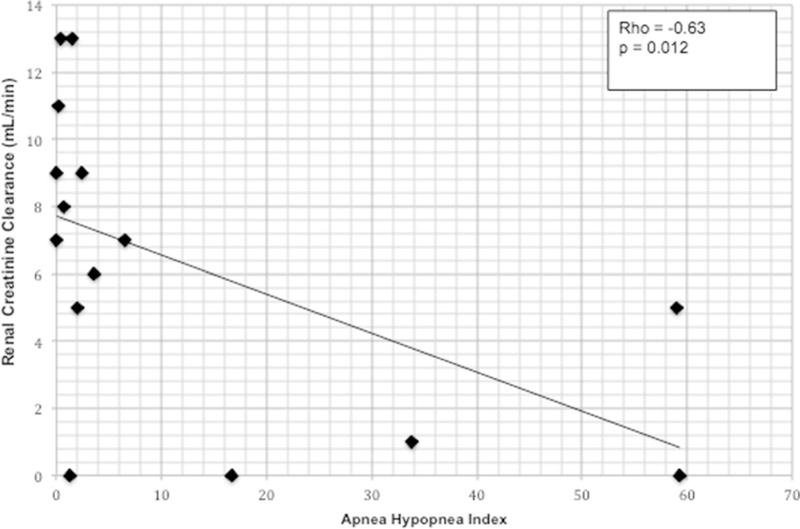
Of fifteen participants recruited, 33% had obstructive sleep apnea diagnosed by apnea-hypopnea index ≥ 5 events per hour of sleep. Renal creatinine clearance based upon 24-h urine collection was negatively correlated with apnea-hypopnea index (ρ = - 0.63, p = 0.012). There were no significant associations between anthropometric measures, intra-abdominal dwell volume, or peritoneal membrane transporter status and obstructive sleep apnea measures.
The prevalence of obstructive sleep apnea and sleep disturbances is high in participants receiving peritoneal dialysis. Elevated apnea-hypopnea index is associated with lower residual renal function, whereas dialysis-specific measures such as intra-abdominal dwell volume and peritoneal membrane transporter status do not correlate with severity of obstructive sleep apnea.
阻塞性睡眠呼吸暂停在终末期肾病患者中很常见,越来越多的证据表明,终末期肾病特有的临床因素在病理生理学上与阻塞性睡眠呼吸暂停有关。目前尚不清楚透析方式(在本例中为腹膜透析)的具体情况是否会影响阻塞性睡眠呼吸暂停。我们的研究旨在调查腹膜透析人群中阻塞性睡眠呼吸暂停的患病率,以及透析特异性措施和肾功能在评估这种双向关系中的相关性。
从医院透析中心招募了至少接受 3 个月夜间自动腹膜透析治疗的终末期肾病患者。通过病历回顾收集实验室透析充分性、腹膜膜转运体状态和残余肾功能的测量值。患者在家中使用 III 级睡眠呼吸暂停监测仪进行睡眠呼吸暂停测试。
在招募的 15 名参与者中,33%的人通过睡眠呼吸暂停指数(apnea-hypopnea index,AHI)≥5 次/小时的诊断患有阻塞性睡眠呼吸暂停。基于 24 小时尿液收集的肾肌酐清除率与 AHI 呈负相关(ρ=-0.63,p=0.012)。人体测量指标、腹腔内驻留量或腹膜膜转运体状态与阻塞性睡眠呼吸暂停测量值之间均无显著相关性。
接受腹膜透析的参与者中阻塞性睡眠呼吸暂停和睡眠障碍的患病率很高。较高的 AHI 与较低的残余肾功能相关,而透析特异性措施,如腹腔内驻留量和腹膜膜转运体状态与阻塞性睡眠呼吸暂停的严重程度无关。