Peter MacCallum Cancer Centre, Melbourne, VIC, Australia.
Department of Pathology/GZA, Antwerp, Belgium.
Br J Cancer. 2018 Jul;119(1):4-11. doi: 10.1038/s41416-018-0126-6. Epub 2018 May 29.
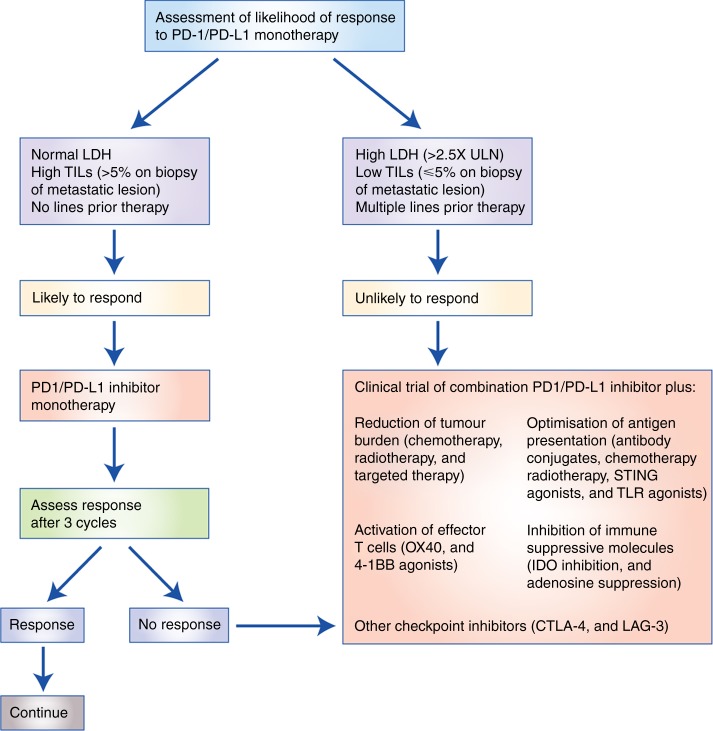
There is now accumulating evidence that the host immune system plays an important role in influencing response to treatment and prognosis in breast cancer. Immunotherapy with immune checkpoint inhibitors is a promising and rapidly growing field of interest in many solid tumours, including breast cancer. Trials to date have largely focused on metastatic triple-negative disease, a genomically unstable subtype of breast cancer that is believed to be the most immunogenic and following the development of treatment resistance, has limited treatment options and a particularly poor prognosis. Both checkpoint inhibitor monotherapy and combinations with chemotherapy are being investigated. In this review, we discuss the current evidence for PD-1/PD-L1 blockade in metastatic triple-negative breast cancer (TNBC), HER2+ breast cancer and ER+ disease, as well as the emerging evidence for use in the early-stage (neoadjuvant) setting. We also propose potential ways of improving responses to checkpoint blockade in breast cancer.
目前有越来越多的证据表明,宿主免疫系统在影响乳腺癌的治疗反应和预后方面起着重要作用。免疫检查点抑制剂的免疫疗法是许多实体瘤(包括乳腺癌)中一个有前途且快速发展的研究领域。迄今为止,临床试验主要集中在转移性三阴性疾病上,这是一种基因组不稳定的乳腺癌亚型,被认为是最具免疫原性的亚型,在发生治疗耐药后,治疗选择有限,预后特别差。目前正在研究检查点抑制剂单药治疗以及与化疗联合应用。在这篇综述中,我们讨论了 PD-1/PD-L1 阻断在转移性三阴性乳腺癌(TNBC)、HER2+乳腺癌和 ER+疾病中的现有证据,以及在早期(新辅助)治疗环境中的新出现的证据。我们还提出了提高乳腺癌对检查点阻断反应的潜在方法。