Department of Neurosurgery, Institute of Neurology, Lanzhou University Second Hospital, 82 Cuiying Men Road, Lanzhou, 730030, China.
Center for Systems Biology and Institute for Innovation in Imaging, Department of Radiology, Harvard Medical School, Massachusetts General Hospital, 185 Cambridge Street, 5.210 Richard B. Simches Research Building, Boston, MA, 02114, USA.
Mol Neurobiol. 2019 Feb;56(2):954-962. doi: 10.1007/s12035-018-1137-2. Epub 2018 May 28.
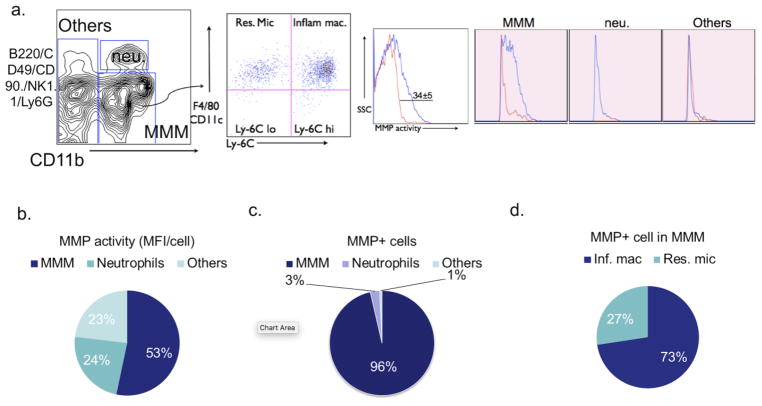
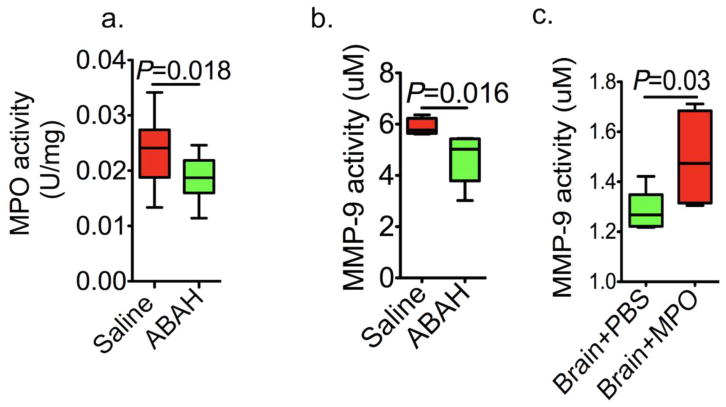
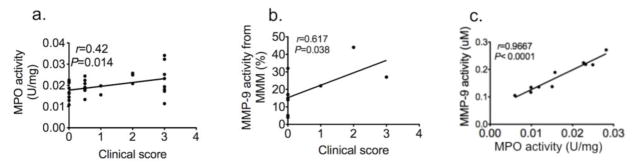
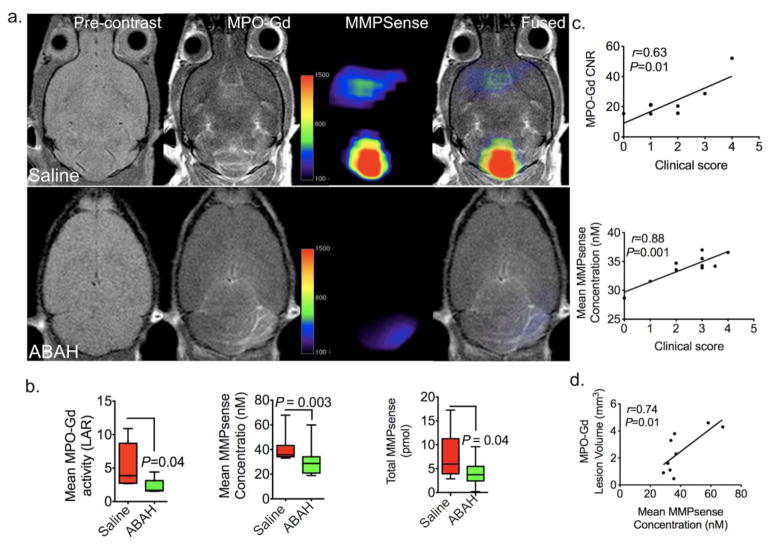
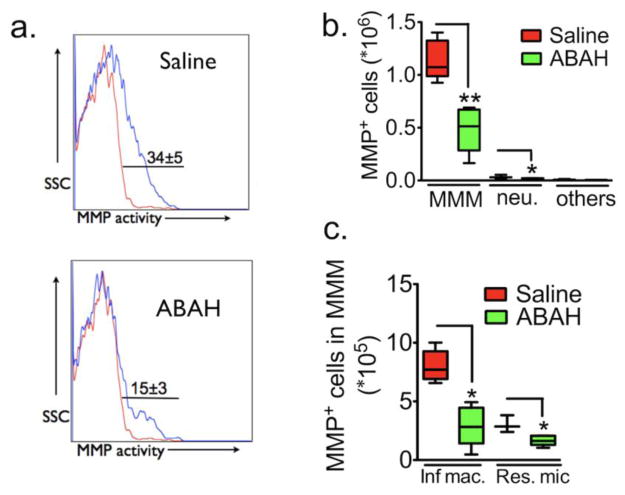
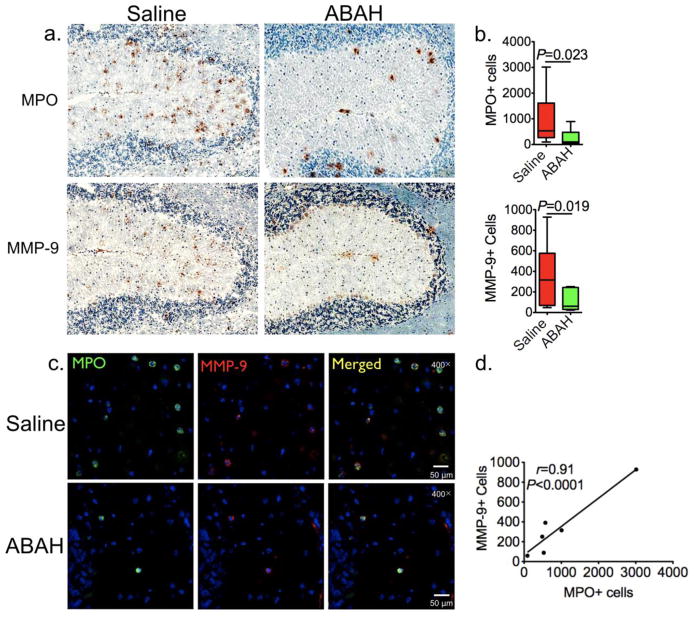
Myeloperoxidase (MPO) has paradoxically been found to be able to both activate matrix metalloproteinases (MMPs) as well as inhibit MMPs. However, these regulatory effects have not yet been observed in vivo, and it is unclear which pathway is relevant in vivo. We aim to track MPO regulation of MMP activity in living animals in neuroinflammation. Mice induced with experimental autoimmune encephalomyelitis (EAE), a mouse model of neuroinflammation and multiple sclerosis, were treated with either the MPO-specific inhibitor 4-aminobenzoic acid hydrazide or saline as control. Mice underwent concurrent magnetic resonance imaging (MRI) with the MPO-specific molecular imaging agent MPO-Gd and fluorescence molecular tomography (FMT) with the MMP-targeting agent MMPsense on day 12 after induction. Biochemical and histopathological correlations were performed. Utilizing concurrent MRI and FMT imaging, we found reduced MMP activity in the brain with MPO inhibition, demonstrating MPO activity positively regulates MMP activity in vivo. In vivo MMPSense activation and MMP-9 activity correlated with MPO-Gd lesion volume and disease severity. This was corroborated by in vitro assays and histopathological analyses that showed MMP activity and MMP-9 cells correlated with MPO activity and MPO cells. In conclusion, multimodal molecular imaging demonstrates for the first time MPO regulation of MMP activity in living animals. This approach could serve as a model to study the interactions of other biologically interesting molecules in living organisms.
髓过氧化物酶 (MPO) 出人意料地被发现既能激活基质金属蛋白酶 (MMPs),也能抑制 MMPs。然而,这些调节作用尚未在体内观察到,也不清楚哪种途径在体内是相关的。我们旨在追踪 MPO 在神经炎症中对 MMP 活性的调节作用。用实验性自身免疫性脑脊髓炎 (EAE) 诱导的小鼠,一种神经炎症和多发性硬化症的小鼠模型,用 MPO 特异性抑制剂 4-氨基苯甲酰肼或盐水作为对照进行治疗。在诱导后第 12 天,小鼠同时进行 MPO 特异性分子成像剂 MPO-Gd 的磁共振成像 (MRI) 和 MMP 靶向剂 MMPsense 的荧光分子断层扫描 (FMT)。进行了生化和组织病理学相关性分析。利用同时进行的 MRI 和 FMT 成像,我们发现 MPO 抑制后大脑中的 MMP 活性降低,证明 MPO 活性在体内正向调节 MMP 活性。体内 MMPSense 激活和 MMP-9 活性与 MPO-Gd 病变体积和疾病严重程度相关。这得到了体外测定和组织病理学分析的证实,表明 MMP 活性和 MMP-9 细胞与 MPO 活性和 MPO 细胞相关。总之,多模态分子成像首次证明了 MPO 在活体动物中对 MMP 活性的调节作用。这种方法可以作为研究其他在生物体中具有生物学意义的分子相互作用的模型。