Jha Chandan K, Mir Rashid, Khullar Naina, Banu Shaheena, Chahal S M S
Department of Human Genetics, Punjabi University, Punjab 147002, India.
Department of Medical Lab Technology, Faculty of Applied Medical Sciences, University of Tabuk, Tabuk 71491, Saudi Arabia.
J Cardiovasc Dev Dis. 2018 May 29;5(2):31. doi: 10.3390/jcdd5020031.
The low-density lipoprotein receptor is responsible for the binding and uptake of plasma LDL particles and plays a critical role in maintaining cellular cholesterol homeostasis. gene SNP rs688 has been reported to be associated with increased plasma total and LDL cholesterol in several populations and can lead to elevated plasma LDL levels, resulting in an increased risk for atherosclerosis and coronary artery disease. This study aimed to explore genetic LDLR variant rs688 for its potential roles in coronary artery disease.
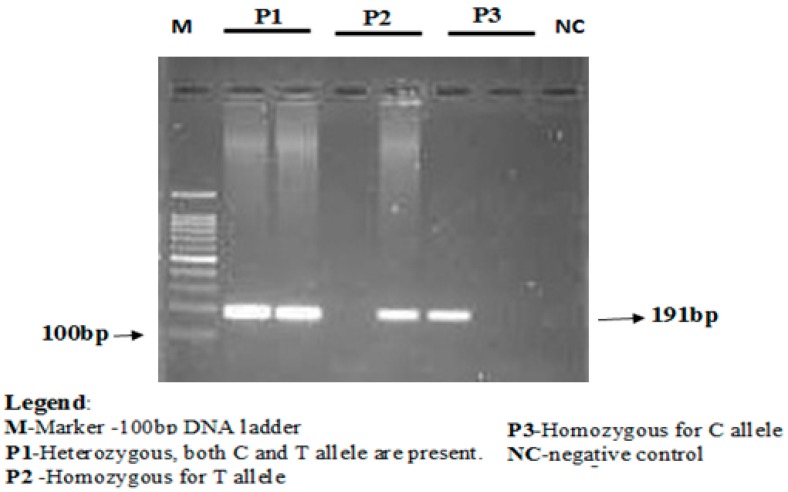
This study recruited 200 coronary artery disease patients and 200 healthy individuals. Genotyping of LDLR-rs688C > T gene variations was performed using the allele specific PCR method. Correlation of LDLR-rs688C > T gene variants with different clinicopathological features of coronary artery disease patients was performed. Pooled odds ratios (ORs) and 95% confidence intervals (CIs) were applied to evaluate the correlation of this microRNA polymorphism with coronary artery disease risk.
A significant difference was observed in genotype distribution among the coronary artery disease and matched healthy controls ( = 0.003). The frequencies of all three genotypes CC, CT, TT reported in the patient samples were 14%, 65% and 21% and in the healthy controls samples were 18%, 73% and 9%, respectively. The increased risk of developing CAD in Indian patients was found to be associated with rs688 TT genotype (OR = 3.0, 95% CI, 1.43 × 6.2; = 0.003) RR 1.87 (1.20⁻2.91) = 0.0037) and also the increased risk of developing CAD was reported to be associated with rs688 T allele (OR = 0.74, 95% CI, 1.57⁻0.97; = 0.03) RR 0.85 (0.73⁻0.99) = 0.03) compared to the C allele. Therefore, it was observed that more than a 3.0- and 0.74-fold increase risk of developing CAD was associated with TT genotype and T allele in Indian coronary artery disease patients.
The findings indicated that rs688 TT genotype and T allele are associated with an increased susceptibility to coronary artery disease patients. LDLR-rs688C > T gene variation can be used as a predisposing genetic marker for coronary artery disease. Further studies with larger sample sizes are necessary to confirm our findings.
低密度脂蛋白受体负责血浆低密度脂蛋白颗粒的结合与摄取,在维持细胞胆固醇稳态中起关键作用。据报道,基因单核苷酸多态性rs688在多个人群中与血浆总胆固醇和低密度脂蛋白胆固醇升高相关,可导致血浆低密度脂蛋白水平升高,增加动脉粥样硬化和冠状动脉疾病的风险。本研究旨在探讨低密度脂蛋白受体(LDLR)基因变异rs688在冠状动脉疾病中的潜在作用。
本研究招募了200例冠状动脉疾病患者和200名健康个体。采用等位基因特异性PCR方法对LDLR-rs688C>T基因变异进行基因分型。分析LDLR-rs688C>T基因变异与冠状动脉疾病患者不同临床病理特征的相关性。应用合并比值比(OR)和95%置信区间(CI)评估该微小RNA多态性与冠状动脉疾病风险的相关性。
冠状动脉疾病患者与匹配的健康对照者的基因型分布存在显著差异(P=0.003)。患者样本中CC、CT、TT三种基因型的频率分别为14%、65%和21%,健康对照样本中分别为18%、73%和9%。在印度患者中,发现CAD发病风险增加与rs688 TT基因型相关(OR=3.0,95%CI,1.43×6.2;P=0.003),相对危险度(RR)为1.87(1.20⁻2.91),P=0.0037),并且据报道CAD发病风险增加还与rs688 T等位基因相关(OR=0.74,95%CI,1.57⁻0.97;P=0.03),RR为0.85(0.73⁻0.99),P=0.03),与C等位基因相比。因此,观察到在印度冠状动脉疾病患者中,TT基因型和T等位基因使CAD发病风险分别增加3.0倍和0.74倍以上。
研究结果表明,rs688 TT基因型和T等位基因与冠状动脉疾病患者易感性增加相关。LDLR-rs688C>T基因变异可作为冠状动脉疾病的遗传易感性标志物。需要进一步进行更大样本量的研究来证实我们的发现。