Section of Audiology and Health Systems, University of Auckland, Auckland, New Zealand.
Center for Brain Research, University of Auckland, Auckland, New Zealand.
Sci Rep. 2018 May 29;8(1):8311. doi: 10.1038/s41598-018-26665-1.
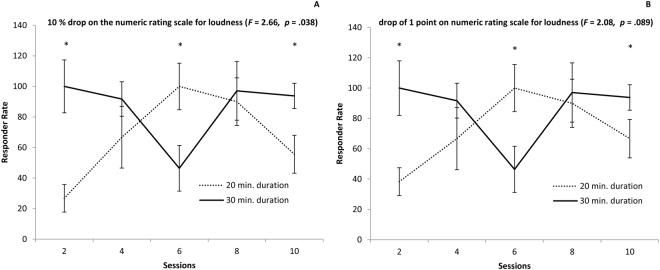
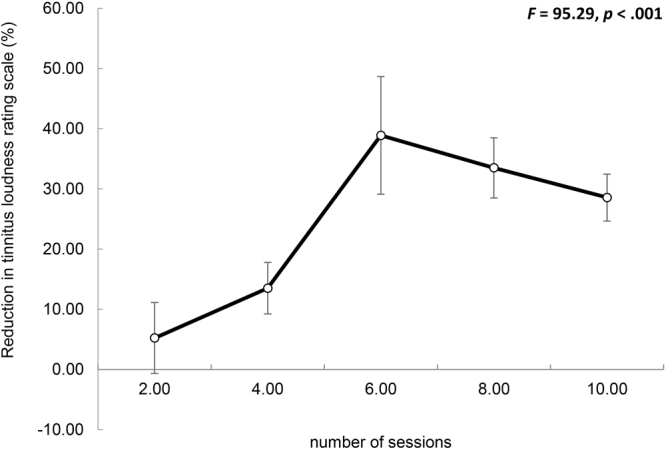
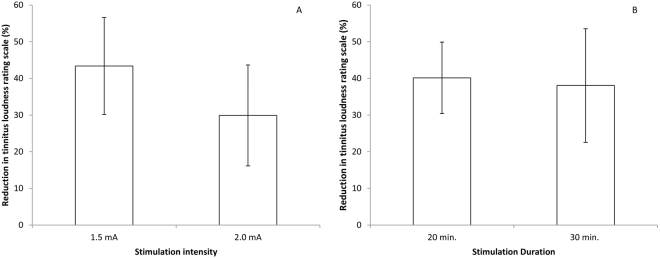
Neuromodulation is defined as the process of augmenting neuroplasticity via invasive or non-invasive methods. Tinnitus is the perception of sound in the absence of its external source. The objective of this study was to optimize the parameters of transcranial direct current stimulation (tDCS) of dorsolateral prefrontal cortex (DLPFC) for tinnitus suppression. The following factors were optimized in the dose-response design (n = 111): current intensity (1.5 mA or 2 mA), stimulation duration (20 min or 30 min), and number of stimulation sessions (2, 4, 6, 8, or 10), with a 3-4 day washout period between each session. Participants underwent a minimum of 2 sessions in 1 week or maximum of 10 sessions in 5 weeks' time. Tinnitus loudness was measured in pre-post design using a 10-point numeric rating scale. There was a significant reduction in tinnitus loudness after tDCS of DLPFC. There was no significant difference between the intensity and duration of stimulation. As the number of sessions increased, there was a higher reduction in the tinnitus loudness; however, this effect plateaued after 6 sessions.
神经调节被定义为通过侵入性或非侵入性方法增强神经可塑性的过程。耳鸣是指在没有外部声源的情况下感知到声音。本研究的目的是优化经颅直流电刺激(tDCS)对外侧前额叶皮层(DLPFC)的参数,以抑制耳鸣。在剂量反应设计(n=111)中优化了以下因素:电流强度(1.5mA 或 2mA)、刺激持续时间(20 分钟或 30 分钟)和刺激次数(2、4、6、8 或 10),每次刺激之间有 3-4 天的洗脱期。参与者在 1 周内至少进行 2 次治疗,在 5 周内最多进行 10 次治疗。耳鸣响度采用 10 点数字评定量表进行前后设计测量。DLPFC 的 tDCS 后,耳鸣响度显著降低。刺激的强度和持续时间没有显著差异。随着刺激次数的增加,耳鸣响度的降低幅度更高;然而,在 6 次治疗后,这种效果趋于平稳。