Thonhoff Jason R, Beers David R, Zhao Weihua, Pleitez Milvia, Simpson Ericka P, Berry James D, Cudkowicz Merit E, Appel Stanley H
Houston Methodist Neurological Institute (J.R.T., D.R.B., W.Z., M.P., E.P.S., S.H.A.), Houston Methodist Hospital Research Institute, Stanley H. Appel Department of Neurology, Houston, TX; and Neurological Clinical Research Institute (J.D.B., M.E.C.), Massachusetts General Hospital, Boston, MA.
Neurol Neuroimmunol Neuroinflamm. 2018 May 18;5(4):e465. doi: 10.1212/NXI.0000000000000465. eCollection 2018 Jul.
To determine whether autologous infusions of expanded regulatory T lymphoctyes (Tregs) into patients with amyotrophic lateral sclerosis (ALS) are safe and tolerable during early and later stages of disease.
Three patients with ALS, with no family history of ALS, were selected based on their differing sites of disease onset and rates of progression. Patients underwent leukapheresis, and Tregs were subsequently isolated and expanded ex vivo. Tregs (1 × 10 cells/kg) were administered IV at early stages (4 doses over 2 months) and later stages (4 doses over 4 months) of disease. Concomitant interleukin-2 (2 × 10 IU/m/injection) was administered subcutaneously 3 times weekly over the entire study period. Patients were closely monitored for adverse effects and changes in disease progression rates. Treg numbers and suppressive function were assayed during and following each round of Treg infusions.
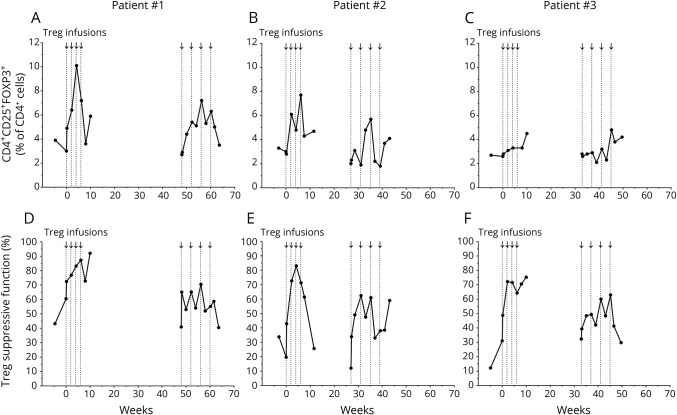
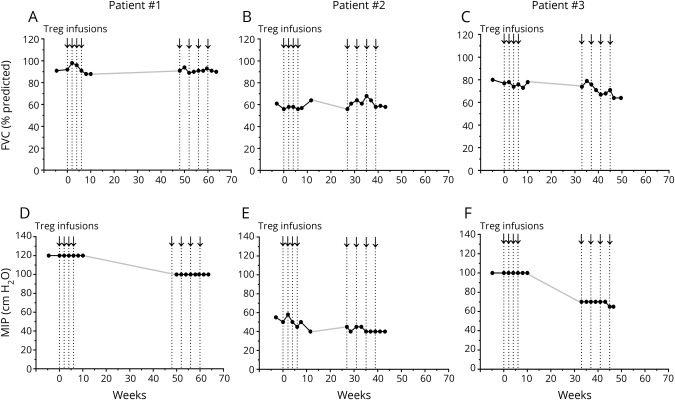
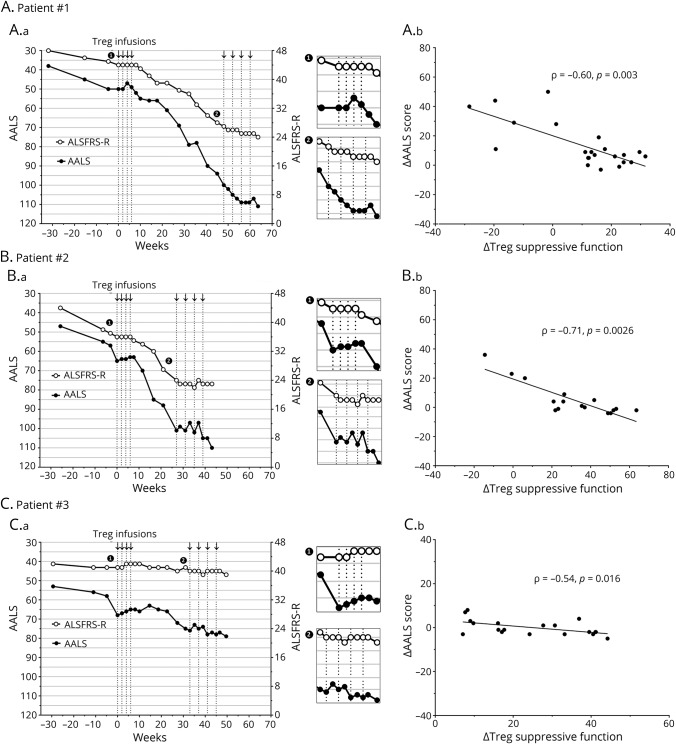
Infusions of Tregs were safe and well tolerated in all patients. Treg numbers and suppressive function increased after each infusion. The infusions slowed progression rates during early and later stages of disease. Spearman correlation analyses showed that increased Treg suppressive function correlated with slowing of disease progression per the Appel ALS scale for each patient: patient 1: ρ (rho) = -0.60, = 0.003; patient 2: ρ = -0.71, = 0.0026; and patient 3: ρ = -0.54, = 0.016. Measures of maximal inspiratory pressure also stabilized, particularly in 2 patients, during Treg infusions.
These results demonstrate the safety and potential benefit of expanded autologous Treg infusions, warranting further clinical trials in patients with ALS. The correlation between Treg suppressive function and disease progression underscores the significance of using Treg suppressive function as an indicator of clinical status.
This study provides Class IV evidence. This is a phase I trial with no controls.
确定向肌萎缩侧索硬化症(ALS)患者自体输注扩增的调节性T淋巴细胞(Tregs)在疾病早期和晚期是否安全且可耐受。
选取3例无ALS家族史的ALS患者,根据其不同的疾病起始部位和进展速度进行选择。患者接受白细胞分离术,随后在体外分离并扩增Tregs。在疾病早期(2个月内注射4剂)和晚期(4个月内注射4剂)静脉注射Tregs(1×10⁶细胞/kg)。在整个研究期间,每周皮下注射3次伴随的白细胞介素-2(2×10⁶IU/m²/注射)。密切监测患者的不良反应和疾病进展速度的变化。在每一轮Treg输注期间及之后检测Treg数量和抑制功能。
所有患者输注Tregs均安全且耐受性良好。每次输注后Treg数量和抑制功能均增加。输注减缓了疾病早期和晚期的进展速度。Spearman相关性分析表明,根据每位患者的阿佩尔ALS量表,Treg抑制功能增强与疾病进展减缓相关:患者1:ρ(相关系数)=-0.60,P=0.003;患者2:ρ=-0.71,P=0.0026;患者3:ρ=-0.54,P=0.016。在Treg输注期间,最大吸气压力测量值也趋于稳定,尤其是2例患者。
这些结果证明了扩增的自体Treg输注的安全性和潜在益处,有必要在ALS患者中进行进一步的临床试验。Treg抑制功能与疾病进展之间的相关性强调了将Treg抑制功能用作临床状态指标的重要性。
本研究提供IV级证据。这是一项无对照的I期试验。