Department Orthopedics and Traumatology, Longhua Hospital, Shanghai University of Traditional Chinese Medicine, Shanghai 200032, P.R. China.
Mol Med Rep. 2018 Jul;18(1):945-957. doi: 10.3892/mmr.2018.9061. Epub 2018 May 23.
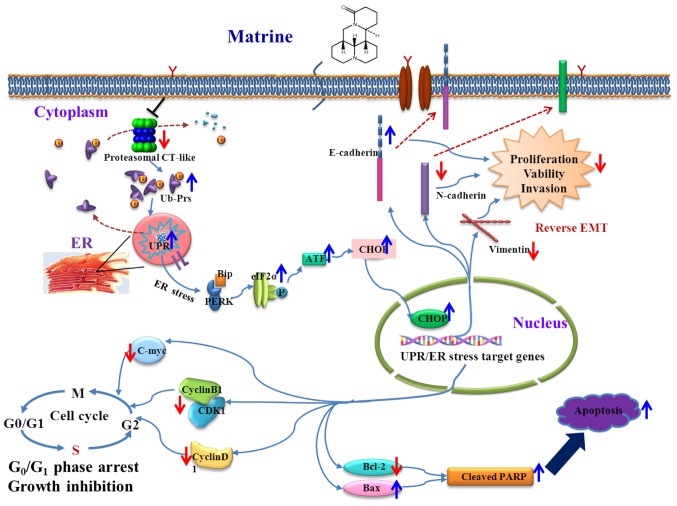
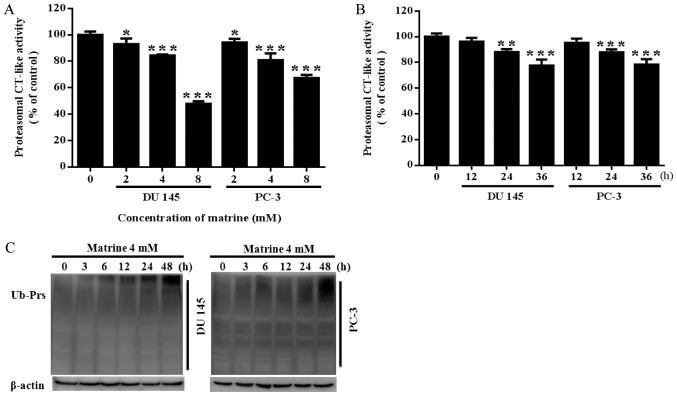
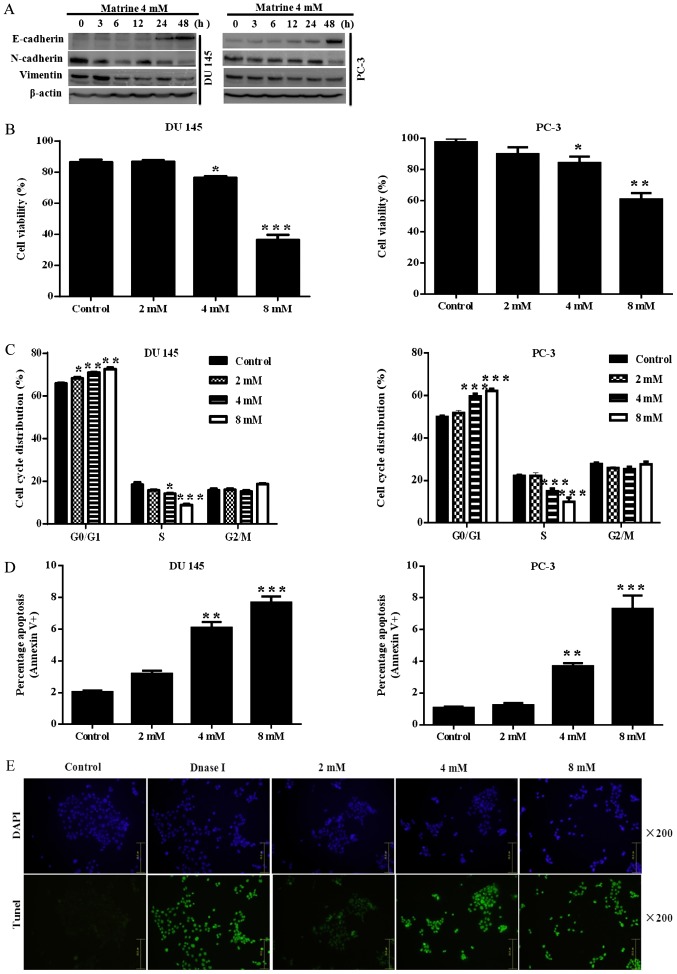
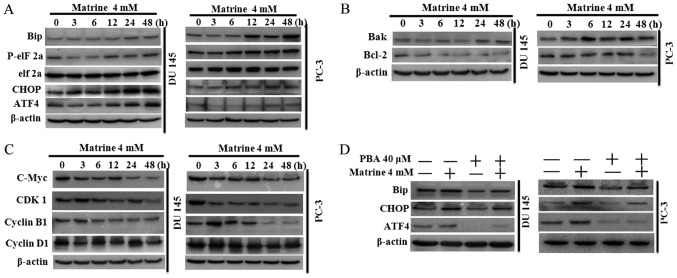
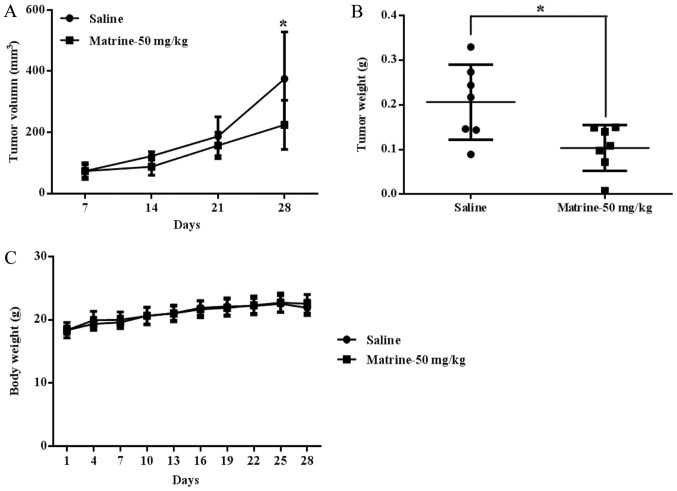
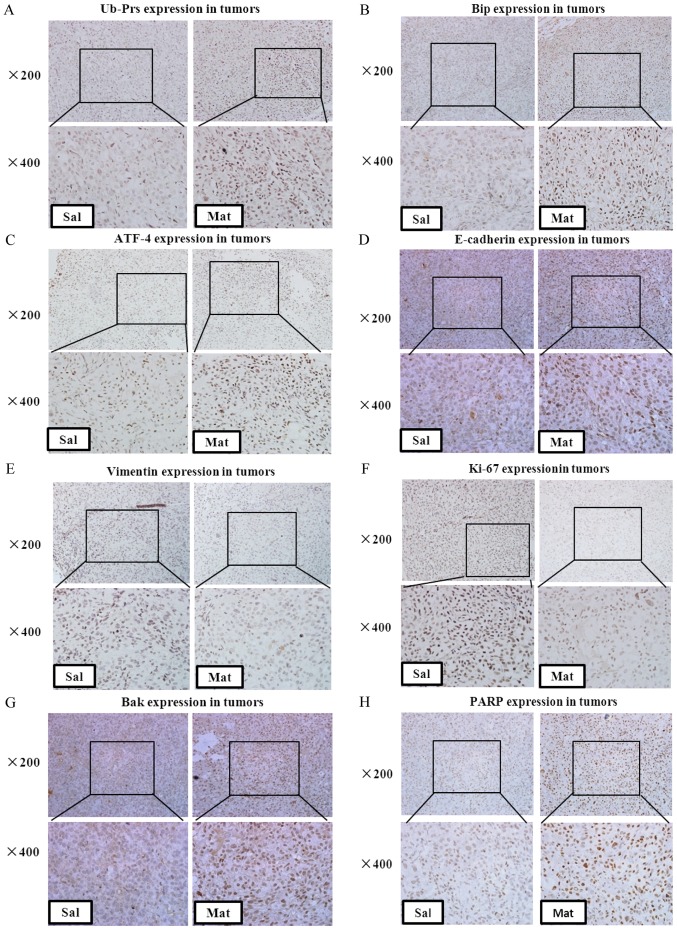
Prostate cancer is the second most commonly diagnosed malignancy and the sixth global primary cause of malignancy‑associated fatality. Increased invasiveness and motility in prostate cancer cells are associated with ubiquitin proteasome system‑regulated epithelial to mesenchymal transition (EMT). Impairment of the endoplasmic reticulum (ER) causes ER stress due to the accumulation of unfolded proteins and altered cell survival. In the current study, the effect and mechanism of matrine on cell apoptosis, viability, migration and invasion of human prostate cancer cells in vivo and in vitro through the unfolded protein response (UPR)/ER stress pathway were investigated. Matrine inhibited proteasomal chymotrypsin‑like (CT‑like) activity in the prostate carcinoma cellular proteasome. Upregulated vimentin and N‑cadherin and downregulated E‑cadherin were also observed in vitro and in vivo. In vitro analyses showed that matrine repressed cell motility, viability and invasion, arrested the cell cycle at the G0/G1 phase and induced prostate cancer cell apoptosis. Furthermore, matrine activated the UPR/ER stress signaling cascade in prostate cancer cells and tumor tissues of xenograft‑bearing nude mice. Results also demonstrated that the anti‑apoptotic protein Bcl‑2 was downregulated, the pro‑apoptotic protein Bak was upregulated and the cell growth and cell cycle‑related proteins c‑Myc, Cyclin B1, Cyclin D1 and CDK1 were downregulated. Moreover, matrine inhibited tumor growth and Ki‑67 expression in xenograft‑bearing nude mice. To the best of our knowledge, the present study indicated for the first time that matrine exerted marked anticancer functions in human prostate carcinoma in vivo and in vitro through activation of the proteasomal CT‑like activity inhibition mediated by the UPR/ER stress signaling pathway.
前列腺癌是第二大常见恶性肿瘤,也是第六大全球恶性肿瘤相关致死的主要原因。前列腺癌细胞的侵袭性和迁移性增加与泛素蛋白酶体系统调节的上皮间质转化(EMT)有关。内质网(ER)的损伤会导致未折叠蛋白的积累和细胞存活的改变,从而引起 ER 应激。在本研究中,通过未折叠蛋白反应(UPR)/内质网应激途径,研究了苦参碱对人前列腺癌细胞在体内和体外细胞凋亡、活力、迁移和侵袭的影响及其机制。苦参碱抑制了前列腺癌细胞的蛋白酶体糜蛋白酶样(CT-样)活性。还观察到细胞内的波形蛋白和 N-钙黏蛋白上调,E-钙黏蛋白下调。体外分析表明,苦参碱抑制了细胞迁移、活力和侵袭,将细胞周期阻滞在 G0/G1 期,并诱导前列腺癌细胞凋亡。此外,苦参碱激活了前列腺癌细胞和荷瘤裸鼠肿瘤组织中的 UPR/ER 应激信号级联。结果还表明,抗凋亡蛋白 Bcl-2 下调,促凋亡蛋白 Bak 上调,细胞生长和细胞周期相关蛋白 c-Myc、Cyclin B1、Cyclin D1 和 CDK1 下调。此外,苦参碱抑制了荷瘤裸鼠的肿瘤生长和 Ki-67 表达。据我们所知,本研究首次表明,苦参碱通过激活 UPR/ER 应激信号通路介导的蛋白酶体 CT-样活性抑制,在体内和体外对人前列腺癌具有显著的抗癌作用。