The Novo Nordisk Foundation Center for Biosustainability, Technical University of Denmark, 2800, Lyngby, Denmark.
School of Chemistry & Manchester Institute of Biotechnology, The University of Manchester, 131 Princess St, Manchester, M1 7DN, UK.
BMC Genomics. 2018 May 30;19(1):418. doi: 10.1186/s12864-018-4816-5.
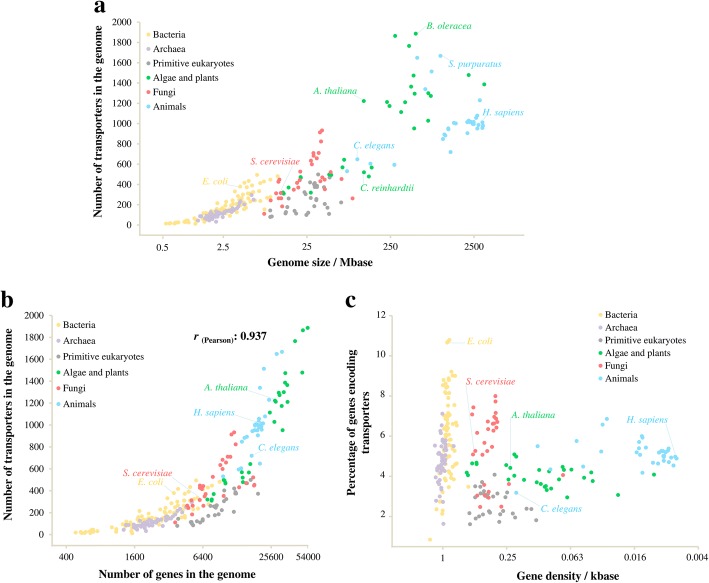
Transporter proteins mediate the translocation of substances across the membranes of living cells. Many transport processes are energetically expensive and the cells use 20 to 60% of their energy to power the transportomes. We hypothesized that there may be an evolutionary selection pressure for lower energy transporters.
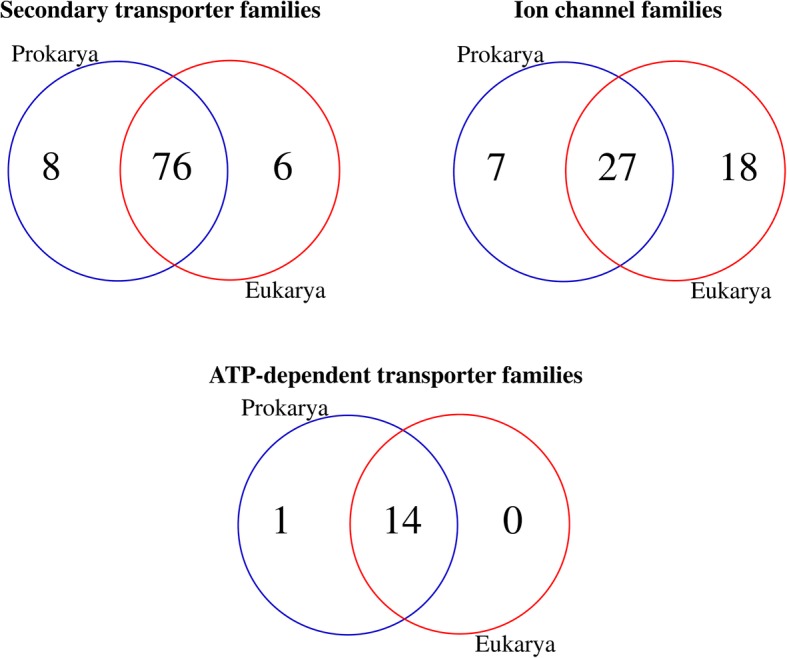
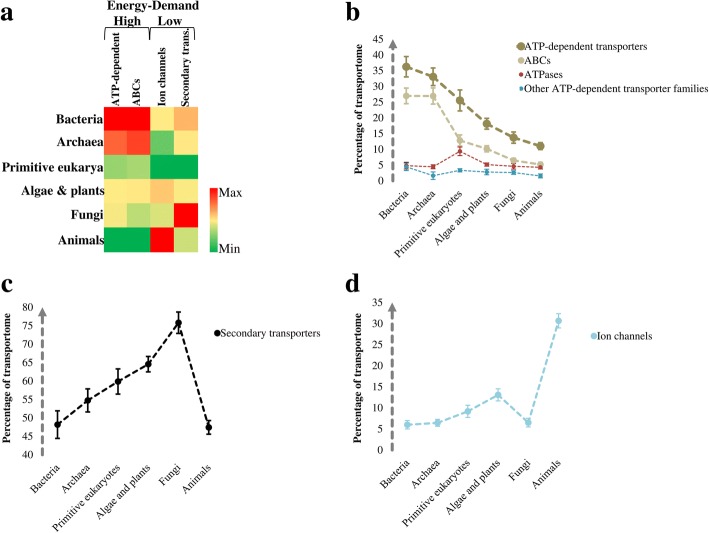
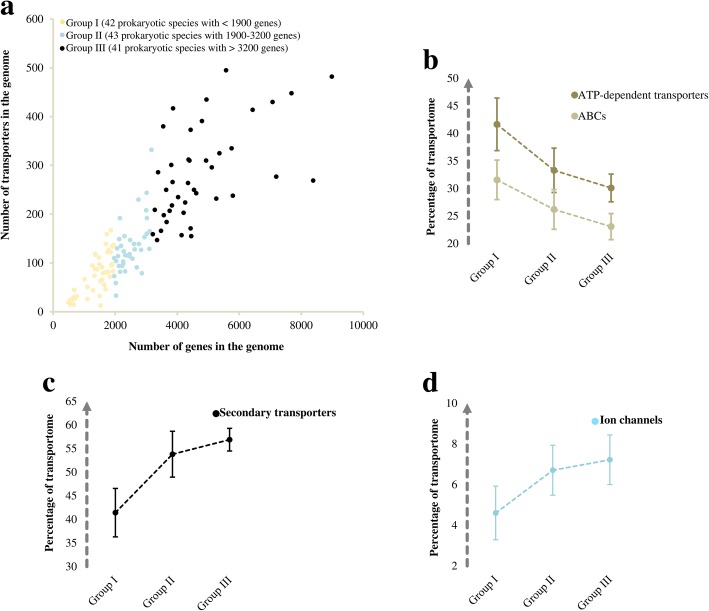
We performed a genome-wide analysis of the compositional reshaping of the transportomes across the kingdoms of bacteria, archaea, and eukarya. We found that the share of ABC transporters is much higher in bacteria and archaea (ca. 27% of the transportome) than in primitive eukaryotes (13%), algae and plants (10%) and in fungi and animals (5-6%). This decrease is compensated by an increased occurrence of secondary transporters and ion channels. The share of ion channels is particularly high in animals (ca. 30% of the transportome) and algae and plants with (ca. 13%), when compared to bacteria and archaea with only 6-7%. Therefore, our results show a move to a preference for the low-energy-demanding transporters (ion channels and carriers) over the more energy-costly transporter classes (ATP-dependent families, and ABCs in particular) as part of the transition from prokaryotes to eukaryotes. The transportome analysis also indicated seven bacterial species, including Neorickettsia risticii and Neorickettsia sennetsu, as likely origins of the mitochondrion in eukaryotes, based on the phylogenetically restricted presence therein of clear homologues of modern mitochondrial solute carriers.
The results indicate that the transportomes of eukaryotes evolved strongly towards a higher energetic efficiency, as ATP-dependent transporters diminished and secondary transporters and ion channels proliferated. These changes have likely been important in the development of tissues performing energetically costly cellular functions.
转运蛋白介导物质在活细胞的膜之间的转运。许多运输过程能量消耗大,细胞将其 20%至 60%的能量用于为转运体系统提供动力。我们假设可能存在一种进化选择压力,以降低能量转运蛋白的水平。
我们对细菌、古菌和真核生物的转运体系统进行了全基因组的组成重塑分析。我们发现,ABC 转运蛋白在细菌和古菌中的比例(约占转运体系统的 27%)远高于原始真核生物(13%)、藻类和植物(10%)以及真菌和动物(5-6%)。这种减少被继发性转运蛋白和离子通道的增加所补偿。离子通道在动物(约占转运体系统的 30%)和藻类和植物(约占 13%)中的比例特别高,而在细菌和古菌中仅占 6-7%。因此,我们的研究结果表明,从原核生物到真核生物的进化过程中,一种倾向于选择低能量需求转运蛋白(离子通道和载体)的趋势取代了高能量成本的转运蛋白类别(ATP 依赖性家族,特别是 ABC 家族)。转运体系统分析还表明,包括 Neorickettsia risticii 和 Neorickettsia sennetsu 在内的七种细菌物种可能是真核生物中线粒体的起源,这是基于现代线粒体溶质载体在其系统发育上的受限存在。
这些结果表明,真核生物的转运体系统在进化过程中强烈地向更高的能量效率方向发展,因为 ATP 依赖性转运蛋白减少,而继发性转运蛋白和离子通道则增多。这些变化在执行能量消耗高的细胞功能的组织发展中可能非常重要。