Rheumatology Research Group, Vall d'Hebron Research Institute, 08035, Barcelona, Spain.
Department of Rheumatology, Hospital Universitario Gregorio Marañón, 28007, Madrid, Spain.
Arthritis Res Ther. 2018 May 30;20(1):100. doi: 10.1186/s13075-018-1604-1.
Systemic lupus erythematosus (SLE) is a common systemic autoimmune disease with a complex genetic inheritance. Genome-wide association studies (GWAS) have significantly increased the number of significant loci associated with SLE risk. To date, however, established loci account for less than 30% of the disease heritability and additional risk variants have yet to be identified. Here we performed a GWAS followed by a meta-analysis to identify new genome-wide significant loci for SLE.
We genotyped a cohort of 907 patients with SLE (cases) and 1524 healthy controls from Spain and performed imputation using the 1000 Genomes reference data. We tested for association using logistic regression with correction for the principal components of variation. Meta-analysis of the association results was subsequently performed on 7,110,321 variants using genetic data from a large cohort of 4036 patients with SLE and 6959 controls of Northern European ancestry. Genetic association was also tested at the pathway level after removing the effect of known risk loci using PASCAL software.
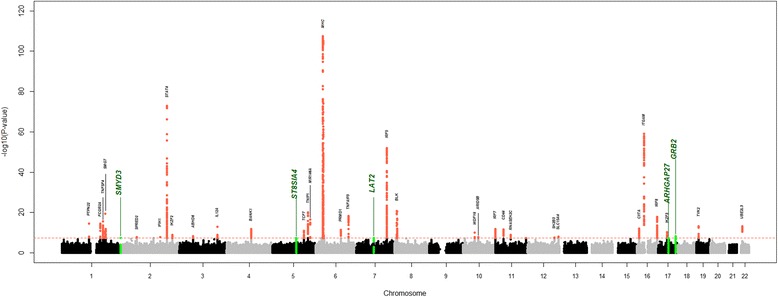
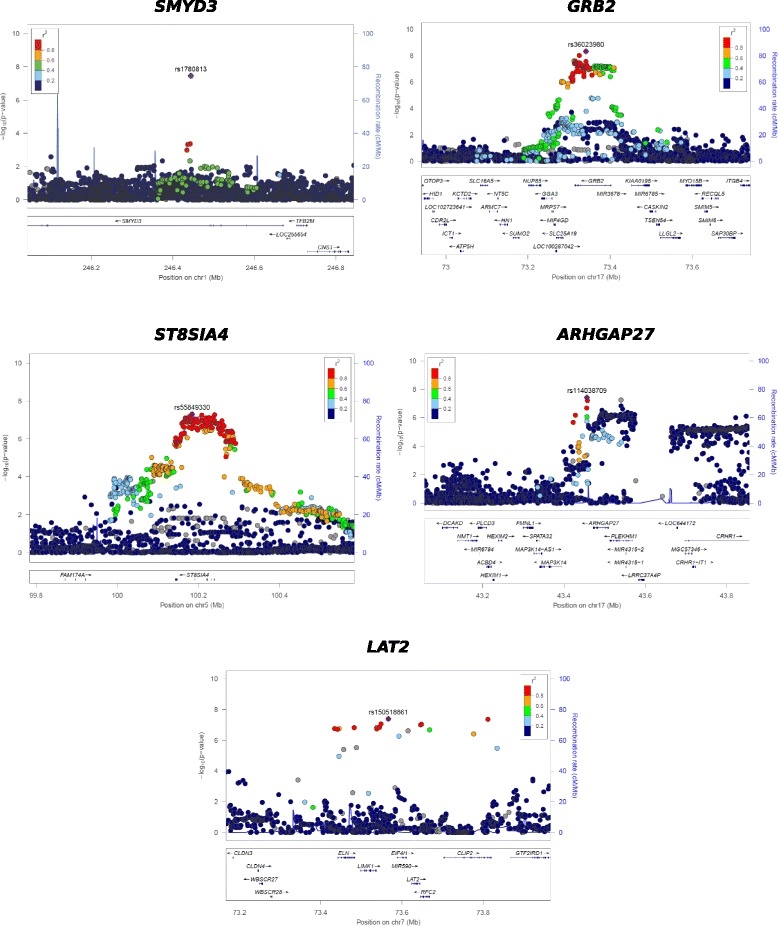
We identified five new loci associated with SLE at the genome-wide level of significance (p < 5 × 10): GRB2, SMYD3, ST8SIA4, LAT2 and ARHGAP27. Pathway analysis revealed several biological processes significantly associated with SLE risk: B cell receptor signaling (p = 5.28 × 10), CTLA4 co-stimulation during T cell activation (p = 3.06 × 10), interleukin-4 signaling (p = 3.97 × 10) and cell surface interactions at the vascular wall (p = 4.63 × 10).
Our results identify five novel loci for SLE susceptibility, and biologic pathways associated via multiple low-effect-size loci.
系统性红斑狼疮(SLE)是一种常见的全身性自身免疫性疾病,具有复杂的遗传遗传。全基因组关联研究(GWAS)显著增加了与 SLE 风险相关的显著基因座数量。然而,迄今为止,已确定的基因座仅占疾病遗传率的不到 30%,并且尚未发现其他风险变异。在这里,我们进行了 GWAS 后进行了荟萃分析,以确定 SLE 的新全基因组显着基因座。
我们对来自西班牙的 907 例 SLE 患者(病例)和 1524 名健康对照进行了基因分型,并使用 1000 基因组参考数据进行了推测。我们使用逻辑回归进行关联测试,并对变异的主要成分进行了校正。随后,使用来自 4036 例 SLE 患者和 6959 例北欧血统对照的大量遗传数据对 7110321 个变体进行了关联结果的荟萃分析。使用 PASCAL 软件消除已知风险基因座的影响后,还在途径水平上测试了遗传相关性。
我们在全基因组水平上鉴定了五个与 SLE 相关的新基因座(p<5×10):GRB2、SMYD3、ST8SIA4、LAT2 和 ARHGAP27。途径分析显示,几个生物学过程与 SLE 风险显著相关:B 细胞受体信号(p=5.28×10)、T 细胞激活时 CTLA4 共刺激(p=3.06×10)、白细胞介素 4 信号(p=3.97×10)和血管壁细胞表面相互作用(p=4.63×10)。
我们的结果确定了 SLE 易感性的五个新基因座,并且通过多个低影响大小的基因座与生物途径相关。