Aterido Adrià, Julià Antonio, Carreira Patricia, Blanco Ricardo, López-Longo José Javier, Venegas José Javier Pérez, Olivé Àlex, Andreu José Luís, Aguirre-Zamorano Maria Ángeles, Vela Paloma, Nolla Joan M, Marenco-de la Fuente José Luís, Zea Antonio, Pego José María, Freire Mercedes, Díez Elvira, López-Lasanta María, López-Corbeto Mireia, Palau Núria, Tortosa Raül, Gelpí Josep Lluís, Absher Devin, Myers Richard M, Fernández-Nebro Antonio, Marsal Sara
Rheumatology Research Group, Vall d'Hebron Research Institute, Barcelona, 08035, Spain.
Department of Experimental and Health Sciences, Universitat Pompeu Fabra, Barcelona, 08005, Spain.
Arthritis Res Ther. 2017 Jun 15;19(1):138. doi: 10.1186/s13075-017-1345-6.
Systemic lupus erythematosus (SLE) is a genetically complex rheumatic disease characterized by heterogeneous clinical manifestations of unknown etiology. Recent studies have suggested the existence of a genetic basis for SLE heterogeneity. The objective of the present study was to identify new genetic variation associated with the clinically relevant phenotypes in SLE.
A two-stage pathway-based approach was used to identify the genetic variation associated with the main clinical phenotypes in SLE. In the discovery stage, 482 SLE patients were genotyped using Illumina Human Quad610 microarrays. Association between 798 reference genetic pathways from the Molecular Signatures Database and 11 SLE phenotypes was tested using the set-based method implemented in PLINK software. Pathways significantly associated after multiple test correction were subsequently tested for replication in an independent cohort of 425 SLE patients. Using an in silico approach, we analyzed the functional effects of common SLE therapies on the replicated genetic pathways. The association of known SLE risk variants with the development of the clinical phenotypes was also analyzed.
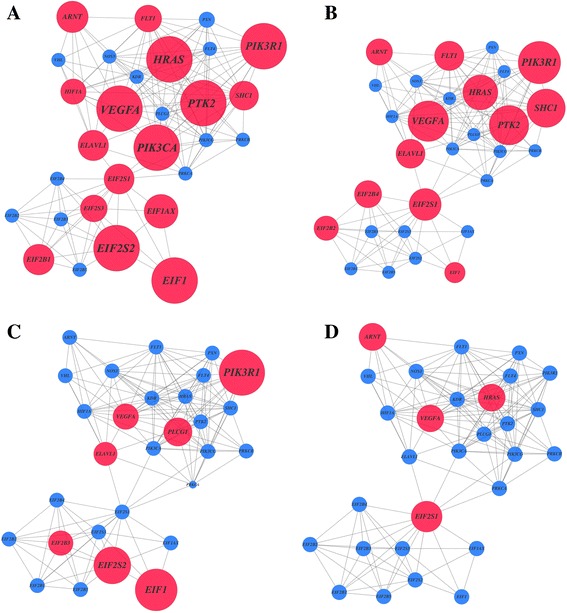
In the discovery stage, we found a significant association between the vascular endothelial growth factor (VEGF) pathway and oral ulceration (P value for false discovery rate (P ) < 0.05), and between the negative regulation signaling pathway of retinoic acid inducible gene-I/melanoma differentiation associated gene 5 and the production of antinuclear antibodies (P < 0.05). In the replication stage, we validated the association between the VEGF pathway and oral ulceration. Therapies commonly used to treat mucocutaneous phenotypes in SLE were found to strongly influence VEGF pathway gene expression (P = 4.60e-4 to 5.38e-14). Analysis of known SLE risk loci identified a strong association between PTPN22 and the risk of hematologic disorder and with the development of antinuclear antibodies.
The present study has identified VEGF genetic pathway association with the risk of oral ulceration in SLE. New therapies targeting the VEGF pathway could be more effective in reducing the severity of this phenotype. These findings represent a first step towards the understanding of the genetic basis of phenotype heterogeneity in SLE.
系统性红斑狼疮(SLE)是一种遗传复杂性风湿性疾病,其病因不明,临床表现具有异质性。最近的研究表明SLE异质性存在遗传基础。本研究的目的是识别与SLE临床相关表型相关的新遗传变异。
采用两阶段基于通路的方法来识别与SLE主要临床表型相关的遗传变异。在发现阶段,使用Illumina Human Quad610微阵列对482例SLE患者进行基因分型。使用PLINK软件中实现的基于集合的方法测试分子特征数据库中的798条参考遗传通路与11种SLE表型之间的关联。在多次检验校正后显著相关的通路随后在425例SLE患者的独立队列中进行复制检验。使用计算机模拟方法,我们分析了常见SLE疗法对复制的遗传通路的功能影响。还分析了已知SLE风险变异与临床表型发展之间的关联。
在发现阶段,我们发现血管内皮生长因子(VEGF)通路与口腔溃疡之间存在显著关联(错误发现率校正后的P值(P)<0.05),以及视黄酸诱导基因-I/黑色素瘤分化相关基因5的负调控信号通路与抗核抗体产生之间存在显著关联(P<0.05)。在复制阶段,我们验证了VEGF通路与口腔溃疡之间的关联。发现常用于治疗SLE黏膜皮肤表型的疗法强烈影响VEGF通路基因表达(P = 4.60e - 4至5.38e - 14)。对已知SLE风险位点的分析确定蛋白酪氨酸磷酸酶非受体型22(PTPN22)与血液系统疾病风险以及抗核抗体产生之间存在强烈关联。
本研究确定了VEGF遗传通路与SLE口腔溃疡风险之间的关联。针对VEGF通路的新疗法可能在减轻该表型的严重程度方面更有效。这些发现代表了朝着理解SLE表型异质性的遗传基础迈出的第一步。